

Key takeaways
- Best for intensive prep: A 2.5- to 3-inch-thick end-grain hardwood board, ideally at least 18 by 24 inches.
- Best balance of stability and price: A 1.5- to 2-inch edge-grain maple, walnut, or cherry board.
- Best for a small kitchen: A 1- to 1.5-inch edge-grain board around 12 by 16 inches, preferably with a juice groove and a handhold.
- Best for occasional cooking: A 1- to 1.25-inch board made from hard maple or walnut; it costs less and is less cumbersome to maintain.
- Best for serving as well as cutting: A reversible edge-grain board with finished edges and no deep juice groove on the usable side.
The best butcher block cutting boards for durability are usually thick end-grain boards for heavy, frequent chopping, while edge-grain boards are the better-value choice when you need a lighter, slimmer board that is easier to store.
Our top picks
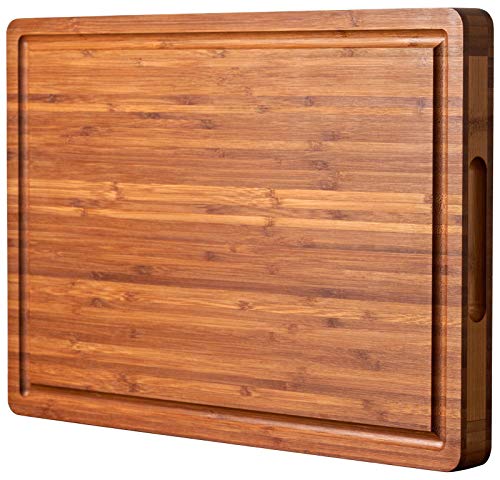


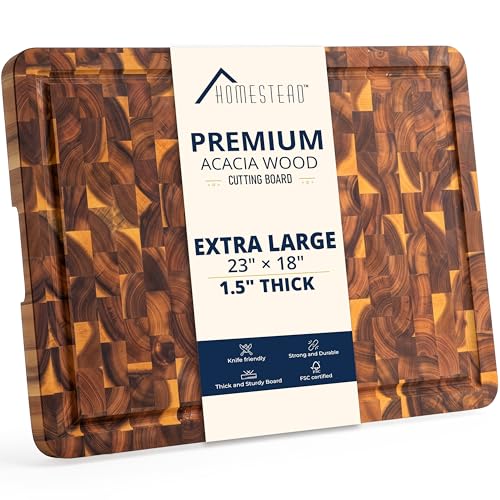
As an Amazon Associate we earn from qualifying purchases at no extra cost to you. Ratings are shown as listed on Amazon.
Quick picks by kitchen and workload
- Best for intensive prep: A 2.5- to 3-inch-thick end-grain hardwood board, ideally at least 18 by 24 inches.
- Best balance of stability and price: A 1.5- to 2-inch edge-grain maple, walnut, or cherry board.
- Best for a small kitchen: A 1- to 1.5-inch edge-grain board around 12 by 16 inches, preferably with a juice groove and a handhold.
- Best for occasional cooking: A 1- to 1.25-inch board made from hard maple or walnut; it costs less and is less cumbersome to maintain.
- Best for serving as well as cutting: A reversible edge-grain board with finished edges and no deep juice groove on the usable side.
There is no single best board for every kitchen. The right choice depends on how much counter space you have, whether the board stays out, how often you use a chef’s knife, and whether you will oil it on a regular schedule.
End-grain versus edge-grain: the durability decision
End-grain boards
End-grain boards are assembled with the cut ends of the wood facing upward. Your knife enters the ends of the fibers rather than slicing across their length. This construction tends to hide knife marks better and can remain attractive through years of chopping when it is kept dry and conditioned.
The trade-off is weight, price, and care. End-grain boards are commonly 2 to 3 inches thick, so they can weigh 15 to 40 pounds depending on size and wood species. Their many glued joints also make them less forgiving of standing water, dishwashers, and rapid changes in humidity. A neglected end-grain board may develop cracks or separated seams even though its cutting surface initially looks robust.
Edge-grain boards
Edge-grain boards use the long edge of each wood strip as the cutting surface. They are generally lighter and less expensive than end-grain boards, with fewer glue seams and simpler construction. A quality edge-grain board 1.5 to 2 inches thick is stable enough for most home cooking and is often easier to lift for cleaning.
Edge-grain surfaces show knife marks sooner, especially under frequent rocking cuts. That is cosmetic wear rather than immediate failure, but a heavily scarred board may eventually need sanding. For many households, the easier handling and lower cost outweigh the extra visible marks.
| Construction | Typical thickness | Typical size | Approximate weight | Best use | Main drawback |
|---|---|---|---|---|---|
| End-grain hardwood | 2.5–3 in | 18 × 24 in | 25–40 lb | Daily chopping, large meal prep, professional-style work | Heavy, expensive, and more sensitive to moisture |
| End-grain hardwood | 2–2.5 in | 16 × 20 in | 16–28 lb | Frequent cooking in a medium kitchen | Still difficult to store vertically |
| Edge-grain hardwood | 1.5–2 in | 16 × 20 in | 10–20 lb | General home cooking and batch preparation | Knife marks become visible sooner |
| Edge-grain hardwood | 1–1.25 in | 12 × 16 in | 5–10 lb | Small counters, apartments, occasional use | Can slide or flex under force |
Weights vary with wood species, moisture content, feet, handles, and juice grooves. Treat these figures as buying estimates rather than exact specifications.
How thick and heavy should a board be?
Thickness improves resistance to flexing and helps a board stay planted, but more is not always better. A 3-inch board may be wonderfully stable on a permanent prep table and frustrating on a narrow counter where it must be moved after every use.
For most kitchens, 1.5 to 2 inches is the practical middle ground. A 16 by 20 inch board in this range provides enough surface for a chef’s knife, vegetables, and a resting area without occupying the entire counter. If you regularly break down large quantities of produce, knead dough, or carve roasts, move up to 18 by 24 inches. If the board must fit beside a sink or cooktop, measure the usable counter area first.
A simple fit calculation helps: subtract at least 4 inches from the counter depth to leave room for your hands and a bowl. For a counter 25 inches deep, a board no deeper than about 21 inches is more workable. Also measure the storage route, not just the cabinet. A thick 20-pound board that cannot be lifted safely is unlikely to be used often.
Wood species: what wears first
- Hard maple: A common all-purpose choice with a relatively fine, light-colored grain. It shows stains more readily than darker woods but offers a dependable cutting surface.
- Walnut: Attractive, moderately hard, and darker in color, which disguises some staining. It can show dents more readily than hard maple.
- Cherry: Smooth-looking and moderately hard, with a color that deepens over time. It is a good choice for a board that also serves as a counter display.
- Teak: Naturally oily and often resistant to moisture changes, but its higher silica content can be less gentle on knife edges than softer hardwoods. It also requires careful sourcing.
- Bamboo: Technically a grass rather than wood. It is often affordable and hard-wearing, but laminated strips can feel more abrasive and may be less pleasant for knife work.
Harder does not automatically mean better. An extremely hard surface can dull a knife faster, while a softer surface may acquire marks but be more comfortable to cut on. Avoid boards made from unknown reclaimed wood, especially if the previous finish or treatment is unclear.
Decision matrix: match the board to your routine
| Your situation | Recommended specification | Why it fits |
|---|---|---|
| Small apartment, limited storage, cooking 2–3 times weekly | 12 × 16 in, 1–1.25 in edge-grain | Light enough to wash and store easily; adequate for ordinary prep |
| Family kitchen, frequent vegetable and meat preparation | 16 × 20 in, 1.5–2 in edge-grain | Good working area without end-grain weight and cost |
| Daily cooking, batch prep, large knives | 18 × 24 in, 2.5–3 in end-grain | Maximum stability and better concealment of knife marks |
| Board must be carried to the sink after every use | 14 × 18 in, about 1.5 in edge-grain | More manageable than a thick end-grain block |
| Budget-conscious buyer who will maintain the board | Hard maple edge-grain, 1.5 in thick | Usually costs less and can be sanded and reconditioned later |
Oiling and cleaning: the ownership requirement
Wood boards need protection because water makes the fibers swell. Use a food-grade mineral oil intended for cutting boards; it is inexpensive, odorless, and does not cure into a sticky film. Many owners add a food-safe board wax containing beeswax after oiling, but wax is optional rather than a substitute for oil.
Initial conditioning
- Apply mineral oil generously to every face, edge, and end-grain area.
- Let it absorb for several hours or overnight.
- Wipe away the excess and repeat until the surface stops absorbing oil quickly.
- Apply a thin wax layer if you want additional water resistance.
New, dry boards may need two or three applications. After that, oil when the surface looks pale, feels rough, or absorbs a drop of water immediately. For a frequently used board, this may mean once every two to four weeks at first, then less often in a stable, moderate-humidity kitchen. A lightly used board may need conditioning only every few months.
After use, scrape off food, wash both sides with warm water and mild dish soap, rinse briefly, and dry the board upright or on its edge so air reaches both faces. Do not soak it, leave it in a draining rack full of water, or put it in a dishwasher. Do not rely on vinegar or bleach as routine treatments; harsh or repeated exposure can dry the wood and damage the finish. Use separate boards for raw meat and ready-to-eat foods if that separation suits your kitchen’s food-safety routine.
What usually wears out first?
The cutting surface normally shows knife marks before the board becomes unusable. On laminated boards, the more serious problems are raised seams, edge splitting, rocking, and cracks that retain food or moisture. Small surface marks can often be smoothed by a professional or an experienced owner using appropriate sanding and refinishing methods. Deep cracks, persistent movement between glued sections, or contamination that cannot be cleaned are reasons to replace the board.
Rubber feet can improve stability but may trap moisture underneath and prevent using both sides. Reversible boards offer more usable life, provided both faces are cleaned and dried equally. Juice grooves are helpful for roasts and juicy fruit, but they reduce flat cutting area and can collect residue if they are narrow or difficult to clean.
Bottom line
Choose a 2.5- to 3-inch end-grain board if maximum stability, frequent chopping, and long-term refinishing matter more than weight or price. Choose a 1.5- to 2-inch edge-grain board if you want the best combination of durability, handling, and value. For a compact kitchen, resist the temptation to buy the largest block: a board that fits your counter, storage, and cleaning routine will usually outlast a heavier board that is inconvenient to use.



Write Your Review
No reviews yet. Be the first to share your experience!