

Key takeaways
- For most renters, choose a matte d-c-fix furniture or countertop film in a wide roll, buy 15–20% more than the measured area, and use a test patch before committing. Con-Tact is the sensible budget choice for small, lightly used surfaces. If the counter receives heavy…
Best Contact Paper for Kitchen Countertops That Lasts
The best contact paper for kitchen countertops is a thick, water-resistant PVC self-adhesive film with a repositionable application layer, and d-c-fix countertop film is the strongest all-round choice for renters who want realistic finishes and clean removal when the surface is properly prepared.
For a lower-cost option, choose Con-Tact Brand adhesive shelf liner in a stone or wood pattern, provided the product is labeled for smooth, nonporous surfaces. For the most convincing temporary makeover, look for a premium architectural or countertop-grade film rather than thin shelf liner. The difference is usually visible in edge adhesion, pattern alignment, thickness, and how easily the surface wrinkles during installation.
Our top picks

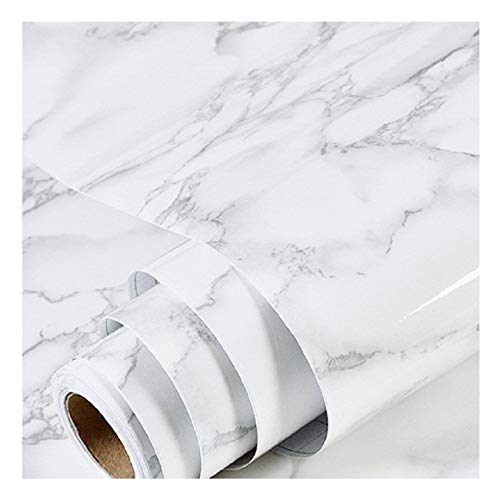


As an Amazon Associate we earn from qualifying purchases at no extra cost to you. Ratings are shown as listed on Amazon.
What matters more than the pattern
Adhesion strength
A countertop film must grip laminate, sealed wood, tile, or another smooth surface without lifting around the sink and front edge. Strong adhesive is useful, but permanently aggressive adhesive can damage a rental countertop or leave residue. The practical compromise is a film described as removable, repositionable during installation, or suitable for temporary renovations.
Adhesion depends as much on preparation as on the roll. Grease, silicone, dust, textured laminate, and moisture prevent good contact. Films also adhere poorly when installed in a cold room. A clean, dry countertop at roughly 65–80°F (18–27°C) gives most adhesive films a better chance of bonding evenly.
Heat and water resistance
Most countertop films tolerate ordinary splashes and brief contact with warm cookware, but they are not a substitute for a heatproof trivet. A film may soften, discolor, shrink, or release at a seam when exposed to a hot pan, air fryer, toaster oven, or boiling water.
Water resistance is most important around the sink. The film itself may resist water while the exposed adhesive at an unsealed seam does not. Run a continuous bead of clear, removable-friendly silicone or a suitable kitchen sealant along vulnerable sink and backsplash edges if the manufacturer permits it. Never allow water to sit beneath a lifted edge.
Finish realism
Glossy faux marble can make repeating patterns and bubbles easy to spot. Matte or low-sheen films usually look more convincing and hide minor installation marks. Films with printed veining, tactile grain, or a thicker surface layer tend to look better than very thin, shiny shelf liners, especially on large islands.
Best options by situation
| Best for | Recommended film type or product family | Typical roll size | Approximate material thickness | Expected service in normal kitchen use | Main compromise |
|---|---|---|---|---|---|
| Best overall rental upgrade | d-c-fix countertop or furniture film | 17.7–26.5 in wide; 78–118 in long | About 0.2–0.4 mm | 1–3 years with careful cleaning | Edges need careful sealing and trimming |
| Lowest-cost small counter | Con-Tact Brand adhesive liner | 18 in wide; commonly 6–18 ft long | About 0.1–0.2 mm | 6–18 months in demanding areas | More visible wrinkles and less realistic texture |
| Most realistic stone appearance | Premium architectural countertop film | 24–48 in wide; sold by linear foot or roll | About 0.3–0.6 mm | 2–5 years when installed correctly | Higher material cost and less forgiving removal |
| Vertical backsplash or cabinet sides | Removable PVC furniture film | 17.7–24 in wide; 78–118 in long | About 0.15–0.3 mm | 2–4 years away from direct water | Not as durable on a frequently wiped work surface |
Thickness figures are typical ranges rather than a guarantee for every color or production batch. Check the current technical sheet before ordering, particularly if the supplier gives separate figures for the film and the release liner.
Head-to-head: d-c-fix versus Con-Tact
d-c-fix
d-c-fix is the better pick when appearance and longer ownership matter more than the lowest initial price. Its furniture films are widely available in marble, granite, wood, and solid-color designs. A wider roll can reduce the number of seams on a standard 24-inch-deep counter, and a heavier-feeling film is generally easier to smooth without stretching.
Choose a low-sheen stone pattern if you are covering a large area. Align the printed pattern before removing the backing, because a seam that is only a few millimeters off can be noticeable across a veined design. The material is still a temporary surface, so use a cutting board and trivets.
Con-Tact Brand
Con-Tact is practical for a bathroom vanity, narrow kitchenette, rental cabinet top, or small countertop where replacing a damaged section is inexpensive. It is often easier to find in shorter rolls, which reduces waste on a compact project. Thin liner can conform to simple curves, but it also telegraphs every bump and is more likely to crease during installation.
Use it where daily abuse is moderate. Around a busy sink or cooking zone, a thicker countertop-grade film is usually worth the additional cost.
Decision matrix for renters
| Your situation | Best choice | Why | What to avoid |
|---|---|---|---|
| Under $40 and under 12 sq. ft. | Con-Tact or another removable PVC liner | Low waste and adequate coverage for a small vanity or kitchenette | Buying several narrow rolls with mismatched patterns |
| First installation | Matte, thicker film with grid-lined backing | More forgiving when measuring and smoothing | Glossy film and complicated marble veining |
| Heavy cooking and daily wiping | Premium countertop-grade film | Better resistance to abrasion and edge wear | Thin shelf liner near the hob |
| Frequent moving or uncertain lease terms | Removable, repositionable film installed on a test section | Reduces the chance of damaging the original surface | Permanent vinyl or film applied over damaged laminate |
| Large island or long run | Widest roll you can transport and handle | Fewer seams and a more realistic appearance | Joining multiple strips across the main work area |
How much film do you need?
Measure the length and depth of every section, then add enough material to wrap the front edge and leave an extra 2 inches on each exposed side. For a 72-by-25-inch countertop with a 1.5-inch front edge, calculate a working rectangle of approximately 72 by 27 inches, then add trimming allowance. That is 13.5 square feet before waste.
A roll that is 17.7 inches wide cannot cover that depth in one piece with a front-edge return, so you would need a seam or a wider roll. A 26.5-inch-wide roll may cover the top but still leave too little material for a generous edge wrap. Order at least 15–20% extra for pattern matching and mistakes. For the example, 13.5 square feet multiplied by 1.2 equals 16.2 square feet of material.
Installation steps that improve durability
- Inspect the counter. Repair loose laminate, deep scratches, swollen particleboard, and failing caulk first. Film hides color but not significant height changes.
- Degrease thoroughly. Use a suitable cleaner, rinse away residue, and let the surface dry completely. Pay special attention to the area beside the cooktop and the sink rim.
- Test removal. Apply a small piece in an inconspicuous spot for several days. Remove it slowly at a low angle and check for adhesive transfer or lifted finish.
- Cut oversized pieces. Leave roughly 1–2 inches extra on each edge. Trim after the film has bonded rather than trying to cut the exact size in advance.
- Apply with a squeegee. Peel back 2–3 inches of liner at a time and smooth from the center outward. A hair dryer on low can help soften the film around a simple edge, but excessive heat can stretch it.
- Seal vulnerable edges. Press down firmly around the sink and backsplash. Seal only where compatible with the film and lease conditions.
- Allow the adhesive to settle. Keep the surface dry and avoid heavy use for 24–48 hours, following the product instructions.
Ownership realities: what wears first
The first failures are usually not on the middle of the countertop. Expect wear at the front edge, sink cutout, seams, and corners where fingernails or cleaning cloths catch the film. Repeated standing water is more damaging than occasional splashes. Abrasive powders, scouring pads, bleach-heavy cleaners, and acetone can dull or attack the printed surface.
Clean with warm water, a small amount of mild dish soap, and a soft microfiber cloth. Wipe spills promptly, especially oils and strongly colored foods. Do not place hot pans directly on the film, cut on it, drag appliances across it, or use it as a substitute for a sealed food-preparation surface.
Final verdict
For most renters, choose a matte d-c-fix furniture or countertop film in a wide roll, buy 15–20% more than the measured area, and use a test patch before committing. Con-Tact is the sensible budget choice for small, lightly used surfaces. If the counter receives heavy cooking, constant wiping, or frequent standing water, a premium architectural film is the more durable option—but none of these products should be treated as heatproof, cut-resistant, or permanent countertop material.



Write Your Review
No reviews yet. Be the first to share your experience!