

Key takeaways
- Choose a glass magnetic set holding 1.5–3 ounces per jar when visibility and frequent access are the priorities. Choose shallow magnetic tins when refrigerator clearance, weight, or break resistance is more important. Whichever format you select, prioritize a broad magnetic back, a gasketed lid, high-contrast…
The best magnetic spice jar set for refrigerator use is one with a full-back magnet, an airtight gasket, a compact profile under 2.5 inches deep, and labels that remain readable when the jars are mounted at eye level. For most kitchens, choose glass jars holding about 2–3 ounces each; choose magnetic tins only when maximum clearance and low weight matter more than seeing the contents.
Our top picks


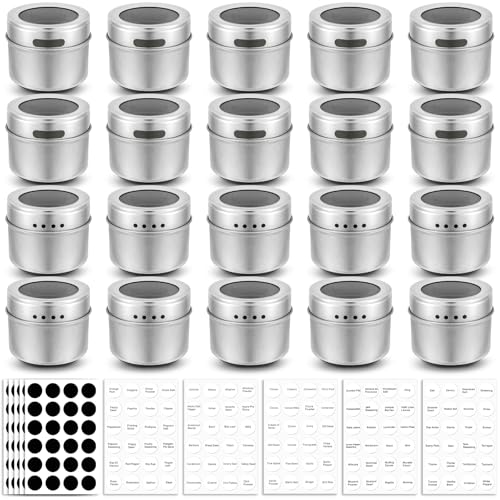
As an Amazon Associate we earn from qualifying purchases at no extra cost to you. Ratings are shown as listed on Amazon.
Best magnetic spice jar sets by situation
| Kitchen situation | Best format | Target specifications | Why it fits |
|---|---|---|---|
| Frequent cooking with many spices | Glass jars with magnetic backs | 2–3 oz capacity; 12–24 jars; 2–2.5 in depth | Visible contents, quick identification, enough capacity for regular use |
| Small refrigerator or narrow clearance | Flat magnetic tins | 1.5–2 oz capacity; under 1.25 in depth | Lower projection reduces door and walkway interference |
| Occasional cooking or a tight budget | Small glass or plastic magnetic jars | 1–2 oz capacity; 6–12 jars | Less initial cost and less spice waste |
| Open shelving beside the refrigerator | Glass jars with wide labels | At least 1.5 in label area; clear lids or bodies | Readable from the side and easy to inventory |
| Children or pets near the refrigerator | Locking or screw-top containers | Gasketed lids; magnets fully enclosed | Reduces the chance of a loose lid or detached magnet becoming accessible |
What to assess before buying
Magnet strength and mounting area
A strong magnet is not enough if it is a small disc attached to the center of a jar. Look for a full back plate, two or more widely spaced magnets, or a magnet that covers most of the container’s rear surface. These designs resist tipping when you pull the lid off with one hand.
Magnetic force is also reduced by the refrigerator’s surface. A painted steel door usually holds better than a stainless-steel door, and some stainless doors are nonmagnetic or have a thin decorative layer over another material. Test the intended area with an ordinary refrigerator magnet before purchasing a full set.
Do not mount a filled jar above a handle, food-preparation area, or location where it could fall onto glassware. A magnet that holds a 3-ounce empty jar may not hold it reliably after adding dense spices such as salt, peppercorns, or whole cloves.
Capacity versus freshness
Large jars look efficient, but they are not automatically better. Ground spices gradually lose aroma after opening, so a 2-ounce jar is often a better compromise than a 4-ounce container unless you cook with that spice frequently. A practical estimate is:
Required capacity = average monthly use × the number of months you expect to finish the spice.
For example, if you use about 0.5 ounce of paprika each month and want to finish it within four months, a 2-ounce jar is sufficient. Buying an 8-ounce magnetic container for the same usage would occupy refrigerator space while the contents age.
Airtight lids and dispensing control
The lid should have a silicone or rubber gasket and a secure screw, snap, or bayonet closure. Shaker inserts are useful for dry powders, but they can clog when exposed to steam. A removable sifter gives more control, while a wide opening is easier to clean and better for measuring with a spoon.
Avoid lids that depend on a loose friction fit if the jars will be opened while mounted vertically. Repeated sideways pressure can gradually loosen that style. Also check whether the gasket can be removed for washing; trapped spice dust and oil are common sources of stale odors.
Label visibility
Labels should be placed on the front or lid in the orientation you will actually see on the refrigerator. A label on the rear is nearly useless once the jar is mounted. White lettering on a dark lid can be attractive but difficult to read in low kitchen light, so high-contrast printed labels are preferable.
Choose labels at least 1.25 inches wide for short names and use a second line for longer names such as “smoked paprika” or “Italian seasoning.” If the container has a clear lid, a top label helps when jars are mounted above eye level. Leave room to write the purchase date or refill date.
Glass jars versus magnetic tins
| Feature | Glass magnetic jar | Magnetic tin |
|---|---|---|
| Typical capacity | 1.5–3 oz | 1–2 oz |
| Typical empty weight | 3–6 oz | 1.5–3 oz |
| Typical depth | 2–2.75 in | 0.75–1.25 in |
| Contents visible | Yes | No, unless the lid has a viewing window |
| Drop resistance | Low to moderate | High |
| Best use | Fast identification and organized cooking | Narrow refrigerator doors and lightweight mounting |
Glass is the better choice when you want to identify a spice without reading a label, but it needs more clearance and careful handling. Tins are lighter and shallower, making them safer for a marginal magnetic surface. Their disadvantages are hidden contents, possible internal coating wear, and more difficulty checking how much remains.
Gneiss Spice’s magnetic glass-jar format is an example of the transparent-jar approach, while Kamenstein and Norpro have offered magnetic spice-storage formats based on compact tins or magnetic containers. Product configurations change, so verify the current lid construction, magnet coverage, capacity, and included labels rather than relying on a brand name alone.
Check refrigerator clearance before ordering
Measure from the refrigerator door to the nearest cabinet, wall, or walkway obstruction. Then add the container’s depth and a small handling allowance:
Required clearance = jar depth + at least 0.5 inch for fingers and door movement.
If the refrigerator door has 3 inches of free space, a 2-inch-deep jar leaves roughly 1 inch for handling and movement. A 2.75-inch jar may make the door awkward to open even if it technically fits. On a French-door refrigerator, also check whether the jars collide with the neighboring door, door seal, water dispenser, or recessed handle.
Keep jars away from the door gasket. A container pressing against the seal can create a small gap, increasing energy loss and allowing the door to sit unevenly. Leave at least 1 inch around hinges, seals, and moving shelves unless the refrigerator manufacturer’s design clearly provides more room.
Safe setup on a vertical surface
- Confirm the surface. Test magnetic attraction at the exact mounting point, not just elsewhere on the refrigerator.
- Clean and dry the area. Remove grease, condensation, and crumbs. Dirt reduces friction and can let a jar slide.
- Start with empty containers. Mount one jar for several hours, then fill it halfway and check for downward movement before installing the full set.
- Load by weight. Put lighter herbs near the top and heavier salt, peppercorns, or whole spices lower down.
- Keep magnets separated. Leave about 0.5 inch between jars when possible. This makes individual removal easier and reduces knocking neighboring jars loose.
- Inspect after opening. Pull the jar straight outward rather than twisting it sideways. Twisting places more stress on the magnet adhesive and lid.
For a nonmagnetic stainless-steel refrigerator, do not assume an adhesive magnetic plate is a permanent fix. Only use a plate designed for the surface, follow its weight limit, and consider whether removing it could damage the finish. A freestanding spice rack may be safer than loading a decorative panel with multiple filled containers.
Ownership details that matter after purchase
The first parts likely to wear are adhesive-backed magnets, lid gaskets, printed labels, and shaker screens. Heat, oil, and repeated condensation can weaken adhesive. Replace a jar if the magnet shifts, the glass chips, the lid no longer seals, or the gasket becomes brittle.
Wash jars with warm water and mild dish soap, then dry them completely before refilling. Do not refill a damp container: even a small amount of moisture can cause powdered spices to cake. For oily spices such as chili blends, clean the gasket groove separately with a soft brush. Avoid putting magnetic components in a dishwasher unless the manufacturer specifically permits it.
Before refilling, compare the new spice with the old one rather than topping it off automatically. Emptying and cleaning the container prevents old powder from forming a stale layer underneath fresh contents. Write the refill month on the label or on a removable inventory card.
Bottom line
Choose a glass magnetic set holding 1.5–3 ounces per jar when visibility and frequent access are the priorities. Choose shallow magnetic tins when refrigerator clearance, weight, or break resistance is more important. Whichever format you select, prioritize a broad magnetic back, a gasketed lid, high-contrast labels, and a measured fit around the refrigerator door seal. Those details determine whether the set remains convenient—or becomes a collection of sliding, stale, hard-to-read containers.




Write Your Review
No reviews yet. Be the first to share your experience!