

Key takeaways
- Rack width: Leave roughly 1 inch of side clearance if possible.
- Rack depth: Include the handles and any rear lip when measuring.
- Door clearance: A tall lid or upright handles may interfere with the oven door.
- Storage height: Domed lids can add 5 to 8 inches above the pan.
- Sink width: If the roaster cannot fit into your sink, cleaning may require a bathtub, outdoor basin, or careful hand washing.
The best ham roaster for holiday cooking is usually a 16- to 18-inch stainless-steel or enamel-on-steel roasting pan with at least 3 inches of interior depth, a securely fitting lid, and enough clearance for the ham’s weight and height.
Choosing by exterior dimensions alone is a common mistake: handles, thick walls, domed lids, and rack supports can reduce the usable cooking area. Measure the ham first, then compare those measurements with the pan’s interior cooking space.
Our top picks
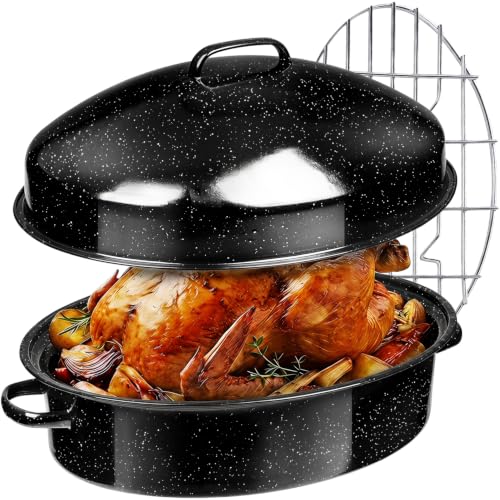


As an Amazon Associate we earn from qualifying purchases at no extra cost to you. Ratings are shown as listed on Amazon.
What size roaster do you need?
A fully cooked bone-in ham often needs more room than its weight suggests. The bone creates an irregular shape, while a spiral-cut ham may be wider at the base than a compact boneless roast. Allow at least 1 inch of clearance on each side and 1 to 2 inches above the ham so a lid does not press against the meat or prevent heat from circulating.
| Ham type and approximate weight | Useful interior pan size | Recommended exterior footprint | Best for |
|---|---|---|---|
| Boneless ham, 5–8 lb | 12 x 9 x 3 inches | 14 x 11 inches | Small households and occasional cooking |
| Bone-in ham, 8–12 lb | 14 x 10 x 3½ inches | 16 x 12 inches | Most holiday meals |
| Bone-in ham, 12–16 lb | 16 x 11 x 4 inches | 18 x 13 inches | Large families and leftovers |
| Ham, 16–20 lb | 18 x 12 x 4½ inches | 20 x 14 inches | Very large gatherings; check oven width carefully |
These are practical planning ranges rather than universal standards. A 12-pound ham with a long shank may require more length than a heavier, compact boneless ham. Measure length, width, and height at the widest points, including the exposed bone or any attached rind.
Pan size versus oven and storage space
Before buying, measure the oven rack—not just the oven cavity. A large roaster must fit between the side walls with enough space for your hands to lift it out. A 20-inch exterior pan can be difficult to maneuver in a standard oven even when the rack technically accommodates it.
Check these dimensions:
- Rack width: Leave roughly 1 inch of side clearance if possible.
- Rack depth: Include the handles and any rear lip when measuring.
- Door clearance: A tall lid or upright handles may interfere with the oven door.
- Storage height: Domed lids can add 5 to 8 inches above the pan.
- Sink width: If the roaster cannot fit into your sink, cleaning may require a bathtub, outdoor basin, or careful hand washing.
For many kitchens, a 16-inch roaster offers the best compromise. It can handle a typical 10- to 14-pound ham without consuming the entire oven, while a 20-inch model is more suitable when large holiday meals are a regular event.
Stainless steel versus enamel: which material is better?
Stainless-steel roasters
Stainless steel is the more versatile choice for cooks who want a pan that can also roast turkey, beef, poultry, and vegetables. It is usually lighter than thick enamel-coated cookware and is less likely to chip if stored with other pans. A quality stainless pan with a substantial base can brown vegetables and make pan sauce effectively, particularly when the manufacturer permits stovetop use.
- Advantages: durable, relatively light, resistant to rust, suitable for frequent use, and generally easy to scrub.
- Trade-offs: thin models can warp, discolor, or develop hot spots; food may stick more readily; some lids fit loosely.
- Best choice: look for a multi-layer or thick encapsulated base, rolled edges, strong handles, and a rack that does not flex under a heavy ham.
Stainless steel is not automatically nonstick. Glaze, sugar, and rendered fat can become stubborn if they bake onto a hot surface. Soaking while the pan is still warm—but not dangerously hot—usually reduces scrubbing.
Enamel-coated steel roasters
Enamel roasters are steel pans covered with a glass-like coating. The coating resists staining and gives the pan a smooth surface that is often easier to wipe clean after a glazed ham. Many are sold with matching enamel lids, which can retain moisture well during covered cooking.
- Advantages: smooth cleanup, good resistance to acidic glazes, attractive appearance, and useful heat retention.
- Trade-offs: heavier than thin stainless steel, vulnerable to chips from drops or metal utensils, and sometimes less suitable for direct stovetop use.
- Best choice: choose a model with an even coating, protected rim, sturdy handles, and clear instructions about stovetop and broiler use.
A chip does not necessarily make an enamel pan unusable, but exposed steel can rust and the damaged area may spread. Avoid banging the pan against a sink or nesting it directly with rough metal cookware. Silicone or wood utensils help preserve the coating.
| Buying criterion | Stainless steel | Enamel-coated steel |
|---|---|---|
| Typical empty weight for a large pan | 4–8 lb | 6–11 lb |
| Durability concern | Warping on thin pans | Chipping from impact |
| Cleanup after sugary glaze | Good with soaking; may need scrubbing | Usually easier to wipe clean |
| Stovetop flexibility | Often good, if specified by the maker | Varies; never assume it is safe |
| Long-term appearance | May discolor but remains functional | Stays bright unless chipped or stained |
The lid matters more than many buyers expect
A lid should sit securely without pressing on the ham. A flat lid is easier to store but may touch a tall bone-in ham. A domed lid offers more vertical clearance, making it preferable for a ham with a protruding bone or thick glaze. Measure from the pan floor to the highest point inside the lid—not from the pan rim to the lid’s exterior peak.
Look for a lid that overlaps the rim by at least ½ inch. This helps limit steam loss and reduces the chance of the lid sliding when the pan is moved. A lid that rattles or shifts is especially inconvenient when carrying a pan weighing more than 20 pounds after adding the ham, liquid, and rack.
Do not depend on a tight lid to determine doneness. Use the cooking instructions supplied with the ham and a food thermometer as appropriate for the product. The lid’s job is moisture retention and splash control, not temperature measurement.
Best choice by cooking situation
| Your situation | Recommended specification | Why it makes sense |
|---|---|---|
| Budget-conscious, occasional holiday use | 14–16 inch stainless pan, 3-inch depth, removable rack | Lower general market cost and useful for other roasts |
| New cook who wants easier cleanup | 16-inch enamel pan with domed lid | Smooth surface and extra lid clearance reduce common frustrations |
| Frequent large holiday meals | 18–20 inch heavy stainless pan, 4-inch depth | Better capacity and greater resistance to repeated handling |
| Small kitchen or limited storage | 14-inch rectangular pan with low-profile lid | Fits more cabinets and is easier to wash |
| Pan-sauce and gravy focused cooking | Stainless model with a thick base and stovetop-safe construction | Allows safer transfer from oven to burner when approved |
How to check the fit before buying
- Measure the ham: record its maximum length, width, and height.
- Add clearance: add 2 inches to length and width, plus at least 1 inch to height.
- Compare interior dimensions: ignore advertised exterior size until the usable cooking area meets those measurements.
- Check rack placement: make sure the rack leaves room for juices without lifting the ham into the lid.
- Confirm total lifting weight: a 14-pound ham plus a 6-pound pan and several cups of liquid can exceed 20 pounds.
For example, if a ham measures 15 inches long, 9 inches wide, and 5 inches high, seek an interior area of at least 17 x 11 inches and a lid clearance of 6 inches or more. If the listed pan dimensions are exterior measurements, choose the next size up.
Cleaning, maintenance, and common mistakes
Let the roaster cool until it is safe to handle before adding water. Sudden temperature changes can warp stainless steel and stress enamel. Soak baked-on glaze in warm water with dish soap, then use a nonabrasive pad. Avoid steel wool on enamel and abrasive powders on polished stainless surfaces.
Remove the rack before washing so residue does not remain trapped underneath. Dry stainless steel completely to reduce water spotting, and dry enamel especially well around exposed rims and handles. Do not use a broiler unless the pan and lid instructions specifically allow it; high direct heat can damage coatings, lids, or handles.
The parts most likely to wear first are thin racks, loose lid handles, rubber or plastic grips, and enamel at the rim. A replaceable rack is a practical advantage because it extends the useful life of the pan. For most households, a well-sized 16- to 18-inch roaster with a stable rack and correctly fitted lid is a better purchase than the largest pan available.





Write Your Review
No reviews yet. Be the first to share your experience!