

Key takeaways
- The best sawhorses for most home workshops are adjustable folding models with a 1,000–1,500-pound pair capacity, a working height near 30 inches, wide feet, and a compact folded profile; the right choice depends on whether you value portability, work-surface versatility,…
The best sawhorses for most home workshops are adjustable folding models with a 1,000–1,500-pound pair capacity, a working height near 30 inches, wide feet, and a compact folded profile; the right choice depends on whether you value portability, work-surface versatility, or maximum stability.
Our top picks

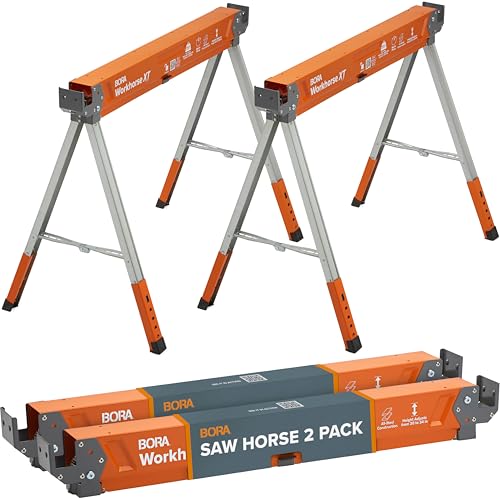


As an Amazon Associate we earn from qualifying purchases at no extra cost to you. Ratings are shown as listed on Amazon.
Best sawhorses at a glance
| Model | Best for | Capacity | Working height | Folded size or portability | Useful feature |
|---|---|---|---|---|---|
| ToughBuilt C700 | Heavy-duty home workshops | Up to 1,300 lb per pair | 25–32 inches | Folds flat; about 23 lb each | Adjustable legs, material supports, and wide steel frame |
| WORX Pegasus WX051 | Workbench-and-sawhorse flexibility | 1,000 lb as a sawhorse; 300 lb as a worktable | About 32 inches | Folds to roughly 5 inches thick; about 30 lb | Integrated clamping system and removable worktop |
| DEWALT DWX725B | Portable jobsite work | Up to 1,000 lb per pair | Approximately 29.5 inches | Folds flat; about 15.4 lb each | Lightweight metal construction and carry handle |
| BORA Speedhorse XT | Fast setup and bulky materials | Up to 1,500 lb per pair | About 30 inches | Folds quickly; approximately 17 lb each | Rapid-opening legs and built-in material support |
Capacities above are commonly quoted maximum ratings for a properly distributed load on a level surface. Do not treat them as permission to concentrate a heavy load at one corner or to use a pair on unstable ground. Product revisions and regional specifications can change, so confirm the current manual before buying.
Our picks by workshop situation
Best overall for a permanent home workshop: ToughBuilt C700
The ToughBuilt C700 is a strong choice when sawhorses will support sheet goods, doors, cabinets, and long boards regularly. Its adjustable legs help compensate for uneven floors and allow a more comfortable working height than fixed folding models. Material supports reduce the need to balance lumber across the top, while the steel construction gives it a planted feel.
The trade-off is weight. At roughly 23 pounds per sawhorse, a pair is less convenient to carry upstairs or load into a small car. The C700 also takes more storage space than very slim folding models. Choose it when stability and load margin matter more than the lightest possible kit.
Best for a dual-purpose work surface: WORX Pegasus WX051
The Pegasus WX051 is more than a basic support stand. Its removable top converts the unit from a worktable rated around 300 pounds into a sawhorse rated around 1,000 pounds, and its integrated clamps can hold smaller boards during cutting, sanding, or assembly.
This is particularly useful in a garage or apartment workshop where a separate bench would consume valuable floor space. Its broad plastic-and-metal design is stable for general DIY work, but it is not the most compact option once you account for its wider folded body. The worktable rating also applies to the table configuration, not automatically to every way the top can be loaded.
Best lightweight option: DEWALT DWX725B
The DEWALT DWX725B suits people who routinely move their setup between rooms, vehicles, and jobsites. Each stand weighs about 15.4 pounds and folds flat, making a pair much easier to transport than heavy-duty steel alternatives. The top can accept a sacrificial 2-by-4 or similar timber, which protects the stand when cutting through material.
Its fixed height is less adaptable than an adjustable model. If you are tall, frequently work on sloping driveways, or need to align a support with a table saw, that limitation becomes noticeable. For occasional framing, trim work, painting, and general cutting, the low weight is a major advantage.
Best for fast setup and large materials: BORA Speedhorse XT
The BORA Speedhorse XT emphasizes quick deployment. Its folding mechanism opens rapidly, and its support points are suited to long boards and sheet goods. A pair rated for approximately 1,500 pounds provides useful capacity for remodeling materials without moving to extremely heavy industrial stands.
Look closely at the locking mechanism before each use. Rapid-opening designs are convenient only when every leg and brace is fully engaged. The BORA is a good middle ground for DIYers who want more load capacity than lightweight stands but still need to carry the pair occasionally.
How the important specifications affect your decision
Weight capacity
Estimate the actual load, then leave a safety margin. A 4-by-8-foot sheet of 3/4-inch plywood weighs roughly 60–70 pounds, while a solid hardwood countertop or a cabinet carcass can weigh considerably more. Cutting forces and shifting weight also matter. For routine work, a pair rated at 1,000 pounds gives ample capacity for most household projects, but a higher rating can improve rigidity and durability.
Capacity is meaningful only when the load is centered and spread across both stands. A long board extending far beyond one end can tip a stand even when the total weight is well below its advertised limit.
Working height
A height around 29–32 inches works well for crosscutting lumber and supporting sheet goods. Adjustable legs are preferable if several people use the workshop or if the floor is uneven. For hand-planing or detailed assembly, you may prefer a higher temporary bench; for power-tool work, excessive height can make it harder to control the material.
Measure your existing table saw, outfeed surface, or workbench. If the sawhorse top is lower or higher by more than a small amount, long boards may rock or catch as they pass from one surface to another.
Folded size and portability
Check more than the folded thickness. Note the folded length, handle position, pair weight, and whether the stands can be stored vertically. A stand that folds to five inches thick may still be awkward if it is wide and heavy. If you carry the stands frequently, two 15–18-pound units are much more manageable than two 23–30-pound units.
Stability and surface protection
Wide feet, positive leg locks, braced frames, and non-skid pads usually matter more than a very high capacity number. Rubber feet can improve grip on concrete, but they collect sawdust and may wear faster when dragged. Replace damaged feet rather than compensating with loose blocks or folded cardboard.
Decision matrix for choosing the best sawhorses
| Your situation | Prioritize | Best fit | Why |
|---|---|---|---|
| Occasional DIY and limited budget | Simple folding frame, 800–1,000 lb pair capacity | Lightweight fixed-height metal pair | Lower cost and fewer mechanisms to maintain |
| Small garage or apartment | Thin folded profile and multiple uses | WORX Pegasus WX051 | Acts as both a worktable and sawhorse |
| Frequent remodeling | Fast setup, 1,000–1,500 lb pair capacity | BORA Speedhorse XT | Balances capacity with jobsite portability |
| Uneven floors or varied users | Adjustable legs and wide stance | ToughBuilt C700 | Height and leveling adjustments improve fit and stability |
| Transport in a car or frequent relocation | Low individual weight and flat folding | DEWALT DWX725B | Easier to lift, carry, and store |
Setup practices that prevent common problems
-
Set both sawhorses on the same firm surface and open every leg completely. A partially opened leg can look secure while leaving the brace unlocked.
-
Place the stands far enough apart to support the material without excessive overhang. For an 8-foot board, spacing of about 4–6 feet is a useful starting point, adjusted for the board’s stiffness and the cut location.
-
Check that the workpiece is level and does not rock. Use the manufacturer’s built-in supports or a matching timber rather than loose scraps that can slide.
-
Keep the cutting zone clear of clamps, cords, and hardware. If a blade will pass through the material, add a sacrificial top board so the saw does not strike the sawhorse.
-
After loading the material, push gently from several directions. If either stand shifts, reduce the overhang, reposition the feet, or move to a more level surface.
Durability, maintenance, and ownership costs
The parts most likely to wear are rubber feet, plastic clamps, hinge points, and leg-lock hardware. Sawdust can prevent a latch from fully closing, while outdoor moisture can rust uncoated steel. Brush debris from joints, wipe metal parts dry after damp use, and inspect pins and braces before heavy loading. Do not grease a mechanism if the manufacturer warns that lubricant can attract abrasive dust.
A pair priced in the general $40–$80 range may be adequate for occasional projects, while adjustable or dual-purpose models commonly fall around $80–$180 per pair. If you use a $120 pair 30 times over five years, the equipment cost is about $4 per use before replacement parts. That can justify sturdier construction when a cheaper pair would be replaced after a few seasons.
Avoid standing on sawhorses, using them as ladders, dragging loaded stands, or exceeding the rating with a concentrated load. For most home workshops, buy the lightest pair that still has a wide stance, secure locks, and at least a 1,000-pound pair rating. Choose the ToughBuilt C700 for heavy, repeated work; the WORX Pegasus for limited-space versatility; the DEWALT DWX725B for portability; and the BORA Speedhorse XT for quick setup with higher capacity.



Write Your Review
No reviews yet. Be the first to share your experience!