

Key takeaways
- For frequent daily adjustments, a full-electric bed is often the most practical starting point. For occasional positioning on a tighter budget, consider manual or semi-electric options. Choose a bariatric model only when its capacity and width are needed, and verify that it fits the room…
Best Hospital Beds for Home Care: Choose by Room, Care Needs, and Budget
The best hospital beds for home care are usually full-electric beds with a compatible pressure-management mattress, reliable locking casters, and rails chosen for the person—not simply the most features or the highest weight rating. A basic manual bed can suit occasional adjustments on a tight budget; frequent repositioning or caregiver strain usually points to a full-electric model. Before buying, confirm the bed’s actual mattress dimensions, total height range, safe working load, delivery setup, and return policy.
Compare the main bed types
| Bed type | Typical adjustment | Typical capacity | Best fit | Trade-off |
|---|---|---|---|---|
| Manual | Hand cranks operate head, knee, or height sections; configuration varies | About 350–450 lb | Infrequent changes, limited budget, or a room without convenient power | Cranking takes time and effort; check that the crank is accessible from the foot end |
| Semi-electric | Motor adjusts head and knee; hand crank commonly adjusts bed height | About 350–450 lb | Regular positioning changes when powered height adjustment is not essential | Caregiver still has to crank the frame up or down |
| Full-electric | Motor adjusts head, knee, and bed height | About 350–500 lb | Frequent adjustments, limited caregiver strength, or a need to vary transfer height | Higher purchase cost; motors and controls add parts that may need service |
| Bariatric | Usually powered; features and dimensions vary by model | Often 600–1,000 lb or more | When a standard bed’s rated capacity or width is not appropriate | Requires more floor space, a wider mattress, and confirmation that the home can accommodate delivery |
These are common market ranges, not guarantees for every model. Capacity may refer to the combined load of the occupant, mattress, and accessories. Use the manufacturer’s definition, and do not treat a bed’s maximum rating as a recommended target.
Our top picks
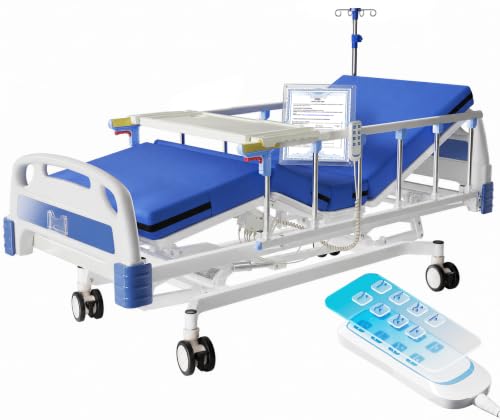


As an Amazon Associate we earn from qualifying purchases at no extra cost to you. Ratings are shown as listed on Amazon.
Best choice by home-care situation
| Situation | Likely starting point | Check before ordering |
|---|---|---|
| Bed is adjusted only occasionally and budget is the priority | Manual or semi-electric bed | Who will operate the crank, and can they reach it comfortably? |
| Position or height changes happen several times a day | Full-electric bed | Control layout, quiet operation specifications, and access to replacement parts |
| Room is small or has a narrow doorway | A standard-width home-care bed with a compact footprint | Fully assembled dimensions, turning clearance, and delivery path—not just mattress size |
| Standard capacity or sleeping width may not be sufficient | Bariatric bed sized to the individual and room | Rated capacity, frame width, mattress compatibility, and floor space |
| Caregiver needs to move the bed for cleaning or repositioning | Bed with locking casters suited to the floor surface | Wheel diameter, brake access, and whether all wheels lock |
For a person’s specific transfer, positioning, or fall-risk needs, ask a clinician or occupational therapist to help assess the setup. Bed rails in particular should not be added without considering the person, mattress, and entrapment risk.
Specifications that matter more than the product name
Adjustability and usable height
Head and knee adjustment can make it easier to change posture, while raising and lowering the whole bed can help caregivers work at a more suitable height and may simplify some transfers. Compare the complete height range, including the mattress: a thick mattress can raise the sleep surface substantially. Also check whether the controls have a lockout function and whether the hand control can be stored within easy reach.
Weight capacity and frame fit
Compare the bed’s safe working load with the manufacturer’s definition of that load; do not assume it means occupant weight alone. Include the mattress and any attachments if required by the manual. If capacity is close to the person’s weight, or the person needs a wider surface, ask the supplier to recommend an appropriately rated model rather than relying on a general category label.
Mattress dimensions and support
Many home-care beds use a mattress around 36 by 80 inches, but this is not universal. Bariatric and specialty frames may require different widths or lengths. Match the mattress to the frame’s specified dimensions and retainers. A poorly fitting mattress can shift or leave gaps; an extra-thick mattress can also change rail coverage and the effective height of the bed. If pressure management is a concern, ask a clinician what mattress type is appropriate and verify that it is compatible with the frame.
Rails, casters, and flooring
Rails may help with a particular transfer or provide a handhold, but they are not a substitute for supervision and can create gaps where a person may become trapped. Confirm the manufacturer’s approved rail and mattress combinations, and assess whether a partial-length assist handle is more appropriate than a full rail. For casters, look for accessible brakes and a locking arrangement suited to the bed. Hard floors, thresholds, thick rugs, and carpet can all affect rolling; a bed that can roll is not necessarily easy or safe to move while occupied.
Measure the room and delivery route before purchase
A nominal 36-inch mattress does not mean the assembled bed is only 36 inches wide. Measure the frame’s outside width and length, then leave space for caregivers to work and for the bed to move if needed. Measure the route from the entrance to the room: door clearances, hallway turns, stairs, and elevator openings. Ask whether delivery is curbside, room-of-choice, or includes assembly and packaging removal. A low quoted price can be less attractive if the household must move and assemble a heavy frame itself.
Request the delivery window, cancellation terms, and process for damaged or missing parts in writing. For a powered model, confirm whether the delivery team tests the motors and controls, and whether the bed needs a nearby outlet. If power outages are a concern, ask whether that model has a battery backup or a manual emergency-lowering method; these features are not standard across all beds.
Estimate the real cost, not just the frame price
As a broad market guide, basic manual home-care beds may cost a few hundred dollars, semi-electric models often fall in the several-hundred-dollar range, and full-electric or specialty beds can run from around $1,000 to several thousand dollars. Bariatric configurations and advanced features may cost more. Mattress, rails, delivery, setup, and service can be separate charges, so request an itemized quote.
For example, if a full-electric bed costs $1,200 and is used for two years, the frame cost alone works out to about $1.64 per day ($1,200 ÷ 730 days). That does not include a mattress, delivery, repairs, or eventual resale—and it does not account for the value of easier adjustments. The calculation is useful for comparing ownership periods, not for predicting what a bed will cost to operate.
Ownership: what wears and what to maintain
On powered beds, controls, cables, connectors, and actuators are parts to inspect if movement becomes intermittent, unusually noisy, or uneven. Casters and brakes collect hair and debris, while mattress covers and rails need cleaning according to their care instructions. Keep liquids away from electrical components, avoid pinching the control cable in moving joints, and follow the manufacturer’s inspection schedule. Do not use a damaged power cord or continue operating a frame that moves unpredictably.
Before buying, check the warranty separately for the frame, motors, and electronics, and ask who handles service in your area. A long warranty is less useful if replacement parts are unavailable or shipping and labor are excluded. Keep the model number, manual, and supplier contact information after delivery.
Bottom line
For frequent daily adjustments, a full-electric bed is often the most practical starting point. For occasional positioning on a tighter budget, consider manual or semi-electric options. Choose a bariatric model only when its capacity and width are needed, and verify that it fits the room and delivery route. The best hospital beds are the ones whose adjustments, mattress, safety accessories, casters, and service arrangements match the actual home-care setup.



Write Your Review
No reviews yet. Be the first to share your experience!