

Key takeaways
- 4–6 inches: common on compact steppers; convenient for beginners and shorter users, but less similar to household stairs.
- 6–8 inches: a useful middle range for general home conditioning.
- 8–10 inches: more demanding and closer to a substantial stair climb; check that you can maintain balance without leaning heavily on the rails.
- 10 inches or more: typically found on commercial-style machines and best suited to users who already tolerate stair workouts.
The best stair climbers depend on one practical question: do you need a full-size cardio machine, a quiet compact stepper, or a low-cost mini climber that can be stored after every workout?
Quick picks by workout situation
| Shopper situation | Best fit | Target specifications | Main compromise |
|---|---|---|---|
| Dedicated home gym and frequent training | Commercial-style revolving stair climber | 8–10 inch step height, 300–400 lb user capacity, 24–36 inch width | High price, noise, and a permanent footprint |
| Apartment or shared living space | Hydraulic or magnetic mini stepper | 4–8 inch step range, under 30 lb, roughly 16–20 inches wide | Shorter stride and less precise resistance control |
| Most varied cardio in limited space | Compact stepmill or elliptical-style climber | 6–10 inch steps, 20–30 inch width, transport wheels | Usually costs more than a basic stepper |
| Beginner using the machine two or three times weekly | Stable mini stepper with adjustable resistance | Wide pedals, 220–300 lb capacity, 10–20 minute continuous-use rating | May need cooldowns between longer sessions |
| Training for long, demanding sessions | Full-size stepmill | Continuous steps, 10–12 inch step height, 30-minute-plus duty cycles | Requires ceiling clearance, ventilation, and a dedicated outlet |
What counts as a stair climber?
A revolving stepmill, such as the StairMaster 8G, presents a continuous staircase. It most closely resembles climbing real stairs and is the strongest choice for sustained cardio, but it is also the largest and most expensive category.
Our top picks

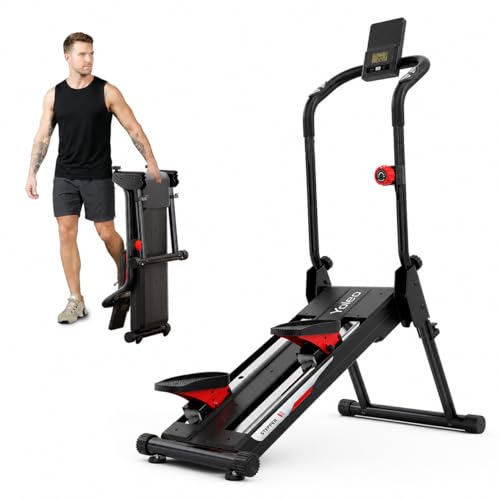


As an Amazon Associate we earn from qualifying purchases at no extra cost to you. Ratings are shown as listed on Amazon.
A stepper has two independent pedals that move up and down without circulating. Hydraulic models are common in the compact category, while magnetic-resistance models generally offer smoother adjustment and better heat management. These machines are often easier to store but do not reproduce a full staircase.
An elliptical-style climber combines a climbing motion with handlebars and a guided stride. It can feel more controlled than a mini stepper and may be a better compromise for someone who wants regular cardio without dedicating an entire room to a stepmill.
Step height: the specification that changes the workout
Step height is the vertical distance traveled by the pedal or stair. A higher step demands more hip and knee movement and can make a slow speed feel challenging. A low step is usually easier to control, but it may feel more like rapid stepping than climbing.
- 4–6 inches: common on compact steppers; convenient for beginners and shorter users, but less similar to household stairs.
- 6–8 inches: a useful middle range for general home conditioning.
- 8–10 inches: more demanding and closer to a substantial stair climb; check that you can maintain balance without leaning heavily on the rails.
- 10 inches or more: typically found on commercial-style machines and best suited to users who already tolerate stair workouts.
Do not compare step height alone. A 6-inch pedal moving at high speed may be harder than a 10-inch step moving slowly. Look for a wide resistance or speed range, then choose the machine that lets you start comfortably and progress without immediately using the highest setting.
Resistance: hydraulic, magnetic, or motor-driven?
Hydraulic resistance
Hydraulic cylinders keep compact steppers inexpensive and simple. They usually have few electronic parts and no required wall outlet. Their limitation is heat: during repeated stepping, the fluid can warm and resistance can soften. If a listing specifies a 10- to 20-minute continuous-use period, treat that as an ownership specification rather than an inconvenience.
Magnetic resistance
Magnetic resistance is usually smoother and more consistent during longer sessions. It is a strong choice for someone exercising several days each week, particularly when quiet operation matters. The machine may be heavier and more expensive, but the improved adjustment can make progressive training easier.
Motorized stepmills
Motorized machines control belt or stair speed and usually provide the most repeatable workout. They also produce the greatest mechanical complexity. Expect a substantial purchase price, more moving parts, and the need to follow lubrication, inspection, and electrical requirements carefully.
Footprint, ceiling clearance, and storage
Measure the machine in use, not only when folded. A compact stepper may occupy approximately 16–20 inches in width and 12–20 inches in depth, while a full-size stepmill commonly needs roughly 30–36 inches of width and 60–80 inches of depth. Exact dimensions vary by model and handrail position.
Add clearance around the machine so your elbows and hands do not strike walls. For a stepmill, also measure ceiling height. A simple estimate is:
Required ceiling height = user height + maximum pedal rise + safety clearance.
For example, a 5-foot-10-inch user on a machine with a 10-inch maximum rise should allow at least 6 feet 8 inches before adding a safety margin. In practice, 7 feet or more may still feel restrictive if the user holds an upright posture. A low ceiling can force excessive bending, which is a reason to choose a lower-profile stepper rather than attempting to make a tall machine fit.
For storage, prioritize transport wheels, a manageable machine weight, and a secure locking mechanism. A 25-pound stepper is easy to move but may slide more readily than a 90-pound unit. Place a rubber exercise mat underneath to protect flooring and reduce vibration.
Noise: what to expect in an apartment
The loudest part of a stair climber is not always the motor. Foot impact, loose pedal joints, frame vibration, and a hard floor can create more disturbance than the resistance system. Hydraulic steppers are often quiet at first, but warmed cylinders can produce squeaks. Magnetic units generally offer smoother movement. Motorized stepmills add belt, gearbox, and fan noise.
For shared walls or early-morning workouts, choose a machine with sealed bearings or bushings, rubber feet, and a stated low-noise design. Keep the cadence controlled: fast, forceful stepping increases both impact and mechanical noise. A thick mat can reduce vibration, but it will not eliminate a poorly maintained pedal or loose fastener.
Durability and ownership costs
The first components to wear are usually pedal bushings, pivot pins, hydraulic cylinders, belts, and drive rollers. On a mini stepper, inspect the pedal attachment points and resistance cylinders regularly. A small amount of side-to-side play can become a loud knock if ignored.
- Wipe sweat from the frame and pedals after each session.
- Check bolts and pedal hardware weekly during the first month.
- Lubricate only the locations and lubricant types specified by the manufacturer.
- Keep dust away from belts, vents, and sensors.
- Stop using the machine if a pedal drops unevenly, the frame rocks, or resistance suddenly disappears.
Suppose a compact stepper costs $180 and you use it four times per week for a year. That is about 208 sessions, or approximately $0.87 per session before maintenance. A $2,500 full-size machine used five times weekly for five years provides about 1,300 sessions, or approximately $1.92 per session. The larger machine may be the better long-term value for a committed user, but only if it receives regular use and fits the room permanently.
How to choose the right climber in five steps
- Measure the workout area. Record width, depth, ceiling height, and the space needed to walk around the machine.
- Set a realistic session length. If you want 30-minute workouts, avoid a compact unit rated only for short intervals.
- Choose the step height. Beginners and shorter users may prefer 4–6 inches; experienced climbers may want 8–10 inches or more.
- Match resistance to frequency. Occasional users can consider hydraulic resistance; frequent users should favor smooth magnetic or motorized control.
- Test the storage plan before buying. Confirm that the machine can pass through doorways and that you have a safe, dry place to keep it.
Bottom line
The best stair climbers for a dedicated workout room are full-size stepmills with substantial step height, stable handrails, and a long-duty-cycle motor. For most apartments and multipurpose rooms, a quiet magnetic or hydraulic stepper is the more practical choice. Focus first on step height, then continuous-use rating, footprint, noise, and storage—not on the number of workout programs. If you have joint pain, balance concerns, or a medical condition that affects exercise, seek individualized guidance from a qualified health professional before choosing an intense stair workout.



Write Your Review
No reviews yet. Be the first to share your experience!