

Key takeaways
- Best Trenchers for Landscaping and Utility Work The best trenchers are walk-behind models for most homeowners and landscapers, compact ride-on trenchers for frequent work or difficult soil, and large tractor- or skid-steer-mounted trenchers for deep, long utility runs. Choose by…
Best Trenchers for Landscaping and Utility Work
The best trenchers are walk-behind models for most homeowners and landscapers, compact ride-on trenchers for frequent work or difficult soil, and large tractor- or skid-steer-mounted trenchers for deep, long utility runs. Choose by the trench you need—not simply by engine size—because digging depth, chain width, soil conditions, transport, and operator control can matter more than horsepower.
Quick comparison: which trencher fits the job?
| Trencher type | Typical depth | Typical trench width | Power source | Approx. operating weight | Best use |
|---|---|---|---|---|---|
| Compact walk-behind | 12–24 in. | 2.5–4 in. | 5–15 hp gasoline or battery-electric | 250–650 lb | Landscape lighting, irrigation, invisible fencing, small drainage work |
| Heavy-duty walk-behind | 24–36 in. | 3–6 in. | 15–25 hp gasoline | 600–1,200 lb | Contractor work, utility lines, roots, compacted soil |
| Compact ride-on | 24–48 in. | 4–8 in. | 20–40 hp gasoline or diesel | 1,500–3,500 lb | Long runs, deeper trenches, regular commercial work |
| Skid-steer or tractor attachment | 24–60+ in. | 4–12 in. | Hydraulic flow from host machine | Attachment: 400–1,500 lb | Large sites, rocky ground, high daily production |
These are planning ranges rather than universal specifications. Chain configuration, boom length, soil, and manufacturer settings can change the final result. A 24-inch boom does not always produce a 24-inch usable trench in rocky or root-filled ground.
Our top picks

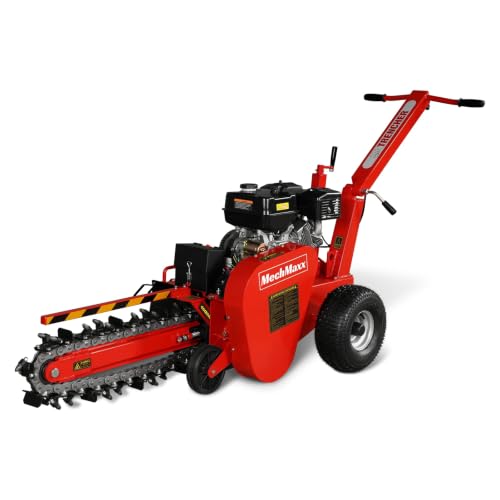


As an Amazon Associate we earn from qualifying purchases at no extra cost to you. Ratings are shown as listed on Amazon.
Best trencher types by situation
Best for occasional residential landscaping: compact walk-behind
A compact walk-behind trencher is usually the most practical choice for planting-bed edging, irrigation, low-voltage landscape wiring, and pet-fence cable. Models in the 12- to 24-inch depth range fit through many gates and can be transported on a small utility trailer or a vehicle-rated ramp.
The main advantage is control. An operator can slow the machine around tree roots, make short turns, and avoid removing more soil than necessary. Narrow chains also leave less spoil to backfill. The trade-off is limited traction and reduced productivity in wet clay, hard-packed fill, and rock.
Gasoline models remain common because they offer quick refueling and sustained power. Battery-electric trenchers can be quieter and produce no exhaust at the work area, but runtime depends on battery capacity, soil resistance, and whether the machine uses one or multiple packs. They are most attractive for short, intermittent jobs near a charging facility.
Best for contractors: heavy-duty walk-behind
A heavy-duty walk-behind trencher is a better match for repeated utility work when a ride-on machine would be excessive. It generally provides a longer boom, stronger chain drive, larger tires, and more aggressive digging teeth than a compact landscape unit.
These machines are easier to maneuver than ride-ons in narrow side yards, but they demand more physical skill. Steering on a slope, reversing out of a cut, and lifting the trencher onto a trailer can be challenging. Look for a hydrostatic drive, a dedicated reverse function, adjustable digging speed, and a boom or chain design supported by readily available wear parts.
Well-known professional equipment makers such as Toro, Barreto, Ditch Witch, and Vermeer offer walk-behind trenching equipment in different size classes. Exact availability and specifications vary by model and market, so compare the chain, boom, transport width, and service network rather than relying on the brand name alone.
Best for long or deep runs: compact ride-on trencher
Ride-on trenchers reduce operator fatigue and usually provide better traction, hydraulic power, and production speed. They make sense when the job involves hundreds or thousands of feet of trench, repeated 30- to 48-inch cuts, or soil that causes a walk-behind unit to spin or bounce.
The drawbacks are size and ground impact. A compact ride-on may need a trailer with a 3,500- to 7,000-pound rated capacity once the machine, attachments, fuel, and accessories are included. It may also be too wide for a residential gate and heavy enough to damage soft lawns or pavers.
Choose a ride-on when the saved labor and faster production justify the added transport, maintenance, and storage requirements. For a single weekend project, rental is often more sensible than ownership.
Best for demanding utility work: hydraulic attachment
Trencher attachments for skid steers, compact track loaders, and tractors use the host machine’s hydraulic system. They are useful when you already own the carrier and need to switch between trenching, grading, augering, and material handling.
Performance depends on hydraulic flow and pressure. A high-flow attachment connected to a low-flow loader may dig slowly or fail to deliver enough chain speed. Check the attachment’s required gallons per minute, maximum pressure, carrier weight, auxiliary coupler type, and rated lift capacity before purchase.
Skid-steer attachments are particularly effective when the job also requires carrying spoil or backfilling. However, they are less nimble in tight landscaped areas and can leave deeper tire or track marks than a walk-behind trencher.
Head-to-head buying criteria
Digging depth and trench width
Start with the installed material. Irrigation pipe, electrical conduit, and communication cable may require different burial depths under local codes or project specifications. Add room for bedding and avoid selecting a boom that only reaches the minimum depth in ideal soil.
Chain width controls both material removal and backfill volume. A 3-inch trench contains about 25% less excavated soil than a 4-inch trench at the same depth and length. Narrower is usually better for cable and small tubing, but too little clearance can make installation difficult or cause the material to bend sharply.
Soil performance
Standard digging chains with cup-style teeth suit loam, sandy soil, and ordinary topsoil. Hardened or carbide-tipped teeth last longer in compacted ground and mixed fill. Rock chains or rock wheels are more appropriate for abrasive soil, pavement edges, and fractured rock, though they usually cut more slowly and cost more to maintain.
Roots are not the same as rock. A trencher may cut small roots effectively but can snag on large roots, causing the machine to climb or swing. Stop before major roots, expose them safely, and decide whether the route should be moved. Never assume a more aggressive chain makes underground obstructions harmless.
Maneuverability and operator control
Compare turning radius, transport width, tire or track configuration, reverse control, and the ability to trench close to walls. A narrow walk-behind can reach locations a ride-on cannot, but a tracked machine may be more stable on slopes and soft ground.
Useful features include a boom depth indicator, operator-presence controls, adjustable chain speed, hydraulic steering, and a spoil auger or side-discharge arrangement that keeps excavated soil away from the cut.
Power source and runtime
Gasoline provides the most familiar refueling system and is generally the easiest option for long, remote jobs. Battery power is quieter and simplifies starting, but calculate runtime before committing. For example, if a battery trencher delivers 45 minutes of productive digging per charge and your project requires 2.5 hours of actual trenching, you need at least four usable charge cycles—or spare battery capacity—after allowing for stops and recharging.
Hydraulic attachments avoid a separate engine but consume fuel through the carrier. A high-flow carrier may produce excellent digging power while using substantially more fuel than a compact walk-behind.
Transport and storage
Measure every narrow point: trailer gate, garage door, garden gate, and the route to the work area. A machine that is 36 inches wide may fit a gate on paper but still fail when the operator must account for handles, chain guards, or uneven ground.
Confirm the trailer’s payload, ramp rating, tie-down points, and tongue weight. A 600-pound trencher plus fuel, ramps, tools, and accessories can quickly approach an 800- to 900-pound payload. Use the manufacturer’s tie-down locations and secure the boom in its transport position.
Decision matrix for common buyers
| Your situation | Recommended type | Why | Watch out for |
|---|---|---|---|
| One short cable or irrigation project | Compact walk-behind or rental | Lowest transport and operating complexity | Do not overbuy depth or horsepower |
| Several jobs each month | Heavy-duty walk-behind | Good balance of access, production, and ownership cost | Chain and teeth become recurring expenses |
| Long commercial runs | Compact ride-on | Better traction, speed, and operator comfort | Trailer, storage, and ground damage |
| Already own a suitable skid steer or tractor | Hydraulic trencher attachment | Uses existing power unit and broadens its capability | Hydraulic flow compatibility |
| Small gate, finished lawn, or tight planting beds | Narrow walk-behind | Best access and least spoil | Lower performance in rock and heavy clay |
Ownership realities: wear, maintenance, and common mistakes
The chain teeth usually wear first, followed by chain links, sprockets, boom bushings, bearings, and the digging-chain tensioner. Abrasive sand and rock accelerate wear. Before each job, inspect tooth sharpness, chain tension, guard bolts, hydraulic hoses, and fluid levels. A loose chain can jump the sprocket; an over-tight chain can overload bearings and reduce component life.
Clean soil from the boom and chain after use, especially when working in clay that hardens like cement. Lubricate the chain and pivots according to the manual, but do not substitute grease or oil where the manufacturer specifies a dry lubricant. Store gasoline equipment with appropriate fuel treatment and protect battery packs from extreme heat, freezing temperatures, and moisture.
The most common mistakes are trenching without locating underground utilities, selecting a chain that is too narrow for the installed material, forcing the boom through large roots, and backfilling before inspecting depth and line. Call the applicable utility-locating service before digging, follow local burial requirements, and keep bystanders away from the rotating chain and spoil discharge.
Final recommendation
For most residential landscaping, choose a narrow walk-behind trencher with roughly 12 to 24 inches of depth and a 2.5- to 4-inch chain. Choose a heavy-duty walk-behind for regular contracting in ordinary soil, a compact ride-on for long or deep production work, and a hydraulic attachment when an existing skid steer or tractor already matches the required flow. The best trencher is the smallest machine that reaches the required depth, handles the actual soil, fits the access route, and can be transported and maintained without turning every job into a logistics project.


Write Your Review
No reviews yet. Be the first to share your experience!