

Key takeaways
- Replaceable LED bulbs: Often use GU10, MR16, or standard screw-base lamps. They make future replacement simple, but the final appearance depends on the bulbs you choose.
- Integrated LED: The LEDs are built into each head. These fixtures are often slim and efficient, but the complete head or fixture may need replacement when the LED module or driver fails.
- Halogen or incandescent-compatible heads: They offer broad bulb compatibility, but they consume more electricity and produce substantially more heat. They are less attractive for enclosed, low-ceiling, or frequently used spaces.
The best track lighting kits are usually a 4-foot, line-voltage kit with three or four adjustable heads for kitchens, a two- or three-head kit for living rooms, and a dimmable LED kit with narrow-beam heads for work areas.
Our top picks

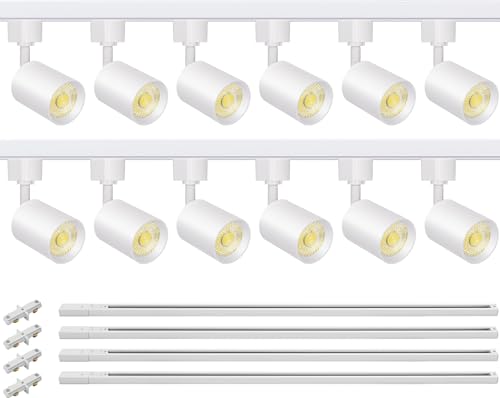


As an Amazon Associate we earn from qualifying purchases at no extra cost to you. Ratings are shown as listed on Amazon.
Best track lighting kits by room and priority
| Situation | Best kit type | Recommended track length | Head count | Why it fits |
|---|---|---|---|---|
| Small kitchen or galley kitchen | Line-voltage track with adjustable LED heads | 4 ft | 3–4 | Spreads light across counters without overwhelming a narrow ceiling |
| Large kitchen or open-plan room | Two-track or 6–8 ft modular system | 6–8 ft | 4–6 | Provides separate aiming points for counters, sink, dining area, and circulation paths |
| Living room accent lighting | Flexible track with wide-tilt heads | 4–6 ft | 3–4 | Can illuminate artwork, shelving, and seating zones without a central glare source |
| Desk, craft table, or home office | Dimmable LED track with directional heads | 4 ft | 2–3 | Allows light to be aimed at the work surface while reducing screen reflections |
| Rental or beginner installation | Plug-in track or rail with a cord-and-plug connection | 3–4 ft | 2–3 | Avoids new ceiling wiring, although the cord remains visible |
What to compare before buying
Track length and layout
A 2-foot track works for a small entryway or a focused display, but it gives you little room to reposition heads later. A 4-foot track is the most versatile size for an average kitchen, bedroom, or office. Six- and 8-foot systems make more sense in open-plan rooms, but a long rail does not automatically produce better lighting. It can leave the middle of a room bright while the counters or walls remain dim if the heads cannot be positioned independently.
Allow clearance at both ends of a straight track. A practical starting point is to keep the rail at least 12 to 24 inches from the nearest wall, then aim individual heads toward the work surface or feature being lit. For a kitchen, place the rail so the light falls in front of the person using the counter rather than directly behind them, which helps prevent body shadows.
Head adjustability
Look for heads that rotate at least 180 degrees and tilt by roughly 90 degrees. Rotation determines whether a head can face along the track or across the room; tilt determines whether it can reach a wall, worktop, or artwork. Heads that only swivel at the base are less useful than they appear because their beam may still point too close to the ceiling.
For a multi-use room, independently adjustable heads are more valuable than extra wattage. A four-head kit can direct one light toward a sink, one toward a preparation counter, one toward a dining table, and one toward a wall. Fixed or closely coupled heads may create overlapping pools of light instead.
Bulb type and color quality
Track kits generally use one of three light sources:
- Replaceable LED bulbs: Often use GU10, MR16, or standard screw-base lamps. They make future replacement simple, but the final appearance depends on the bulbs you choose.
- Integrated LED: The LEDs are built into each head. These fixtures are often slim and efficient, but the complete head or fixture may need replacement when the LED module or driver fails.
- Halogen or incandescent-compatible heads: They offer broad bulb compatibility, but they consume more electricity and produce substantially more heat. They are less attractive for enclosed, low-ceiling, or frequently used spaces.
For most rooms, choose 2700–3000K for warm, relaxed light or 3500–4000K for a crisper kitchen or work area. A color-rendering index of 90 or higher is worthwhile above food-preparation surfaces, near artwork, and at a desk because colors appear more natural. Dimming must be supported by both the kit and the bulbs; a non-compatible dimmer can cause flicker or buzzing.
Kitchen, living room, or work area: which design wins?
For kitchens: prioritize coverage and low glare
A kitchen usually benefits from three or four heads rather than a single high-output lamp. Use wider beams, approximately 35–60 degrees, for general counter coverage. Aim the heads toward the front half of the worktops and sink, not straight down at the center of the room.
As a rough sizing example, suppose a 4-foot kit has four 500-lumen LED heads. Its nominal output is 2,000 lumens. If only about 60 percent reaches the useful counter area after beam spread, mounting height, and surface losses, the effective result is approximately 1,200 lumens. That is usually adequate for supplemental lighting in a small kitchen, but a large kitchen may need a second track, under-cabinet lighting, or brighter heads. Track lighting should not be expected to replace every layer of kitchen lighting.
For living rooms: choose flexibility over maximum brightness
Living rooms often need a mix of ambient and accent illumination. A three-head kit with wide tilt adjustment can aim one head at artwork, one at shelving, and one toward a seating area. Avoid pointing every head at eye level; reflected light from a wall is usually more comfortable than a bare lamp in the viewer’s line of sight.
Replaceable bulbs are useful here because you can use a warmer 2700K lamp for a relaxed room or a higher-color-rendering bulb for artwork. If the room already has floor and table lamps, a lower-output track kit with dimming may be more useful than a very bright six-head model.
For work areas: control reflections and shadows
At a desk or craft table, aim the head from the opposite side of your dominant hand when possible. This reduces shadows cast across the work surface. Keep the beam out of the monitor’s direct reflection path, and choose a narrow-to-medium beam around 25–40 degrees for focused illumination.
A two- or three-head dimmable LED kit is often enough for a single desk. For detailed craft work or a large table, combine track lighting with a dedicated task lamp rather than relying on distant ceiling heads alone.
Ceiling compatibility and installation choices
Check the ceiling box, wiring, and track standard before purchasing. A kit may be mechanically easy to mount but electrically unsuitable for the existing connection. Line-voltage systems connect directly to household wiring and normally offer the broadest choice of replacement bulbs. Low-voltage systems use a transformer, which may be built into the canopy or mounted separately; verify that the transformer is rated for the total load and compatible with dimming.
Sloped ceilings require a canopy and connector designed for angled mounting. A standard straight-track kit can sit unevenly or place stress on the electrical box. For plaster, concrete, or ceilings without a suitable junction box, the mounting hardware and electrical work can differ substantially. Turn off the circuit at the breaker, confirm it is de-energized, and use a qualified electrician where wiring or ceiling-box work is outside your experience.
Ownership realities: what wears out first
- Bulbs: Replaceable LED bulbs are usually the easiest long-term option. Keep one spare of the exact base, beam angle, and color temperature.
- Integrated LED drivers: Heat and power-quality problems can shorten driver life. Good ventilation and an appropriate dimmer matter more than a very thin housing.
- Swivel joints: Repeated forceful repositioning can loosen the joint or damage internal wiring. Move heads by their housing, not by the bulb.
- Dust: Dust on lenses reduces output and increases visible glare. Switch off the fixture and clean it with a dry microfiber cloth; follow the manufacturer’s instructions for removable shades.
- Connectors: Modular systems can develop poor contact if parts are mixed across incompatible track standards. Buy extensions and replacement heads for the same system.
A practical buying decision
| Your priority | Choose | Avoid |
|---|---|---|
| Lowest installation complexity | Plug-in 3–4 ft rail with two or three heads | Hardwired low-voltage systems requiring a separate transformer |
| Lowest long-term replacement cost | Replaceable LED bulbs with a common socket | Uncommon integrated modules with no stated replacement path |
| Best for changing furniture layouts | Modular track with movable heads and extension options | Fixed bars with non-adjustable lamp positions |
| Best for a low ceiling | Compact LED heads with 2700–3000K light and dimming | Hot halogen lamps or deep, bulky shades |
| Best for a large open room | Two coordinated tracks or a 6–8 ft system with four to six heads | One short rail forced to cover every zone |
Bottom line
For most buyers, the best track lighting kits balance a 4-foot rail, three or four independently adjustable LED heads, replaceable bulbs, dimming compatibility, and a mounting system suited to the ceiling. Choose wider beams and more coverage for kitchens, warm adjustable light for living rooms, and narrower, carefully aimed beams for desks and worktables. The right track is not the one with the most heads; it is the one that places useful light where you need it without glare, shadows, or an impractical installation.




Write Your Review
No reviews yet. Be the first to share your experience!