

Key takeaways
- Cardstock: the most dependable material; test a scrap because 80 lb and 110 lb cardstock behave differently.
- Vellum: emboss at lower stress where possible and use a fresh, smooth folder to reduce cracking.
- Foil and specialty papers: check whether the surface scratches when passed through the plates.
- Fabric and leather: use only with a machine and accessory explicitly rated for those materials.
- Chipboard: never assume that a thin-looking sheet is safe; dense board can exceed the machine’s pressure limits.
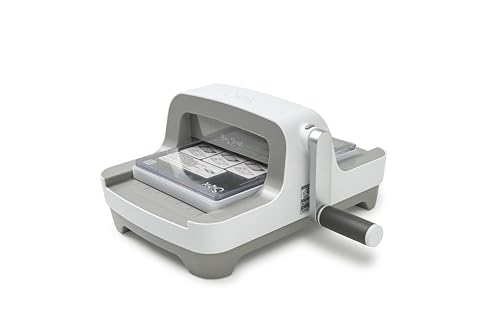
The best embossing machines for most crafting projects are the Sizzix Big Shot for affordable manual control, the Spellbinders Platinum 6 for a compact but sturdy manual option, and the Gemini Junior for faster electronic operation with less hand pressure.
Your choice depends less on the word “embossing” than on the materials, project size, and frequency of use. Manual machines are quieter, simpler, and easier to store; electronic models are more consistent for repeated batches but need a power outlet, more clearance, and careful attention to sandwich thickness.
Our top picks


As an Amazon Associate we earn from qualifying purchases at no extra cost to you. Ratings are shown as listed on Amazon.
Best embossing machines by crafting situation
| Situation | Best fit | Why | Important limitation |
|---|---|---|---|
| First machine or occasional card making | Sizzix Big Shot | Manual operation, broad accessory ecosystem, and a roughly 6-inch work width | Requires turning a crank and occupies more shelf depth than a compact starter tool |
| Small workspace with regular paper projects | Spellbinders Platinum 6 | Compact 6-inch platform and strong pressure for dies and embossing folders | Its narrow opening is less convenient for larger scrapbook layouts |
| High-volume invitations, cards, or repeated batches | Gemini Junior | Electronic feed reduces repetitive cranking and handles a cutting area of about 6 inches | Needs an outlet and has less forgiving setup if the sandwich is too thick |
| Large scrapbook pages and oversized folders | A wider-format manual or electronic machine | Supports approximately 8-inch or larger media, depending on the model | Higher cost, heavier storage, and larger replacement plates |
| Travel, classes, or very limited storage | Compact manual die-cutting machine | No electricity and usually fewer components to pack | Smaller opening and more hand effort for thick materials |
Head-to-head: manual versus electronic embossing machines
Manual machines: better control and simpler ownership
Manual machines use a crank to pull a layered “sandwich” of plates, paper, dies, and embossing folders through rollers. The pressure is produced mechanically, so you can slow down, reverse the handle, or stop immediately if the stack feels wrong. That feedback is useful when working with unfamiliar cardstock or delicate materials.
The Sizzix Big Shot is a practical all-purpose choice because its approximately 6-inch opening accommodates many standard cardmaking dies and folders. The machine does not require a motor, so there is no cord to store and no electronic feed mechanism to maintain. A manual model is also usually the better value for occasional users, with general market prices commonly falling around $80–$150 depending on the bundle.
The Spellbinders Platinum 6 is another strong manual choice. Its 6-inch platform is suited to cards, tags, small panels, and many wafer-thin dies. It is often priced in the general range of $120–$200. Its folding or compact-storage design, where included, can be useful in a craft room with limited shelf space, but check the exact package because plates and accessories vary.
The trade-off is physical effort. A few cards are easy for most users; a large batch can make crank resistance noticeable. Manual operation also makes it possible to apply inconsistent speed or alignment, although a level surface and correctly assembled plates reduce that problem.
Electronic machines: efficient for batches
Electronic machines pull the sandwich through powered rollers. The Gemini Junior is a well-known compact electronic option with a working area of approximately 6 inches. It is appealing for repeated die cuts, invitations, labels, or card panels because the motor performs the feeding motion rather than your wrist. Typical market pricing is often about $180–$300, depending on included plates, dies, and seasonal bundles.
Electronic operation does not remove the need for correct pressure control. Many electronic machines regulate roller pressure internally rather than offering a true user-adjustable pressure dial. The user still controls the result by selecting the correct plates, shims, adapters, and material thickness. Adding an unapproved shim to increase pressure can crack plates, jam the rollers, or damage the machine.
Electronic machines are also less convenient in a crowded workspace. Allow room for the machine, its plates, the power cable, and a clear exit path for the sandwich. The motor can be louder than a hand crank, and a jam generally requires switching off or reversing the machine according to its instructions.
What to compare before buying
Embossing size and throat width
“6-inch” machines generally refer to the maximum width of a compatible die or folder, not the size of every project you can make. A 6-inch platform works well for A2 cards, many A6 cards, tags, and small scrapbook elements. For a 12-inch scrapbook page, you will usually emboss separate sections or need a wider-format machine.
Measure the largest folder you expect to use, then leave extra room for the plates. A folder that technically fits may still be awkward if its edges extend beyond the platform or if the finished paper cannot be positioned squarely.
Material compatibility
Most machines handle ordinary cardstock, patterned paper, vellum with care, and thin metal or plastic dies designed for the machine. Embossing folders usually produce deeper impressions in pliable cardstock than in thin copy paper. Heavy watercolor paper, leather, fabric, chipboard, cork, and metal require specific compatibility information rather than a stronger push.
- Cardstock: the most dependable material; test a scrap because 80 lb and 110 lb cardstock behave differently.
- Vellum: emboss at lower stress where possible and use a fresh, smooth folder to reduce cracking.
- Foil and specialty papers: check whether the surface scratches when passed through the plates.
- Fabric and leather: use only with a machine and accessory explicitly rated for those materials.
- Chipboard: never assume that a thin-looking sheet is safe; dense board can exceed the machine’s pressure limits.
Pressure control and plate wear
A machine with a pressure dial sounds attractive, but compatibility instructions matter more than maximum force. For most home machines, “pressure control” is practical rather than electronic: you choose the prescribed platform, cutting plates, embossing mat, and shims for the material.
Plates are consumables. Cutting dies leave lines and grooves in the cutting surface, while embossing folders can gradually flatten or mark plates. Rotate plates when the manufacturer permits it, keep the smooth side facing the correct direction, and replace plates when warping prevents an even feed. Do not use a visibly bowed plate in a powered machine.
Setup, noise, and storage
| Machine type | Typical working width | Setup time | Storage considerations | Best batch size |
|---|---|---|---|---|
| Compact manual | 3–6 inches | 2–5 minutes | Store plates flat; machine can usually sit on a shelf | 1–20 pieces |
| Standard manual | Approximately 6 inches | 3–7 minutes | Needs a stable surface and space for the crank | 1–50 pieces |
| Compact electronic | Approximately 6 inches | 5–10 minutes | Requires outlet access and clearance at both ends | 20–200 pieces |
| Wide-format machine | 8 inches or more | 5–10 minutes | Heavier, deeper, and more demanding to pack away | Large panels and repeated layouts |
A practical cost-per-use calculation
Suppose a manual machine costs $120 and you use it for 24 crafting sessions per year over four years. That is 96 sessions, or about $1.25 of machine cost per session before plates and dies. An electronic machine costing $240 used for 100 sessions over the same period costs about $2.40 per session. The electronic model may still be worthwhile if it saves 10 minutes per session: across 100 sessions, that is roughly 16.7 hours saved.
This calculation excludes replacement plates, electricity, and accessories, but it clarifies the decision. Buy manual for flexibility and low ownership complexity; buy electronic when repetitive work and reduced hand effort matter more than the purchase-price difference.
Setup method that prevents most failures
- Read the sandwich chart. Match the paper, die or folder, platform, plates, and shim to the machine’s instructions.
- Test a scrap. Use the same paper thickness and folder as the finished project. This reveals cracking, shallow impressions, or excessive pressure before material is wasted.
- Align the folder or die squarely. Keep the stack straight as it enters the rollers; angled feeding creates uneven pressure.
- Feed slowly on a manual machine. Stop if the crank becomes unusually difficult. On an electronic machine, use the prescribed stop or reverse control rather than pulling the sandwich out.
- Inspect the result and adjust one variable. Change the paper moisture, folder orientation, or approved shim—not several things at once.
- Clean and store flat. Remove paper fibers from the plates, keep folders closed or flat, and avoid leaving heavy objects on top of them.
Durability and ownership realities
The parts most likely to wear first are cutting plates, embossing mats, folder hinges, and—on powered machines—the feed path and drive components. Paper dust and scraps can accumulate around rollers, so periodic cleaning with a dry, soft cloth is preferable to spraying liquid into the machine. Store dies dry to prevent rust and keep magnetic sheets or cases from bending.
The most common mistake is adding extra pressure when the impression is shallow. A cleaner solution is often slightly softer cardstock, a properly designed embossing mat, or a folder intended for that machine. Another frequent mistake is using a cutting plate that has developed a deep channel directly over the working area; rotating or replacing it can restore a more even result.
Final recommendation
Choose the Sizzix Big Shot if you want the broadest all-purpose starting point with manual feedback and moderate cost. Choose the Spellbinders Platinum 6 if compact 6-inch crafting and sturdy manual operation are your priorities. Choose the Gemini Junior if you regularly produce batches and value powered feeding enough to accept higher cost, noise, and setup requirements. For oversized scrapbook work, skip all three compact formats and buy a wide-format machine that matches the largest folder you actually plan to use.





Write Your Review
No reviews yet. Be the first to share your experience!