

Key takeaways
- The best TIG welders in 2026 are the Lincoln Electric Square Wave TIG 200 for most beginners, the Miller Syncrowave 210 for serious aluminum work, and the Everlast PowerTIG 200DV for buyers who want broad AC/DC control at a lower…
The best TIG welders in 2026 are the Lincoln Electric Square Wave TIG 200 for most beginners, the Miller Syncrowave 210 for serious aluminum work, and the Everlast PowerTIG 200DV for buyers who want broad AC/DC control at a lower market price.
TIG welding rewards precise control rather than sheer power. The right machine depends on the metal you weld, available electrical supply, how often you use it, and whether you want a simple learning curve or advanced arc adjustment. The comparison below focuses on the features that matter after the product listing is closed: amperage range, AC/DC behavior, duty cycle, torch controls, portability, and setup.
Our top picks
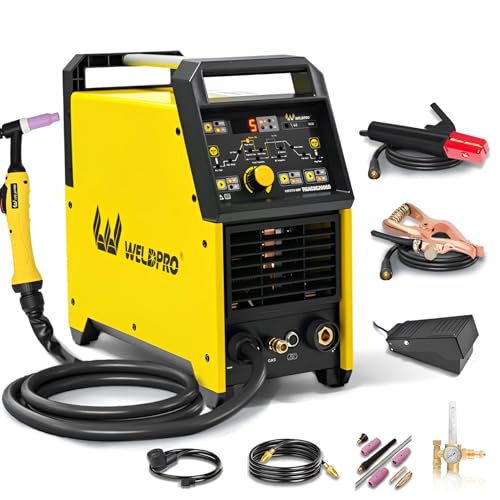


As an Amazon Associate we earn from qualifying purchases at no extra cost to you. Ratings are shown as listed on Amazon.
Best TIG welders at a glance
| Welder | Best for | Output range | AC/DC | Duty cycle | Weight | Useful controls |
|---|---|---|---|---|---|---|
| Lincoln Electric Square Wave TIG 200 | Beginners and general fabrication | 10–200 A | AC/DC | 25% at 200 A | About 46 lb | Square-wave AC, pulse, foot-pedal control |
| Miller Syncrowave 210 | Aluminum and frequent shop use | 5–210 A | AC/DC | 20% at 210 A | About 122 lb | AC balance, frequency, pulse, foot control |
| Everlast PowerTIG 200DV | Feature-rich value | 5–200 A | AC/DC | 35% at 200 A | About 60 lb | AC balance, frequency, pulse, 120/240 V input |
| PrimeWeld TIG225X | Budget AC/DC capability | 10–225 A | AC/DC | 40% at 225 A | About 36 lb | Pulse, AC balance, frequency, foot pedal |
| AHP AlphaTIG 203Xi | Portable hobby and repair work | 10–200 A | AC/DC | 40% at 200 A | About 32 lb | Pulse, pre-flow/post-flow, foot pedal |
Specifications can vary by production revision and market, so confirm the current manual before purchase. Duty-cycle figures are particularly important: a 40% rating at 200 A means approximately 4 minutes of welding followed by 6 minutes of cooling within a 10-minute period.
Our picks by welding situation
Best overall for learning: Lincoln Electric Square Wave TIG 200
The Square Wave TIG 200 is a strong starting point because its controls are approachable without being limiting. It runs from standard 120-volt or 230-volt power, supports both AC and DC TIG, and includes a foot pedal. That combination lets a beginner start on steel or stainless steel at modest amperage, then move to aluminum without replacing the machine.
Its 200-amp ceiling is sufficient for many home-fabrication projects, including aluminum parts around 1/4 inch thick with appropriate joint preparation and heat management. The 25% duty cycle at maximum output is less attractive for long production welds, but it is rarely a problem for intermittent repair work. Choose it when setup clarity and established service support matter more than maximum duty cycle.
Best for aluminum and a permanent shop: Miller Syncrowave 210
The Syncrowave 210 is the most shop-oriented choice in this group. Its AC controls provide practical adjustment of cleaning action and arc behavior, while pulse settings can help manage heat on thin material. The machine is considerably heavier than portable inverter welders, so it belongs on a cart or dedicated welding bench rather than being carried to every job.
The advantage is a controlled, stable platform for repeated aluminum work, stainless assemblies, and fabrication where consistent arc behavior matters. Its lower maximum duty cycle than some lighter competitors does not make it a poor production machine; it means the stated 210-amp output is intended for timed welding intervals rather than continuous operation.
Best value for advanced settings: Everlast PowerTIG 200DV
The PowerTIG 200DV is appealing when you want AC frequency, AC balance, pulse control, and dual-voltage input without moving into a larger shop machine. The 120/240-volt capability is useful in a garage: use 120 volts for lighter work, then move to a 240-volt circuit when you need more headroom and lower input current.
It is a better fit for an intermediate user who understands tungsten selection, gas coverage, and joint preparation. Beginners can use it, but the larger menu of settings creates more opportunities to change variables before learning the fundamentals. Check included torch, pedal, regulator, and consumable packages carefully because bundles can differ.
Best budget pick with high output: PrimeWeld TIG225X
The PrimeWeld TIG225X offers a 225-amp ceiling and a compact format at a generally lower market price than premium shop machines. Its AC/DC operation, pulse controls, and foot pedal make it capable of aluminum, stainless steel, mild steel, and thin sheet work.
This is a sensible choice for a hobbyist who wants advanced controls but does not need a large dealer network or an integrated industrial cooling system. Before buying, verify local warranty arrangements and replacement torch compatibility. A lower purchase price can be offset if a damaged pedal or torch lead is difficult to source.
Best portable option: AHP AlphaTIG 203Xi
At roughly 32 pounds, the AlphaTIG 203Xi is easier to move between a garage, trailer, and repair site than traditional transformer-based welders. It supplies AC/DC TIG, pulse operation, and a foot pedal in a relatively small package.
Portability is its main advantage, but compact machines require sensible expectations. They are excellent for short welds and occasional fabrication, while long, high-amperage aluminum runs will be limited by duty cycle and cooling time. Keep the ventilation openings clear and avoid placing the unit directly on dusty floors.
How to choose between AC/DC and amperage
DC TIG is used for steel, stainless steel, copper, titanium, and many other metals. AC TIG is needed for aluminum and is also useful for magnesium. If aluminum is even a likely future project, an AC/DC welder is usually worth the extra cost; a DC-only machine cannot be upgraded through software or a different torch.
Amperage is not the same as material thickness capacity. A rough starting estimate for TIG on steel is about 1 amp per 0.001 inch of thickness, or approximately 125 amps for 1/8-inch material. Joint design, fit-up, travel speed, preheating, and heat sinking can change the real requirement. For aluminum, plan for additional heat because the material conducts it away quickly.
A machine with a 200-amp maximum does not need to be operated at 200 amps to be useful. More important is a stable low-end range. A 5-amp minimum is helpful for thin stainless work, while a 10-amp minimum remains adequate for many general projects.
Decision matrix: which features deserve your money?
| Your situation | Prioritize | Best match | Why |
|---|---|---|---|
| First TIG welder, occasional steel and aluminum | Simple interface, foot pedal, dual voltage | Lincoln Square Wave TIG 200 | Balanced learning curve and broad material capability |
| Frequent aluminum fabrication in a fixed shop | AC balance, AC frequency, dependable controls | Miller Syncrowave 210 | Shop-oriented design and strong aluminum control |
| Intermediate user on a controlled budget | Pulse, AC adjustment, 120/240 V input | Everlast PowerTIG 200DV | Many useful settings without a large machine footprint |
| Maximum portability for repair work | Low weight, AC/DC, compact inverter design | AHP AlphaTIG 203Xi | Easier to transport and suitable for short welds |
| High output on a tighter purchase budget | 225-amp rating, pulse, included pedal | PrimeWeld TIG225X | Strong feature set for hobby fabrication |
Torch controls, pedals, and beginner setup
A foot pedal is more valuable than a large collection of rarely used menu settings. It lets you reduce amperage at the end of a weld, manage heat around corners, and compensate for changing joint conditions. A torch-mounted amperage rocker is convenient when standing or working in a confined position, but confirm whether it is included or optional.
For a first setup, use a 2% lanthanated tungsten, a #7 or #8 gas cup, and high-purity argon. Start around 15–20 cubic feet per hour, then adjust for drafts and cup size. Set post-flow long enough to protect the hot tungsten—often about 5–10 seconds for common torch sizes. Excessive gas flow can create turbulence and pull atmospheric contamination into the arc.
Ownership costs and maintenance
The initial machine price is only part of the budget. A practical starter setup may also require a regulator and hose, argon cylinder rental or purchase, tungsten electrodes, ceramic cups, collets, a gas lens, filler rod, gloves, and replacement torch consumables. General market pricing in 2026 places entry-level AC/DC inverter TIG machines roughly in the $600–$1,200 range, while established shop machines commonly cost $1,500–$3,000 or more before accessories.
The most frequently replaced items are tungsten electrodes, ceramic cups, collets, collet bodies, gas lenses, and torch hoses. A contaminated tungsten should be ground lengthwise on a dedicated wheel rather than used until the arc becomes unstable. Clean aluminum with a dedicated stainless brush, remove oil and oxide before welding, and keep filler rod covered so it does not collect dust.
Common beginner mistakes include holding the torch too far from the work, touching the tungsten to the puddle, using excessive argon flow, and attempting to correct poor fit-up with more amperage. A clean joint and consistent torch angle usually improve results more than another advanced machine setting.
Final recommendation
Choose the Lincoln Square Wave TIG 200 for the safest all-purpose starting point. Step up to the Miller Syncrowave 210 when aluminum work and fixed-shop durability justify the additional size and cost. For a portable or value-focused setup, compare the Everlast PowerTIG 200DV, PrimeWeld TIG225X, and AHP AlphaTIG 203Xi against warranty support, included accessories, and the electrical supply available in your workspace—not just their maximum amperage.









Write Your Review
No reviews yet. Be the first to share your experience!