

Key takeaways
- Firm foam: easier to stand from and more resistant to deep impressions.
- Medium foam: a versatile choice for family rooms and mixed use.
- Fiber or feather blends: softer and more relaxed, but they require regular reshaping.
- Fixed cushions: cleaner-looking and harder for children to move, but more difficult to repair or replace.
- Loose cushions: easier to rotate and service, although they can shift during use.
The best leather sofas for lasting style are full-grain or top-grain models with a kiln-dried hardwood frame, eight-way hand-tied or high-quality sinuous-spring suspension, high-resilience foam cushions, and dimensions that leave at least 30–36 inches of walking space around the piece.
Our top picks


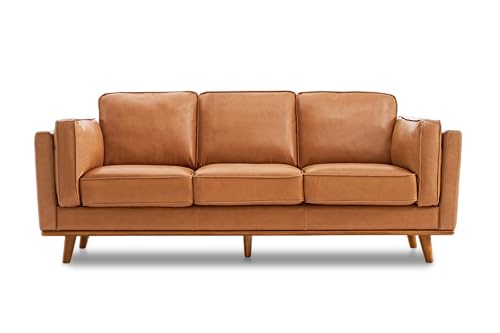

As an Amazon Associate we earn from qualifying purchases at no extra cost to you. Ratings are shown as listed on Amazon.
Best leather sofas by household and budget
| Situation | Best choice | Leather and construction target | Typical market range |
|---|---|---|---|
| Daily family seating | Durable top-grain sofa | Protected finish, kiln-dried hardwood frame, high-resilience foam | $1,800–$4,500 |
| Pets or frequent spills | Protected leather or high-quality corrected-grain leather | Wipeable finish, removable cushions, reinforced seams | $1,500–$4,000 |
| Traditional, long-term investment | Full-grain leather sofa | Premium hide, hardwood frame, replaceable cushions if available | $3,500–$9,000+ |
| Small apartment | Apartment-size two- or three-seat sofa | 72–82-inch width, 36–39-inch depth, removable legs | $1,200–$3,200 |
| Occasional or formal use | Full-grain or top-grain stationary sofa | Medium-firm cushions, 20–22-inch seat depth | $2,000–$5,000 |
These are broad market ranges rather than fixed prices. Leather quality, frame joinery, cushion design, customization, and delivery can change the cost substantially.
Leather grades: what you are actually buying
Full-grain leather
Full-grain leather uses the outer surface of the hide with its natural grain largely intact. It usually shows more variation, including subtle pores, scars, and color differences. Over time, it can develop a patina rather than simply looking worn. This is the strongest choice for buyers who value natural aging and plan to keep the sofa for many years, but it is also the most expensive and may show scratches more clearly.
Top-grain leather
Top-grain leather is also made from the outer portion of the hide, but it may be lightly sanded or finished for a more uniform appearance. It offers a useful balance of durability, consistency, and price. A well-made top-grain sofa with a protective finish is often the most practical choice for a busy household.
Corrected-grain and split leather
Corrected-grain leather has been mechanically treated and embossed to create a consistent surface. Its performance depends heavily on the coating and manufacturing quality. Split leather comes from lower layers of the hide and is generally less durable than full-grain or top-grain leather when used as the main seating surface.
Bonded leather and leather-match upholstery
Bonded leather contains leather fibers combined with a polyurethane binder. Leather-match furniture may use genuine leather on contact areas and synthetic material elsewhere. Neither category is automatically unsuitable, but it should not be confused with a sofa upholstered entirely in a high-grade hide. Ask specifically what covers the seat, arms, back cushions, and outside back.
Frame and suspension matter more than the label
A premium hide cannot compensate for a weak frame. Look for kiln-dried hardwood, reinforced corner blocks, glued-and-screwed joints, and a frame warranty that covers structural failure. “Hardwood” is a useful starting description, but a manufacturer that explains the joinery gives you more meaningful information than a vague material label.
Suspension determines how the sofa feels and how evenly it wears. Eight-way hand-tied springs can provide a supportive, flexible sit when properly built. High-quality sinuous springs are also durable and are often lighter and less expensive. Webbing can work well in a carefully engineered frame, but low-grade webbing is more likely to stretch or sag.
Check whether the seat cushions are reversible, whether cushion covers can be removed, and whether replacement cushions are available. These details affect ownership more than decorative stitching. A sofa with replaceable seat interiors may remain serviceable after the original foam softens.
Seat depth and width: choose for the room and the people
| Dimension | Useful range | Best suited to |
|---|---|---|
| Overall width | 72–82 inches | Small rooms, apartments, compact living areas |
| Overall width | 84–96 inches | Most family living rooms |
| Overall width | 100–120 inches | Large rooms or households needing four seats |
| Seat depth | 20–22 inches | Upright sitting, reading, shorter users |
| Seat depth | 23–25 inches | Relaxed general-purpose seating |
| Seat depth | 26–28 inches | Lounging, taller users, occasional napping |
| Seat height | 17–19 inches | Standard access for most adults |
Measure usable seat depth from the front edge of the cushion to the back cushion, not the sofa’s total depth. A 27-inch usable seat can feel too deep for someone who prefers an upright posture, while a 20-inch seat may feel restrictive to a taller user.
For a quick fit calculation, allow about 24 inches of usable seat width per person. A 78-inch sofa with 6 inches occupied by arms and frame has roughly 72 inches of seating, or room for three adults at 24 inches each. A wide sofa is not automatically a four-seater if its arms are unusually thick.
Cushion construction and the feel of a new sofa
High-resilience polyurethane foam is a practical core for everyday leather seating. Foam density and layering matter, although manufacturers do not always publish them. A foam core wrapped in fiber or down-alternative material feels softer initially, while dense foam generally holds its shape better and needs less daily plumping.
- Firm foam: easier to stand from and more resistant to deep impressions.
- Medium foam: a versatile choice for family rooms and mixed use.
- Fiber or feather blends: softer and more relaxed, but they require regular reshaping.
- Fixed cushions: cleaner-looking and harder for children to move, but more difficult to repair or replace.
- Loose cushions: easier to rotate and service, although they can shift during use.
Expect leather cushions to soften. The desirable change is gradual comfort; a visible trough that remains after standing up indicates uneven loading, insufficient support, or an underbuilt cushion.
Maintenance in a busy household
Leather is relatively easy to wipe clean, but it is not maintenance-free. Dust, grit, body oils, direct sunlight, and heat can gradually change the finish. Follow the upholstery manufacturer’s care code before applying any product, because a cleaner intended for unfinished aniline leather may be unsuitable for a coated surface.
- Vacuum seams and crevices weekly using a soft brush attachment. Grit acts like fine sandpaper when people sit and move.
- Blot fresh spills with a clean, absorbent cloth. Do not scrub, soak, or use a hair dryer.
- Use a leather cleaner only at the recommended interval and test it on a hidden area first.
- Apply a compatible conditioner sparingly when the manufacturer recommends it. Over-conditioning can leave residue and attract dirt.
- Rotate loose cushions and change seating positions every few weeks to distribute compression.
- Keep the sofa away from radiators, heating vents, fireplaces, and strong direct sun.
The most common mistakes are using household disinfectant, baby wipes, dish soap, abrasive sponges, or unapproved oils. These can strip the finish, darken the hide, or create a patch that is difficult to blend. Ink, dye transfer, grease, and pet accidents may require a professional upholstery specialist, especially on aniline or semi-aniline leather.
Full-grain versus protected leather for pets and children
For a household with pets, protected leather is usually easier to live with than an uncoated aniline finish. Its surface coating provides more resistance to everyday spills and makes routine wiping simpler. However, no leather is claw-proof. Cats can puncture or scratch the surface, and dogs may damage edges by jumping or nesting on the arms.
Full-grain leather can be a good choice when visible character is acceptable and minor marks are part of the intended patina. If the sofa must retain a uniform appearance, choose a protected top-grain or performance-oriented leather instead. Also check the color: medium brown, cognac, and textured finishes often disguise small marks better than very pale or very dark smooth surfaces.
Delivery and room-fit checks before ordering
- Measure the front door, hallway, elevator, stair turns, and the narrowest passage.
- Compare those measurements with the sofa’s boxed dimensions, not only its finished size.
- Confirm whether legs are removable and whether the back can be detached.
- Leave approximately 30–36 inches for principal walkways and at least 18 inches between a sofa and a coffee table.
- Use painter’s tape to mark the sofa footprint on the floor for 24 hours before purchasing.
When in doubt, a 78-inch apartment sofa with removable legs is often safer for a constrained entry than a 90-inch model with a fixed, deep frame—even if both would fit once inside.
Bottom line
Choose a protected top-grain leather sofa with a kiln-dried hardwood frame and high-resilience foam if you want the best balance for everyday family use. Choose full-grain leather when natural variation and patina matter more than a uniform finish. Prioritize the frame, suspension, usable seat dimensions, replaceable cushions, and delivery measurements before paying extra for decorative details. Those choices determine whether the sofa remains comfortable and repairable long after its showroom appearance has changed.



Write Your Review
No reviews yet. Be the first to share your experience!