

Key takeaways
- Small room: aim for a stand 9–10 feet long and 3–4 feet wide.
- Typical bedroom: allow approximately 12 feet of length and 5 feet of width.
- Large patio: a 12–14-foot frame gives a gentler hammock curve and more usable shoulder room.
- Uneven outdoor ground: choose broad feet or adjustable leveling points rather than narrow tubular ends.
The best hammocks with stands for most buyers are adjustable steel-stand sets with a 9–14-foot length range, a 400–450-pound capacity, and removable, washable fabric; choose a compact travel stand for portability, a cotton Brazilian hammock for bedroom comfort, or a weather-resistant quilted hammock for a patio.
Our top picks

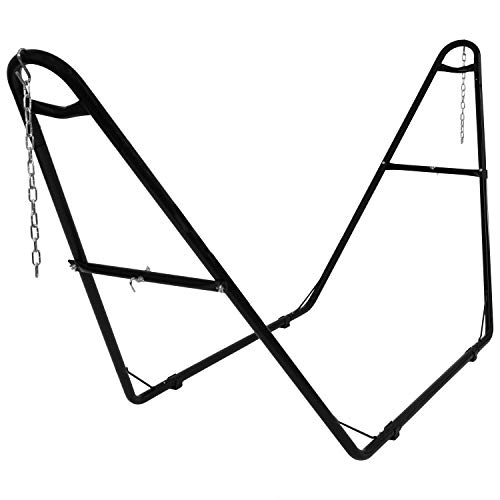
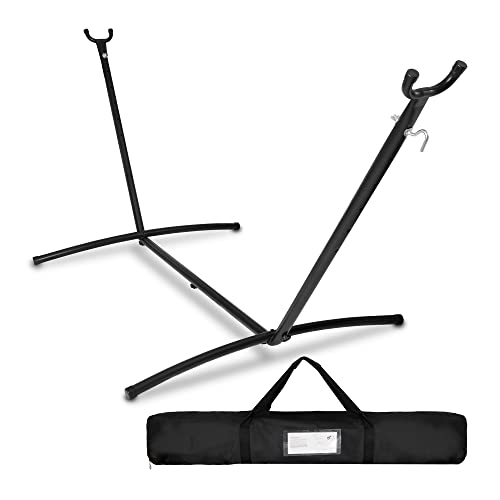

As an Amazon Associate we earn from qualifying purchases at no extra cost to you. Ratings are shown as listed on Amazon.
Best hammocks with stands by situation
| Best for | Recommended type | Typical footprint | Typical capacity | What to prioritize |
|---|---|---|---|---|
| Small patio or apartment | Compact, folding travel hammock stand | About 9–10 ft long × 3–4 ft wide | 300–400 lb | Short storage length, tool-free adjustment, lighter steel |
| Bedroom or indoor lounging | Brazilian cotton or gathered-end hammock with steel stand | About 10–14 ft long × 4–5 ft wide | 350–450 lb | Soft fabric, stable feet, low noise, washable cover |
| Frequent patio use | Quilted polyester or solution-dyed fabric hammock | About 12–14 ft long × 4–5 ft wide | 400–500 lb | UV resistance, quick drying, rust-resistant hardware |
| Camping and travel | Portable camping hammock with lightweight stand | About 9–10 ft long × 3–4 ft wide | 300–400 lb | Packed weight under 25 lb, carry bag, simple pin adjustment |
Capacity figures are maximum advertised loads, not a recommendation to use the stand at its limit. Include the occupants, clothing, blankets, and any movement in your safety margin. For two adults, a set rated at 450 pounds or more is a more sensible starting point than one rated at 300 pounds.
Our top picks
Best all-around: ENO Nomad Hammock Stand with a compatible ENO hammock
The ENO Nomad is a strong choice when one stand needs to serve both a patio and occasional travel. Its adjustable steel frame is designed for gathered-end hammocks, and the length can be changed to accommodate different hammock sizes. A representative setup is roughly 9 feet 6 inches long, about 4 feet 6 inches wide, and rated around 400 pounds, although the exact dimensions depend on the configuration.
Its main advantage is portability rather than maximum compactness. The stand breaks down more easily than a permanent frame, and a compatible ENO hammock can be removed for washing or packed separately. This makes it practical for renters who cannot attach hardware to walls or ceilings. For a bedroom, place it on a rug or furniture pads: steel feet can mark wood flooring, and the frame can shift slightly on smooth surfaces.
Best for: one versatile indoor-outdoor setup, frequent relocation, and buyers who value a recognizable modular system.
Best for bedroom comfort: a Vivere Brazilian Double Cotton Hammock with stand
A Vivere Brazilian Double Cotton Hammock set is better suited to relaxed indoor lounging than to constant exposure to rain and sun. Brazilian-style cotton fabric is soft, flexible, and distributes pressure more evenly than a narrow camping hammock. Many versions pair the hammock with an adjustable steel stand that accepts lengths around 9 to 14 feet and advertise capacities around 450 pounds.
The wide fabric is comfortable for reading or napping, but it has two ownership trade-offs. Cotton absorbs moisture and dries slowly, so it should not be left outside after rain. It can also fade or mildew when stored damp. The stand is usually heavier and less travel-friendly than a minimalist camping frame, but that extra mass helps it feel settled in a bedroom or covered porch.
Best for: indoor use, couples who want a broad lounging surface, and buyers who prioritize softness over weather resistance.
Best for a weather-exposed patio: quilted polyester hammock with an adjustable steel stand
For a patio without a roof, choose a quilted polyester or solution-dyed polyester hammock rather than ordinary cotton. Polyester generally dries faster and handles sunlight better, while a quilted design adds cushioning without requiring a separate pad. Look for powder-coated steel, plastic end caps, and hardware that can be tightened without specialized tools.
A typical patio-oriented set is 12 to 14 feet long, 4 to 5 feet wide, and rated for 400 to 500 pounds. The larger frame needs more clearance than a compact travel stand: allow at least 24 inches beside each side of the stand so the fabric and a reclining person do not strike walls, railings, or plants.
Even outdoor fabric is not maintenance-free. Bring the hammock indoors during storms and winter storage. UV-resistant fabric slows fading; it does not prevent it indefinitely. Covering only the fabric while leaving wet padding attached can trap moisture, so dry every layer separately.
Best for camping and small spaces: a portable hammock stand with a parachute-nylon hammock
A portable stand paired with a parachute-nylon hammock is the best choice when the hammock must fit in a car trunk, closet, or guest room. The fabric is lightweight, dries quickly, and typically packs into an attached or separate pouch. A useful target is a total stand-and-hammock weight below 25 pounds, with a packed length short enough to fit diagonally in your storage area.
The compromise is less furniture-like stability. Lightweight frames can flex more, and narrow feet may be less forgiving on soft soil or uneven flooring. Use the stand only on a firm, level surface and check that every adjustment pin is fully seated. Nylon can also feel warmer and less plush than cotton in a bedroom.
How to compare stand footprints before buying
Measure the available area, then add room for entry and movement. A stand listed as 10 feet long does not mean a 10-by-10-foot room is automatically suitable. You need clear space around the frame, particularly at the hammock’s lowest point.
For a simple fit calculation, measure the open floor length and subtract 2 feet for clearance. If the result is 11 feet, select a stand whose operating range is no more than 11 feet at the intended setting. A 12–14-foot stand forced into a shorter area may leave its feet too close to furniture or walls.
- Small room: aim for a stand 9–10 feet long and 3–4 feet wide.
- Typical bedroom: allow approximately 12 feet of length and 5 feet of width.
- Large patio: a 12–14-foot frame gives a gentler hammock curve and more usable shoulder room.
- Uneven outdoor ground: choose broad feet or adjustable leveling points rather than narrow tubular ends.
Assembly: what “easy setup” should mean
Most freestanding hammock sets use sliding steel sections, spring buttons, or locking pins. Assembly should not require drilling, but it still deserves a careful first setup.
- Lay out every frame section and confirm that the locking pins face outward and are not bent.
- Build the base on a level surface before attaching the hammock.
- Set both ends to the same height and length. Unequal settings can make the fabric twist and shift the load to one side.
- Attach the hammock with moderate slack. The center should sit low enough for a comfortable diagonal position, but not so low that it touches the floor when occupied.
- Apply gradual weight, first with one hand, then by sitting near the center. Do not drop into the hammock.
- Recheck pins, hooks, and end loops after the first few minutes and again after several uses.
A common mistake is hanging the fabric too tightly. A taut hammock creates greater force at the attachment points and can make entry awkward. A gentle curve is normally more comfortable and easier on the stand than a rigid, tight span.
Fabric durability and ownership costs
The fabric usually shows wear before the steel frame. Inspect the body, gathered ends, suspension loops, and sewn seams—not just the visible middle panel. Fraying at an attachment loop is a reason to stop using the hammock immediately.
- Cotton: soft and breathable, but vulnerable to prolonged moisture, mildew, and fading.
- Polyester: better for patios, faster drying, and generally easier to clean.
- Parachute nylon: light and packable, but less cushiony and more sensitive to sharp objects or rough hardware.
- Quilted fabric: comfortable, though padding can retain water and needs extra drying time.
Wash removable fabric according to its care label, usually with mild detergent and without bleach or fabric softener. Air-dry completely before storage. Wipe the frame clean, inspect for rust at joints, and avoid storing any hammock in a sealed container while damp. Replacement fabric is often cheaper than replacing an entire stand, so a system with readily available replacement hammocks can have a lower long-term cost.
Final buying decision
Choose the ENO Nomad style of setup if portability and adjustability matter most. Choose a Vivere-style cotton set for a soft, spacious bedroom hammock. Choose a quilted polyester set for regular covered-patio use, and a lightweight nylon-and-stand combination for travel or very limited storage.
Before ordering, verify four numbers: the stand’s assembled length, its width, the hammock’s usable length, and the manufacturer’s maximum load. Those measurements matter more than decorative fabric, because they determine whether the hammock fits your room, supports its occupants with a safety margin, and remains practical to move and maintain.



Write Your Review
No reviews yet. Be the first to share your experience!