

Key takeaways
- Best for: checked electronics packed with protection, toiletries that might leak, rainy destinations, and families who want wipe-clean interiors.
- Watch first: corner damage, zipper tracks, telescoping handles, and wheels attached directly to the shell.
- Capacity reality: expansion usually adds roughly 5–15% of usable space, but it also increases the risk of exceeding the airline’s depth limit.
Best Checked Luggage for Family Travel
The best checked luggage for family travel is usually a lightweight, expandable 26- to 28-inch suitcase with a durable frame, replaceable wheels, and enough structure to stay below your airline’s size and weight limits; choose hardside for impact protection and easy cleaning, or softside for flexible packing and extra exterior access.
Quick recommendation by family situation
| Family situation | Best choice | Why it fits | Target specifications |
|---|---|---|---|
| One annual vacation on a controlled budget | Basic expandable hardside suitcase | Good protection without paying for premium repair programs | 26–28 inches, 9–12 lb, polypropylene or polycarbonate shell |
| Frequent flyers with children | Premium softside spinner | Flexible capacity, front pockets, and easier organization | 25–27 inches, 7–10 lb, high-denier nylon, replaceable wheels |
| Fragile items or rough baggage handling | Thick polycarbonate hardside | Better resistance to crushing and punctures | 26–28 inches, reinforced corners, dual-layer shell |
| Long trip with bulky clothing | Expandable 28-inch suitcase, used carefully | Offers more volume, but requires strict weighing before departure | 95–120 L unexpanded or expanded, under 62 linear inches |
| Several short trips each year | Lightweight 24- to 26-inch spinner | Less empty weight and easier handling than a large case | 65–90 L, 6.5–9 lb, compact wheel housing |
Hardside versus softside: the family-travel trade-off
Hardside luggage
Hardside cases are the stronger choice when protection, spill resistance, and easy cleaning matter most. A polycarbonate shell can flex under impact and is generally preferable to brittle, inexpensive ABS for repeated travel. Polypropylene is often lighter and more flexible, although the case may feel less rigid.
Our top picks
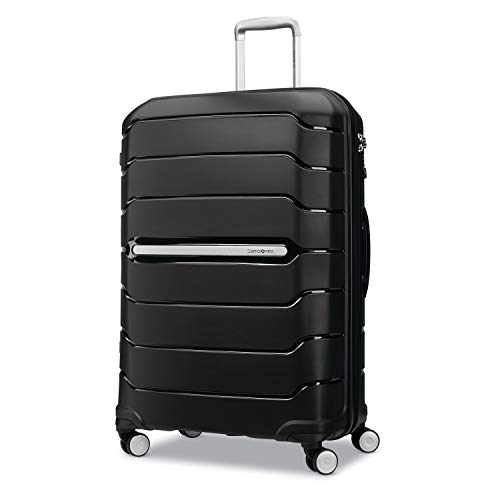


As an Amazon Associate we earn from qualifying purchases at no extra cost to you. Ratings are shown as listed on Amazon.
The main weakness is that hardside luggage gives you little useful compression. An overfilled shell may close only when the zipper or latch is forced, increasing stress on the closure. Shells can also develop scratches, dents, or cracks, particularly around corners and wheel mounts. A textured finish disguises scuffs better than a glossy one.
- Best for: checked electronics packed with protection, toiletries that might leak, rainy destinations, and families who want wipe-clean interiors.
- Watch first: corner damage, zipper tracks, telescoping handles, and wheels attached directly to the shell.
- Capacity reality: expansion usually adds roughly 5–15% of usable space, but it also increases the risk of exceeding the airline’s depth limit.
Softside luggage
Softside cases are usually more forgiving when children bring souvenirs or when clothing needs to be squeezed into irregular spaces. Exterior pockets provide quick access to medications, travel documents, snacks, or a jacket without opening the main compartment. High-denier polyester or ballistic nylon tends to resist abrasion better than thin fashion fabric.
Softside luggage is not automatically less durable. Its fabric can absorb impacts that would crack a shell, and a damaged pocket or panel may be easier to repair. However, fabric can absorb water, collect dirt, and tear if the bag is dragged against rough surfaces. A soft case also offers less protection against crushing.
- Best for: organized family packing, frequent access during travel, flexible capacity, and travelers who value a lighter empty case.
- Watch first: overloaded zippers, torn corner fabric, stretched seams, and wheel housings that catch on curbs.
- Capacity reality: exterior pockets add practical storage, but their contents count toward total weight and may make the case bulge beyond its stated dimensions.
How size and weight affect the airline limit
Many airlines use a checked-bag limit of 62 linear inches, calculated as height plus width plus depth, and a standard weight allowance of 50 pounds for an economy checked bag. Policies differ by airline, route, fare, and frequent-flyer status, so verify the specific rules before buying or packing.
| Suitcase size | Typical usable capacity | Typical empty weight | Practical family use |
|---|---|---|---|
| 24 inches | 60–80 L | 6–9 lb | One adult for a week or one child’s clothing |
| 26 inches | 75–100 L | 7–11 lb | Best all-purpose size for most family trips |
| 28 inches | 95–125 L | 9–14 lb | Long trips, shared packing, and bulky winter layers |
| 30 inches | 110–145 L | 11–16 lb | High capacity, but greater risk of oversize and overweight fees |
These are buying targets rather than universal product specifications. Measure the case from the floor, including wheels and handles, because airlines generally count external dimensions. A nominal “28-inch” suitcase may be compliant or oversized depending on its wheel housing and expansion depth.
A simple weight calculation before you buy
Suppose your airline allows 50 pounds and a family member needs 38 pounds of packed clothing, shoes, toiletries, and souvenirs. A 12-pound suitcase leaves no margin for a scale error or last-minute items. A 7.5-pound case leaves 4.5 pounds more usable allowance:
50 lb allowance − 7.5 lb suitcase = 42.5 lb of packing capacity
That difference is meaningful for a family. Four suitcases that are each 4.5 pounds lighter create 18 pounds of additional allowance without changing the airline’s rules. The trade-off is that very light luggage may use thinner fabric, smaller wheels, or less protective hardware. For frequent travel, a moderate-weight case with robust wheels is often a better ownership choice than the absolute lightest option.
Brands and product lines worth comparing
For hardside luggage, established lines such as Samsonite Freeform, Samsonite Omni PC, Delsey Paris Helium, and Delsey Paris Chatelet Air 2.0 represent different balances of price, shell construction, organization, and styling. Check the exact size and weight of the individual model because specifications vary within each collection.
For softside luggage, Travelpro Maxlite, Travelpro Platinum Elite, Samsonite Solyte, and Briggs & Riley Baseline are recognizable lines to compare. Travelpro’s lighter collections emphasize manageable weight, while premium softside lines typically add stronger hardware, better internal organization, or more comprehensive repair support. Briggs & Riley’s expandable designs are especially useful for travelers who want flexibility, but their higher purchase price makes most sense when the case will be used repeatedly.
Rather than selecting a brand by reputation alone, compare the exact model’s empty weight, expanded depth, wheel replacement policy, warranty exclusions, and handle construction.
Durability details that product descriptions often omit
- Wheels wear before shells do. Two-wheel designs can be sturdy on rough pavement, while four-wheel spinners are easier in airports but expose more hardware to impacts. Look for wheels secured with accessible screws rather than permanently molded assemblies.
- Zippers are load-bearing parts. Expansion should create room, not force the zipper around a bulging case. Leave a little space around the perimeter before closing.
- Handles need side-to-side stability. Extend the telescoping handle and gently move it laterally. A small amount of movement is normal; excessive wobble can become frustrating when the bag is full.
- Warranties have limits. Many luggage warranties cover manufacturing defects but exclude airline damage, normal wear, cosmetic scratches, or overloaded bags. Read the exclusions before treating a warranty as insurance.
- Locks are not theft-proof. A built-in TSA-compatible lock can discourage casual opening, but it does not protect against determined access or prevent damage to the suitcase.
How to pack and maintain checked luggage
- Measure before the first trip. Fill the case as you normally would, expand it if necessary, and measure all three external dimensions.
- Weigh it closed. Use a luggage scale on a level surface. Aim several pounds below the airline maximum if possible, especially with expandable luggage.
- Put dense items near the wheels. Shoes and toiletry bags placed low and centrally improve stability and reduce pressure on the telescoping handle.
- Protect vulnerable corners. Use packing cubes or folded clothing around breakable items rather than relying on the shell alone.
- Clean after each trip. Empty all pockets, vacuum crumbs, wipe hardside shells with mild soap and water, and spot-clean softside fabric according to its care label. Dry the case completely before storing it.
- Store it unexpanded and partly open. This reduces long-term stress on the expansion zipper and prevents trapped moisture or odors.
Bottom line
Choose a 26-inch expandable case for the best balance of capacity, maneuverability, and airline compliance. Select hardside polycarbonate or polypropylene when impact and spill protection matter most; select softside nylon when lighter weight, exterior pockets, and flexible packing matter more. A 28-inch case is worthwhile for long or cold-weather trips only if you can weigh it reliably and keep its expanded dimensions within your airline’s limit.



Write Your Review
No reviews yet. Be the first to share your experience!