

Key takeaways
- Total blanket weight: A 2-pound throw feels noticeably different from an 8-pound one, even if both are called chunky.
- Loop openness: Large gaps provide a lighter, airier drape; compact stitches provide more coverage and warmth.
- Yarn diameter: Jumbo yarn creates the boldest texture, but it also increases snag risk, drying time, and storage volume.
Best Chunky Knit Throw Blankets for Cozy Living
The best chunky knit throw blankets are usually a 50-by-60-inch acrylic or cotton-blend throw for everyday sofa use, a 60-by-80-inch wool or wool-blend blanket for greater warmth, or a smaller 40-by-50-inch throw when you want easy draping and simpler washing.
The right choice depends less on the word “chunky” and more on three specifications: knit weight, yarn material, and finished dimensions. A very thick blanket can look impressive but become difficult to wash, while a large wool blanket may be warm enough for a bed but unnecessarily heavy for an armchair. Use the comparison below to narrow the field before choosing a color or texture.
Our top picks
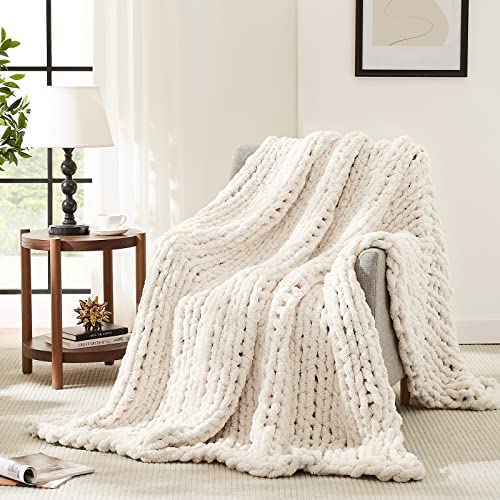


As an Amazon Associate we earn from qualifying purchases at no extra cost to you. Ratings are shown as listed on Amazon.
Quick comparison: which chunky knit throw fits your room?
| Blanket type | Typical dimensions | Approximate weight | Best warmth level | Cleaning practicality | Best use |
|---|---|---|---|---|---|
| Light chunky acrylic | 45 x 55 to 50 x 60 in | 2.0–3.5 lb | Light to medium | Usually easiest; often machine washable | Everyday sofa layering |
| Cotton chunky knit | 50 x 60 to 60 x 80 in | 3.5–6.5 lb | Medium | Washable, but may stretch when wet | Breathable year-round use |
| Wool or wool blend | 50 x 60 to 60 x 80 in | 4.0–8.0 lb | Medium to high | Usually spot-clean or dry-clean; check the label | Cold rooms and winter use |
| Giant chenille or jumbo polyester | 50 x 60 to 60 x 80 in | 5.0–10.0 lb | Medium to high | Can be washable, but bulky in a home machine | Decorative texture and deep lounging |
| Hand-knitted jumbo wool | 40 x 50 to 50 x 60 in | 6.0–12.0 lb | High | Most demanding; often specialist cleaning | Occasional use and statement styling |
These are useful buying ranges rather than universal standards. “Chunky” has no single industry-defined thickness, so compare the actual yarn diameter, loop size, weight, and care label when listings use the same description for very different blankets.
Best choices by situation
Best for an average sofa: 50 x 60 inches, 2 to 5 pounds
A 50-by-60-inch throw is the safest starting point for a two- or three-seat sofa. It covers a seated adult from shoulders to feet without taking over the cushions. Choose acrylic, polyester chenille, or a cotton blend if the blanket will be used several times a week and washed at home.
Look for a knit that is thick enough to resist flattening but not so open that fingers, jewelry, or pet claws catch easily. Medium-weight chunky knits are generally more versatile than jumbo-loop designs: they still create visible texture while folding into a manageable stack.
Best for a large sectional: 60 x 80 inches, 4 to 8 pounds
A sectional needs additional length if the throw is meant to cover legs while you recline. A 60-by-80-inch blanket offers substantially more coverage than a standard sofa throw and can be shared by two people. It also works as a casual top layer at the foot of a twin or full-size bed, although it will not replace a properly sized bed blanket.
For this size, avoid choosing by appearance alone. Measure the available storage space and washing machine drum first. A chunky 60-by-80-inch blanket can occupy roughly two to three times the folded volume of a conventional fleece throw, particularly when made with jumbo yarn.
Best for a cold room: wool or wool blend, 4 to 8 pounds
Wool traps air efficiently and can feel warm without requiring an extremely dense blanket. A wool blend may reduce cost, itchiness, or care demands while preserving some of wool’s insulating character. Choose a tighter knit for warmth and durability; very open loops allow more air movement and work better as decorative layers.
Wool is not automatically the best choice for everyone. It can retain odors less readily than some synthetics, but it may shrink, felt, or lose its shape if washed with hot water or agitated. If frequent machine washing is essential, a washable synthetic or cotton blend is usually the more practical choice.
Best for warm sleepers: cotton or cotton blend, 3 to 6 pounds
Cotton is breathable and has a familiar, less slippery hand feel. It is a good option for heated homes, transitional seasons, and people who want a substantial-looking throw without maximum insulation. The trade-off is weight: cotton absorbs water, so a large wet blanket can become heavy enough to strain a small washer or stretch while hanging.
Dry cotton knits flat whenever the care instructions permit. Hanging a saturated chunky blanket from one edge concentrates the weight and can permanently lengthen the stitches.
Best for decorative styling: 40 x 50 or 50 x 60 inches
A smaller throw is easier to arrange over an armchair, bench, or sofa arm. Jumbo chenille and giant-loop designs work particularly well when visual texture matters more than compact storage. They are less suitable for homes with active pets or rough hardware because the oversized loops have more exposed surface area to snag.
How knit weight changes comfort and ownership
Manufacturers do not always publish knit weight in a consistent way, so use three practical indicators:
- Total blanket weight: A 2-pound throw feels noticeably different from an 8-pound one, even if both are called chunky.
- Loop openness: Large gaps provide a lighter, airier drape; compact stitches provide more coverage and warmth.
- Yarn diameter: Jumbo yarn creates the boldest texture, but it also increases snag risk, drying time, and storage volume.
For ordinary sofa use, approximately 2 to 5 pounds is a comfortable compromise. Move toward 5 to 8 pounds for a large, cold-weather blanket, and treat anything above that as a specialty piece requiring more deliberate handling.
Material head-to-head
| Material | Feel and warmth | Typical strengths | Common drawbacks | Care priority |
|---|---|---|---|---|
| Acrylic | Soft, light to medium warmth | Affordable, colorfast, commonly machine washable | May pill; can build static | Use a gentle cycle and low heat |
| Polyester chenille | Plush, medium to high warmth | Soft texture and strong color range | Can shed fibers or flatten in high heat | Protect the pile; avoid hot drying |
| Cotton | Breathable, medium warmth | Natural feel and good year-round versatility | Heavy when wet; may shrink or stretch | Wash cool and dry flat if possible |
| Wool | Insulating and resilient | Warmth with relatively good shape retention | Can itch, felt, or require specialist care | Follow the label exactly; avoid agitation |
| Blends | Varies by fiber ratio | Can balance softness, durability, cost, and care | Performance is difficult to judge from the word “blend” alone | Check fiber percentages and washing instructions |
A simple sizing calculation before you buy
Measure the sofa seat width and add the amount of side and leg coverage you want. For example, a 72-inch sofa does not need a 72-inch-wide throw: that would be difficult to drape and store. A 50-by-60-inch throw can cover one seated person, while a 60-by-80-inch throw can cover most of the seat and extend over the legs.
For a two-person blanket, estimate about 30 to 36 inches of usable width per person. Two people therefore need approximately 60 to 72 inches of width for comfortable sharing. If the blanket is heavily textured, allow extra room because its loops do not lie as flat as a woven fabric.
Cleaning and durability: what wears first?
The first failure point is often not the yarn itself but the exposed loops along the edges and corners. Repeated pulling can loosen stitches, while sofa friction can flatten chenille or create pills on acrylic. Inspect the binding or edge finish: a reinforced edge is preferable to a raw chain of oversized loops.
- Check the care label before removing packaging or washing the blanket.
- Use a large mesh laundry bag for machine-washable open knits.
- Wash separately or with similarly soft items; zippers and hooks can snag loops.
- Do not wring a wet blanket. Press out water gently and support the full piece.
- Dry flat when the fabric is heavy, elastic, cotton-rich, or loosely knitted.
- Repair a pulled loop promptly with a blunt tapestry needle rather than cutting it.
A home washer may technically fit a large blanket but still fail to clean it effectively if the drum is packed tightly. Leave enough room for the blanket to move freely; if it becomes a dense, immovable bundle when dry, use a larger commercial machine or choose a smaller throw.
Bottom line
Choose a 50-by-60-inch, medium-weight acrylic or cotton-blend throw for the best balance of sofa coverage and easy cleaning. Choose 60-by-80 inches when sharing or covering a sectional, but confirm storage and washer capacity first. Choose wool or a wool blend for concentrated warmth, cotton for breathability, and jumbo chenille for a highly textured decorative look. The best chunky knit throw blankets are the ones whose size, weight, and care requirements match how your household will actually use them—not simply the ones with the thickest-looking stitches.



Write Your Review
No reviews yet. Be the first to share your experience!