

Key takeaways
- Tool-free depth adjustment: Essential for starting shallow and adapting to different grass conditions.
- Replaceable roller or tine cassette: Tines bend and blades wear. A machine with unavailable replacement parts is a poor long-term value.
- Metal rather than thin plastic working components: Metal tines and blades generally tolerate repeated contact better, although they still should not be forced into soil.
- Collection bag: Convenient for small lawns, but it fills quickly in heavy thatch. A side discharge option can be faster if you plan to rake afterward.
- Overload protection: Helpful on electric models when the roller becomes clogged with damp material.
- Foldable handles: A 14-inch machine may still need around 3–5 square feet of floor space when stored upright, depending on handle design.
The best dethatchers for most lawns are adjustable electric machines with a 12–16-inch working width: choose a tine dethatcher for routine maintenance, a blade scarifier for heavy thatch, or a wider model only when your lawn is large enough to justify its extra weight and risk of scalping.
Our top picks



As an Amazon Associate we earn from qualifying purchases at no extra cost to you. Ratings are shown as listed on Amazon.
Best Dethatchers for a Healthier, Thicker Lawn
Thatch is a layer of dead stems, roots, and organic debris between green grass and the soil surface. A thin layer can protect the crown and improve resilience, but a dense layer can restrict water, air, fertilizer, and seed from reaching the soil. The right machine removes enough material to open the surface without stripping healthy turf.
“Dethatcher” describes several different tools. Tine machines comb through the lawn with spring teeth; blade models cut into the thatch layer; and scarifiers use more aggressive fixed blades or cutters. Those designs are not interchangeable, particularly on thin lawns, shallow-rooted grass, or uneven ground.
Quick comparison: tine dethatcher vs. blade scarifier
| Type | Typical working width | Typical power | Best lawn size | Ideal use | Main risk |
|---|---|---|---|---|---|
| Manual tine rake | 14–18 inches | Human-powered | Up to 1,000 sq. ft. | Small patches, tight edges, occasional work | Slow and physically demanding |
| Electric tine dethatcher | 12–16 inches | 10–15 amps | 1,000–8,000 sq. ft. | Routine thatch removal and seasonal maintenance | Can pull loose turf when set too deep |
| Battery tine dethatcher | 12–14 inches | 18–80 volts, depending on system | 1,000–5,000 sq. ft. per charge | Small to medium lawns without a power outlet | Runtime falls in thick, damp thatch |
| Electric scarifier | 12–16 inches | 12–15 amps | 2,000–10,000 sq. ft. | Dense thatch and neglected lawns | Scalping, bare strips, and root damage |
| Petrol scarifier | 16–19 inches | 3–5 horsepower | 8,000+ sq. ft. | Large lawns or frequent professional-style work | Heavier, louder, and more maintenance-intensive |
These are useful buying ranges rather than universal specifications. Actual coverage depends on grass density, cutting depth, operator pace, battery capacity, and how many passes the lawn needs.
Which type is right for your lawn?
Choose a tine dethatcher for routine maintenance
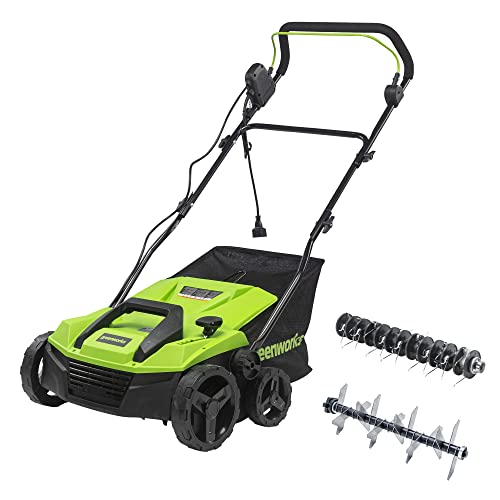
Spring tines are the safest starting point for most homeowners. They flex when they meet firm soil, lift loose dead material, and are less likely than fixed blades to gouge the ground. An electric tine machine such as the Sun Joe AJ801E is a familiar example of this category, while battery-powered models from brands such as Greenworks provide a cordless alternative.
Look for several height settings, a working width around 14–16 inches, a removable collection bag, and replacement tines that can be purchased separately. Adjustable depth matters more than a large motor because the shallowest setting lets you begin conservatively.
Tines are appropriate when the thatch layer is relatively light, the lawn still has good green coverage, and you plan to dethatch every year or two. They are also more forgiving on lawns with minor bumps.
Choose a blade scarifier for thick, compacted thatch
Scarifiers use rigid blades that cut vertically into the surface. They are better at breaking through a stubborn layer that a flexible tine cassette merely skims. Some machines, including certain models sold as two-in-one lawn scarifiers and aerators, accept both a tine roller and a scarifying roller.
Use the blade setting only when you can see a substantial mat at the soil line or when water is visibly running off instead of soaking in. Begin with the blades barely contacting the surface. A second shallow pass is usually safer than one deep pass.
A scarifier is not a substitute for a core aerator. It removes or cuts organic material near the surface; it does not extract deep soil plugs. If the main problem is compacted clay beneath the thatch, scarifying alone will not solve it.
Use a manual rake for small or delicate areas
A thatching rake is inexpensive, easy to store, and gives excellent control around trees, roots, edging, and newly repaired patches. It is practical for a lawn under roughly 1,000 square feet, but tiring on larger areas. For a small garden, the lower purchase cost may outweigh the speed of a powered machine.
Decision matrix: match the machine to the job
| Your situation | Best choice | Why | What to avoid |
|---|---|---|---|
| Small lawn, once-a-year use | Manual rake or compact electric tine model | Lower storage and ownership cost | Petrol scarifier |
| Medium lawn with light thatch | 14–16-inch electric or battery tine dethatcher | Good balance of control and coverage | Fixed blades at maximum depth |
| Dense thatch and poor water penetration | Adjustable scarifier, preferably with a tine roller too | More effective cutting and flexible follow-up | A tine-only machine with no depth adjustment |
| Large, open lawn used frequently | Wide petrol or high-capacity electric scarifier | Fewer passes and sustained power | Small battery model with limited runtime |
| Uneven lawn or inexperienced operator | Light tine dethatcher with multiple height settings | Less likely to dig into high spots | Heavy fixed-blade machine |
How to avoid scalping the lawn
Scalping happens when the machine removes living crowns and growing points instead of just lifting thatch. It is most common when the roller is set too low, the ground is uneven, the lawn is stressed, or the operator moves too slowly.
- Confirm the lawn needs dethatching. Cut a small square of turf and inspect the brown layer between the grass and soil. If it is under about half an inch, aggressive scarifying may be unnecessary.
- Mow slightly shorter than usual. Do not scalp the grass before dethatching. A modestly reduced height helps the tines reach the thatch evenly.
- Work when the soil is lightly moist. Bone-dry soil makes the machine bounce; saturated soil tears turf and compacts easily.
- Start at the highest setting. Make a test pass in an inconspicuous area. The machine should remove brown debris while leaving most crowns rooted.
- Overlap passes by about 1–2 inches. This prevents untreated ribbons without forcing multiple deep passes.
- Change direction only if necessary. A second pass at 90 degrees can improve removal, but it also increases stress. Use it only where the thatch remains heavy.
- Rake up the debris promptly. Leaving a thick layer of loosened material on top can block light and air.
For a 4,000-square-foot lawn, a 14-inch machine covers about 1,167 linear feet in one pass: 4,000 divided by 14/12. At an average walking speed of 2 feet per second, that is roughly 10 minutes of actual forward travel, but turning, emptying the bag, overlapping passes, and difficult patches can easily double the working time. This is why a wider machine helps on open lawns but does not automatically make the job easier.
Features worth paying for
- Tool-free depth adjustment: Essential for starting shallow and adapting to different grass conditions.
- Replaceable roller or tine cassette: Tines bend and blades wear. A machine with unavailable replacement parts is a poor long-term value.
- Metal rather than thin plastic working components: Metal tines and blades generally tolerate repeated contact better, although they still should not be forced into soil.
- Collection bag: Convenient for small lawns, but it fills quickly in heavy thatch. A side discharge option can be faster if you plan to rake afterward.
- Overload protection: Helpful on electric models when the roller becomes clogged with damp material.
- Foldable handles: A 14-inch machine may still need around 3–5 square feet of floor space when stored upright, depending on handle design.
Ownership costs and maintenance
Electric tine dethatchers commonly fall in the general market range of about $100–$250, battery models around $150–$350 before considering the battery system, and larger scarifiers roughly $250–$700. Petrol machines usually cost more to buy and maintain, but their wider rollers and continuous fuel supply suit large lawns.
The working roller is the first part likely to wear. Inspect spring tines for stretching, missing coils, and uneven length. On blade rollers, check for rounded edges, cracks, and bent shafts. Disconnect the power source before clearing wrapped grass, and never reach into a jammed roller while it can move.
After each use, brush away damp debris, allow the housing to dry, and keep ventilation openings clear. Do not spray water directly at the motor, battery compartment, or electrical connections. Store metal components dry; a light protective coating on exposed steel can reduce rust during long storage. Before the next season, check the power cord, handle fasteners, wheels, and height mechanism.
Final buying advice
For the broadest range of lawns, buy an adjustable 14–16-inch electric tine dethatcher with replaceable tines. Select a battery version when cord management is awkward and your lawn fits within the manufacturer’s realistic runtime. Move to a scarifier when the thatch is genuinely dense, and choose a petrol machine only when lawn size and repeated use justify its weight, noise, fuel, and maintenance.
The most powerful machine is not automatically the best dethatcher. The best choice is the one that can remove the unwanted layer at a shallow, controllable setting while leaving healthy grass rooted in place.





Write Your Review
No reviews yet. Be the first to share your experience!