

Key takeaways
- Best beginner tenor: Yamaha YSL-354, a durable .500-inch-bore instrument with a dependable reputation and manageable resistance.
- Best step-up tenor: Yamaha YSL-448G or a comparable medium-bore tenor with an F attachment for broader repertoire.
- Best versatile professional tenor: Bach 42 or Conn 88H, both large-bore F-attachment designs used for orchestral, concert-band, and advanced ensemble playing.
- Best jazz-focused choice: King 3B or another .481- to .491-inch small-bore tenor, chosen for quick response and a focused sound.
- Best advanced low-brass option: A dependent or independent bass trombone with dual valves, commonly using a .562-inch bore and a larger bell.
- Best value strategy: Buy the best-maintained used instrument you can find from a reputable repair shop rather than choosing a cheaper new trombone with poor slide alignment.
The best trombones for beginners are usually small-bore or medium-bore models with a responsive slide, while advanced players can choose a large-bore tenor, F-attachment, bass trombone, or specialist instrument to match repertoire and sound goals.
Our top picks


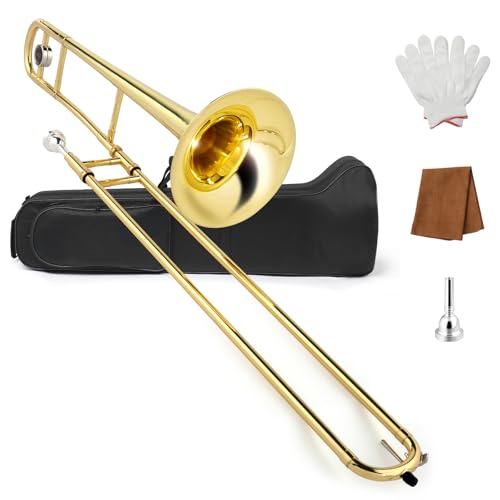

As an Amazon Associate we earn from qualifying purchases at no extra cost to you. Ratings are shown as listed on Amazon.
Quick picks by player and situation
- Best beginner tenor: Yamaha YSL-354, a durable .500-inch-bore instrument with a dependable reputation and manageable resistance.
- Best step-up tenor: Yamaha YSL-448G or a comparable medium-bore tenor with an F attachment for broader repertoire.
- Best versatile professional tenor: Bach 42 or Conn 88H, both large-bore F-attachment designs used for orchestral, concert-band, and advanced ensemble playing.
- Best jazz-focused choice: King 3B or another .481- to .491-inch small-bore tenor, chosen for quick response and a focused sound.
- Best advanced low-brass option: A dependent or independent bass trombone with dual valves, commonly using a .562-inch bore and a larger bell.
- Best value strategy: Buy the best-maintained used instrument you can find from a reputable repair shop rather than choosing a cheaper new trombone with poor slide alignment.
What matters most when choosing a trombone
Bore size: response versus power
Bore is the inside diameter of the tubing. It strongly affects resistance, volume, tone, and how much air the instrument requires.
- Small bore, approximately .481 to .500 inches: Responds quickly, feels relatively easy to center, and suits jazz, beginner study, marching, and lighter ensemble parts. It generally produces a more focused sound.
- Medium bore, approximately .508 to .525 inches: Offers a useful middle ground for students moving into concert band, musical theater, and mixed ensemble work.
- Large bore, approximately .547 inches: Produces a fuller, darker sound and greater projection. It demands more controlled air and may feel tiring for a new player.
- Bass bore, approximately .562 inches: Supports low-register playing and a large sound, but requires substantially more breath, physical control, and familiarity with valves.
A larger bore is not automatically “better.” A beginner who cannot maintain steady airflow on a large-bore instrument may play more freely and in tune on a well-made small-bore trombone.
Slide type and F attachments
A standard tenor trombone has a single slide and no valve. This is often the simplest design for learning position accuracy, embouchure, and breath control.
An F attachment adds tubing activated by a thumb trigger. It extends the instrument’s low range, provides alternate slide positions, and makes some passages more practical. The extra tubing also adds weight and resistance. A closed-wrap F attachment usually keeps the tubing compact, while an open-wrap design often offers a more direct airflow path but can expose more tubing and feel less compact.
For a first instrument, an F attachment is useful when the student is committed to concert band, orchestra, or advanced study, but it is not essential for basic instruction. Bass trombones commonly use two valves. Independent valves give more fingering options than dependent valves, but they add cost, weight, and mechanical maintenance.
Materials and construction
Most trombones use yellow brass for the main tubing and bell. Gold brass contains more copper and can give a warmer visual appearance and, depending on the design, a somewhat broader tonal character. Sterling-silver bells and other specialty materials are available, but they should be treated as tone and response choices rather than automatic upgrades.
The slide is the part where manufacturing quality matters most. Precise inner and outer tubes, straight alignment, smooth stockings, and properly fitted slide crooks have a larger effect on playability than decorative finishes. Lacquer protects the brass from handling and oxidation; unlacquered instruments can develop a different appearance over time and require more diligent wiping.
Best trombones compared by specifications
| Instrument type or example | Typical bore | Typical bell | Approximate weight | Best suited to | General new-price range |
|---|---|---|---|---|---|
| Student small-bore tenor, such as Yamaha YSL-354 | .500 in | About 8 in | 7.5–8.5 lb | Beginners, school band, marching, general study | $700–$1,200 |
| Medium-bore tenor with F attachment, such as Yamaha YSL-448G | About .525 in | About 8.5 in | 8.5–10 lb | Students entering advanced concert-band repertoire | $1,400–$2,400 |
| Large-bore tenor with F attachment, such as Bach 42 | .547 in | About 8.5 in | 9–10.5 lb | Advanced band, orchestra, chamber playing | $2,500–$4,500 |
| Large-bore tenor with F attachment, such as Conn 88H | .547 in | About 8.5 in | 9–10.5 lb | Players wanting a broad orchestral sound | $2,500–$4,500 |
| Small-bore jazz tenor, such as King 3B | About .481 in | About 7.4 in | 7–8.5 lb | Jazz, lead parts, commercial playing | $1,800–$3,500 |
| Bass trombone with dual valves | About .562 in | 9.5–10.5 in | 11–13 lb | Advanced low-brass and orchestral repertoire | $3,500–$7,000 |
Weights vary with bell material, slide design, braces, valve configuration, and case choice. Treat these figures as comparison estimates rather than specifications for every individual example.
Which trombone fits your playing style?
For a first-year student
Choose a .500-inch small-bore tenor with a straight slide, such as the Yamaha YSL-354 or a comparable student model from a reputable manufacturer. The lighter setup helps a player learn slide positions without managing unnecessary valve weight. A straight tenor is also easier to inspect, clean, and repair.
If the student is already committed to orchestra or advanced concert band and has instruction available, a medium-bore instrument with an F attachment may be a sensible longer-term purchase. It should not be selected solely because it has more features.
For jazz and commercial music
A King 3B-style small-bore tenor is a strong starting point for players who prioritize immediate response, articulation, and a centered sound. A smaller bell and bore can make upper-register phrasing feel agile. Players who need both jazz flexibility and a bigger section sound may prefer a medium-bore instrument, accepting a little more resistance.
For concert band and orchestra
A .547-inch large-bore tenor with an F attachment, such as the Bach 42 or Conn 88H, is the conventional advanced choice. These instruments support a broad, blended sound and provide useful low-register alternatives. They are less forgiving of shallow breathing or an unstable embouchure, so a trial session with a teacher is worthwhile before buying.
For bass trombone
Move to a bass trombone only when the music and instruction justify it. The larger mouthpiece, dual valves, heavier case, and increased air demand make it a specialized instrument rather than a natural upgrade from every tenor. Check whether the school, ensemble, or teacher expects an independent or dependent valve system.
Price tiers and the cost of ownership
- Under $700: Primarily entry-level instruments. Quality varies widely, especially in slide alignment and valve reliability. A shop inspection is important.
- $700–$1,500: The most practical range for a dependable beginner tenor, including established student models and carefully selected used instruments.
- $1,500–$3,500: Strong territory for intermediate, jazz, and some professional-style instruments. Condition can matter more than age.
- $3,500 and above: Professional tenors, bass trombones, specialty bells, and custom configurations. Pay for a specific sound or mechanical benefit, not just a higher price.
Budget separately for a case, mouthpiece, slide lubricant, cleaning rod, flexible snake, and a stand. A simple maintenance kit may cost $30–$80, while professional slide repair or valve work can cost considerably more. A $2,000 trombone that needs a $400 slide overhaul may be a worse purchase than a $2,300 instrument in excellent condition.
How to inspect a trombone before buying
- Extend the slide fully and listen. It should move smoothly without scraping, catching, or producing a gritty sensation.
- Check the stockings and tubes under bright light. Deep dents, worn plating, red rot, or corrosion near the lower tube can lead to expensive repairs.
- Test every slide position. Have a player or teacher check whether notes center consistently; a slide that feels smooth but is badly aligned can still cause intonation problems.
- Operate the trigger or valves repeatedly. The mechanism should return quickly and quietly. Listen for air leaks around valve casings and tubing joints.
- Inspect braces and solder joints. Loose braces may rattle, while fresh-looking solder can indicate previous damage repair.
- Compare it with the player’s case and transport needs. A bass trombone or open-wrap tenor may not fit a compact case, car, or school locker as easily as a straight student model.
Maintenance mistakes that shorten a trombone’s life
Clean the slide regularly because dried lubricant and dust act like abrasive paste. Use the product recommended for the slide rather than household oil, which can contaminate surfaces and attract debris. Run a cleaning snake through the tuning slide and main tubing periodically, then rinse and dry the instrument according to the manufacturer’s guidance.
Never force a stuck slide. Pulling aggressively can bend the tubes and turn a minor cleaning problem into a professional repair. Do not rest the trombone on its slide, leave water inside the case, or place the mouthpiece in by striking it with the hand. These habits cause dents, alignment issues, and avoidable wear.
Final buying recommendation
For most beginners, the best trombone is a well-aligned .500-inch student tenor such as the Yamaha YSL-354. Jazz players should consider a King 3B-style small-bore instrument, while advanced concert and orchestral players should compare the Bach 42 and Conn 88H by sound, resistance, and slide feel. Choose a bass trombone only for a genuine low-brass need. Across every price tier, a straight, smooth slide and reliable valves matter more than an impressive feature list.




Write Your Review
No reviews yet. Be the first to share your experience!