

Key takeaways
- Length: add at least 2 inches to the rifle’s overall length. Add more if the foam layout requires a muzzle pocket or if the rifle has protruding controls.
- Height: add 1–2 inches above the tallest optic or sight. A large scope with exposed turrets may need more.
- Width: allow room for the bolt handle, charging handle, magazine, bipod legs, and sling swivels.
- Depth: compare the manufacturer’s usable interior depth, not the outside case thickness.
The best rifle cases are hard cases for maximum protection and security, while soft cases are the better choice for short vehicle trips, light carry, and limited storage space; the right pick depends on your rifle’s actual length, optic height, padding needs, and transport conditions.
Our top picks
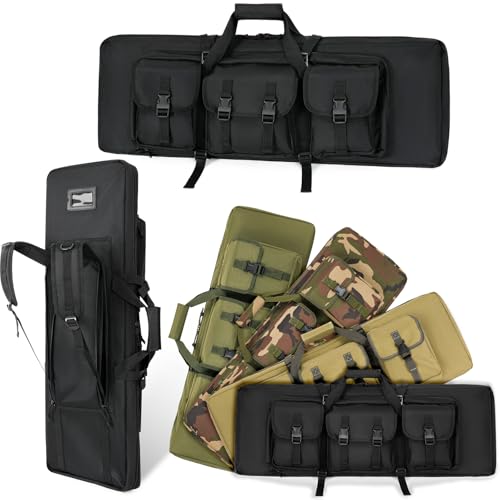


As an Amazon Associate we earn from qualifying purchases at no extra cost to you. Ratings are shown as listed on Amazon.
Quick picks by situation
| Situation | Best case type | Useful target specifications | Why it fits |
|---|---|---|---|
| Frequent airline or rough vehicle transport | Watertight hard case | 48–54 in. interior length, 5–7 in. interior depth, 25–40 lb | Protects against impact, crushing, dust, and moisture |
| Range trips by car | Padded soft case | 42–52 in. length, 600–1,000 denier fabric, 1–2 in. padding | Lower weight and easier carrying at a lower price |
| Scoped bolt-action rifle | Long hard case or purpose-built scoped case | At least 2 in. extra length and 2 in. clearance above the optic | Prevents the scope from pressing against the lid |
| Multiple rifles or accessories | Double-rifle hard or soft case | Two padded compartments and 4–6 accessory pockets | Consolidates equipment without stacking rifles together |
| Small apartment or occasional use | Foldable padded soft case | 40–48 in. length, removable divider, lockable zippers | Stores more easily and costs less to own |
Hard versus soft rifle cases
Hard cases: the safer choice for serious transport
A hard rifle case uses a rigid shell—commonly molded polymer, reinforced plastic, or aluminum—to resist impact and compression. Quality models such as the Pelican Vault series, Pelican Protector cases, SKB iSeries cases, and Plano All Weather cases are designed around this approach. Their value is not simply that they are “strong”; it is that they maintain a protective air gap around the rifle.
Look for convoluted or customizable foam in the lid, a dense lower foam layer, and a base deep enough for the rifle, optic, and controls. Pick-and-pluck foam is convenient, but it should be cut carefully. Removing too much material can leave unsupported areas that allow the rifle to move during transport. Custom closed-cell foam offers better long-term resilience, although it costs more.
Hard cases are usually the better choice for air travel, long-distance trips, truck beds, wet climates, and rifles with expensive optics. Their drawbacks are weight, bulk, and storage space. A large hard case can weigh more than the rifle inside it, and wheels or handles become important once the loaded case exceeds roughly 30 pounds.
Soft cases: practical for ordinary range use
Soft cases are made from nylon, polyester, canvas, or similar fabric over foam padding. Savior Equipment, Allen, Bulldog, and comparable manufacturers offer single- and double-rifle designs in several lengths. The best versions use thick padding, reinforced seams, wide carry straps, lockable zipper pulls, and a muzzle or buttstock end that is protected from abrasion.
A soft case is convenient when you carry the rifle from a home to a vehicle and then from the parking area to a firing line. It folds or hangs more easily than a hard case and normally costs less. It is not, however, a substitute for a rigid shell when luggage may be stacked on top of it or when the case will be exposed to heavy rain, mud, or repeated impacts.
Fabric water resistance is also easy to misunderstand. A water-resistant exterior may shed light rain, but zipper seams and stitching can still admit water. If the case will sit in a damp vehicle or on wet ground, use a waterproof hard case or add a separate rain cover and keep the rifle in a moisture-absorbing environment.
How to size a rifle case correctly
Measure the rifle as it will travel. Include the muzzle device, buttpad, bipod, cheek riser, and any stock adjustment. Measure the height from the lowest point of the stock to the highest point of the optic, not merely the receiver height. Then use these allowances:
- Length: add at least 2 inches to the rifle’s overall length. Add more if the foam layout requires a muzzle pocket or if the rifle has protruding controls.
- Height: add 1–2 inches above the tallest optic or sight. A large scope with exposed turrets may need more.
- Width: allow room for the bolt handle, charging handle, magazine, bipod legs, and sling swivels.
- Depth: compare the manufacturer’s usable interior depth, not the outside case thickness.
For example, a 44-inch rifle with a scope that reaches 3.5 inches above the stock should not be placed in a case advertised as “44 inches long” unless its interior dimensions and foam arrangement provide clearance. A safer target is about 46 inches of usable length and at least 5.5 inches of interior height, with the optic seated in a shaped or relieved section of foam.
Head-to-head comparison of common case options
| Case category | Typical usable interior | Typical weight | Weather resistance | Locking and carry features | Best use |
|---|---|---|---|---|---|
| Compact padded soft case | 40–44 × 9–11 in.; 1–2 in. padding | 3–7 lb | Light rain resistance | Two zipper pulls, shoulder strap, small pocket | Short trips with compact rifles |
| Long padded soft case | 46–54 × 10–12 in.; 1–2 in. padding | 5–10 lb | Light to moderate rain resistance | Backpack straps, accessory pockets, lockable zippers | Frequent range use |
| Double soft case | Two compartments, commonly 46–54 in. long | 8–15 lb | Usually water-resistant, not waterproof | Backpack carry and multiple pockets | Two rifles and shared equipment |
| Polymer hard case | 46–54 × 13–16 × 5–7 in. | 18–35 lb | Often gasketed and dust-resistant; model-dependent | Padlock holes, multiple latches, handles; some have wheels | Vehicle, airline, and harsh-weather transport |
| Aluminum hard case | Commonly 45–52 × 12–15 × 3–6 in. | 10–22 lb | Varies; seams may not be watertight | Key or combination latches, rigid handles | Light-duty protection and organized storage |
These are category ranges rather than specifications for every model. Always confirm the manufacturer’s interior measurements, because exterior length can include wheels, hinges, handles, and shell thickness.
Locks, handles, and weather protection
A lockable zipper is useful for preventing casual access, but it offers little impact protection. For stronger security, choose a hard case with two or more steel-reinforced padlock points. The case itself should remain closed if one latch is damaged. Follow applicable federal, state, and local transport rules; a case’s locking hardware does not by itself determine whether a particular transport method is legal.
Check the handle attachment points before buying. Sewn webbing should be reinforced with box-and-cross stitching, while hard cases should have handles secured to the shell rather than thin trim. Backpack straps are valuable for long walks but can snag in vehicle trunks. Wheels help with heavy cases, although small wheels perform poorly on gravel and uneven ground.
For wet conditions, a gasketed hard case with over-center latches provides the most reliable barrier. After exposure to rain, open the case and dry both the case interior and the rifle. Do not store a damp rifle in a closed case: condensation can remain trapped around the action, optic mounts, and metal fasteners.
Ownership costs and maintenance that matter
Price is only part of the decision. A basic soft case may cost about $30–$90, a better double soft case about $80–$180, and a substantial polymer hard case roughly $150–$400 or more depending on size, foam, and wheels. Specialized custom foam can add substantially to the initial cost.
Consider a $120 soft case used twice each month for four years: 96 uses make the case cost about $1.25 per use before replacement parts. A $280 hard case used once a month for the same period costs about $5.83 per use, but may prevent damage that would be far more expensive than the difference. The hard case is easier to justify when the rifle has a costly optic or travels in shared luggage areas.
- Vacuum or brush grit from foam and zipper tracks before closing the case.
- Lubricate zipper sliders sparingly with a product intended for zippers; excess lubricant attracts dust.
- Inspect foam compression, torn stitching, loose handles, cracked hinges, and damaged gaskets several times a year.
- Replace crushed or permanently flattened foam rather than relying on a thin layer that no longer holds the rifle in place.
- Use desiccant only as a supplement, not as a reason to seal a wet rifle inside the case.
Bottom line
Choose a padded soft case if you make short, controlled vehicle trips and value low weight, quick access, and easy storage. Choose a gasketed polymer hard case if the rifle will face air travel, rough handling, rain, stacking, or long-term storage. In either category, fit is more important than branding: measure the rifle with its optic and accessories installed, compare usable interior dimensions, and make sure the rifle cannot shift, press against the lid, or contact the case hardware during transport.



Write Your Review
No reviews yet. Be the first to share your experience!