

Key takeaways
- Straps and buckles: Constant ultraviolet exposure makes webbing brittle before the main fabric fails. Replacement straps are often inexpensive and can extend the cover’s useful life.
- Seams and corners: These areas experience the most tension. Rounded furniture corners or protective corner pads reduce abrasion.
- Waterproof coating: Repeated folding while damp can encourage peeling or sticky areas. Dry the cover completely before storage.
- Vent mesh: Small mesh panels can tear if pulled during removal. Lift the cover rather than dragging it over the furniture.
- Elastic: Elastic hems gradually lose tension. A drawcord can keep an older cover secure, but severe fabric cracking is a replacement signal.
Best Patio Furniture Covers for Year-Round Protection
The best patio furniture covers are made from solution-dyed polyester or heavy-duty fabric with a waterproof backing, UV resistance, breathable vents, and adjustable fasteners that hold the cover below the furniture frame rather than relying on elastic alone.
The right choice depends less on the advertised fabric weight than on accurate measurements, drainage, wind exposure, and how often you remove the cover. A low-cost cover can work well on a sheltered balcony, while exposed year-round furniture usually needs reinforced seams, a stronger fastening system, and enough room for airflow.
Our top picks


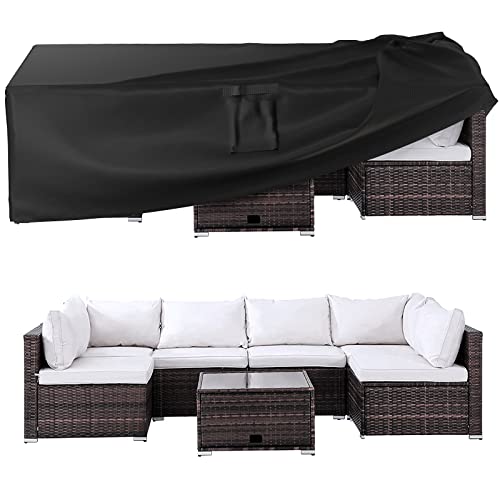

As an Amazon Associate we earn from qualifying purchases at no extra cost to you. Ratings are shown as listed on Amazon.
Best patio furniture covers by situation
| Situation | Best cover type | Useful specifications | Why it fits |
|---|---|---|---|
| Budget protection on a covered balcony | Lightweight polyester cover | 300D fabric, waterproof backing, 1–2 vents, 1-year limited warranty | Low cost and easy to remove frequently; the balcony provides some shelter from wind and rain. |
| Open, windy patio | Heavy-duty fitted cover | 600D polyester, taped or bound seams, four to six buckles, drawcord hem | Multiple anchor points reduce billowing and abrasion against furniture corners. |
| Dining table and six chairs | Table-and-chair set cover | Approximately 120–140 inches long, 70–90 inches wide, 28–32 inches high | One cover is faster than covering every chair separately, provided the chairs remain pushed in. |
| Sectional sofa | Modular sectional covers | Separate left, right, armless, ottoman, or corner pieces; 500D–600D fabric | Several smaller covers shed water more reliably and are easier to lift than one oversized sheet. |
| Infrequently used furniture in winter | Heavy-duty cover with vents and storage bag | 600D or higher, UV-resistant coating, six-month or longer storage period | Better suited to prolonged sun, moisture, and temperature changes. |
What separates a durable cover from a disposable one
Waterproof fabric and seam construction
Most outdoor covers use polyester, often labeled by denier. A 300D cover is lighter and easier to fold; 600D fabric is thicker and usually better at resisting abrasion from chair edges, wind movement, and repeated handling. Denier is not a complete quality measure, because coating and stitching matter just as much.
Look for a waterproof polyurethane or PVC backing and seams that are taped, bound, or double-stitched. A fabric can resist rain while its needle holes allow water through at the seams. Water-resistant covers may be adequate for occasional showers, but year-round protection calls for a waterproof construction with a sloped top so puddles do not sit on the fabric.
UV resistance
Sunlight gradually breaks down both fabric fibers and waterproof coatings. A UV-resistant cover should identify UV treatment or a weather-resistant coating rather than simply using the word “outdoor.” Dark colors can absorb more heat, while pale covers may show dirt quickly; either can work if the material is properly stabilized.
UV protection does not mean the cover will last indefinitely. The top panel and folded edges normally fade and weaken first, especially on furniture exposed to full afternoon sun. Rotating the cover occasionally and keeping it clean can reduce concentrated wear.
Ventilation without sacrificing rain protection
Vents are essential because trapped humid air can produce condensation beneath a supposedly waterproof cover. Mesh-lined vents placed near the sides allow air to escape while limiting direct rain entry. Two vents may be sufficient for a small chair or bistro table; a large sectional or dining set benefits from several vents on opposing sides.
Avoid sealing furniture completely with plastic sheeting. Without airflow, moisture can remain against cushions, wooden surfaces, and metal fasteners. Covers should also be fitted over dry furniture, not used to hide wet cushions after a storm.
Fastening systems
Elastic hems provide a basic fit, but they are not enough in a windy location. The most dependable combination is an adjustable drawcord around the lower hem plus buckles or click-close straps that pass underneath the furniture. Straps should be positioned where they will not rub continuously against a sharp frame.
Hook-and-loop tabs are convenient for light use but collect dirt and lose grip over time. Metal grommets can accept a cable or bungee cord, although a cord should never be tightened so aggressively that it cuts into the fabric. For an exposed patio, choose at least four fastening points for a table cover and additional points for long sectional covers.
How to measure for a proper fit
Measure the furniture in its normal covered arrangement, including chair backs, armrests, table legs, and any raised umbrella hole. Record length, width, and height at the widest and tallest points.
- Measure length and width. For a rectangular table, measure from the outermost edge on one side to the outermost edge on the other.
- Measure height. Measure from the ground to the highest furniture point. Include chair backs if the chairs stay beneath the table.
- Add modest clearance. Add about 2–4 inches to each horizontal dimension and about 1–2 inches to height for a fitted cover.
- Allow for shape. Choose a sectional, round, oval, or sofa-specific cover when possible. A rectangular cover draped over a round table creates loose corners that catch wind.
- Check the hem position. The lower edge should reach near the bottom of the frame but should not drag across a wet deck or patio.
For example, if a table-and-chair arrangement measures 84 inches long, 62 inches wide, and 29 inches high, a practical target is approximately 88–90 inches long, 66–70 inches wide, and 30–32 inches high. A much larger cover may appear generous but can balloon in wind and rub against the ground.
Head-to-head: one large cover or several smaller covers?
One cover for a complete dining set
A single cover is faster to install and keeps the chairs grouped together. It is usually the best option when the chairs remain around the table and the set sits in a moderately sheltered area. The drawbacks are weight, awkward handling, and a greater chance of water pooling across the broad top surface. Push chairs fully under the table and use the included straps underneath the set.
Individual covers for chairs and table
Separate covers usually fit better and are easier to remove for frequent use. They also prevent one wet cover from transferring moisture across an entire furniture set. The trade-off is more seams, more storage pieces, and more opportunities for individual covers to blow away.
One cover for a sectional
A single sectional cover has a clean appearance and fewer gaps, but it can be difficult to position without dragging it across the floor. It also creates large unsupported areas where rainwater can collect. Use furniture risers or a small, smooth support under broad low spots only if the manufacturer permits it, and avoid creating sharp pressure points.
Modular covers for a sectional
Modular covers generally provide the most reliable fit. They follow the separate furniture pieces, reduce sagging, and make daily access easier. Select covers with overlapping edges where modules meet, and secure every section independently in windy conditions.
Ownership realities: what wears first
- Straps and buckles: Constant ultraviolet exposure makes webbing brittle before the main fabric fails. Replacement straps are often inexpensive and can extend the cover’s useful life.
- Seams and corners: These areas experience the most tension. Rounded furniture corners or protective corner pads reduce abrasion.
- Waterproof coating: Repeated folding while damp can encourage peeling or sticky areas. Dry the cover completely before storage.
- Vent mesh: Small mesh panels can tear if pulled during removal. Lift the cover rather than dragging it over the furniture.
- Elastic: Elastic hems gradually lose tension. A drawcord can keep an older cover secure, but severe fabric cracking is a replacement signal.
Clean covers with a soft brush, lukewarm water, and mild soap. Avoid bleach, abrasive cleaners, pressure-washing, and machine drying unless the care label specifically allows them. Rinse thoroughly so detergent does not attract dirt, then air-dry the cover away from intense direct sun.
Common buying and installation mistakes
- Buying by furniture category alone instead of comparing actual measurements.
- Choosing a cover so large that the hem rests on the ground and acts like a sail.
- Covering wet cushions and trapping moisture underneath.
- Using a waterproof cover with no vents in a humid climate.
- Leaving sharp table corners or exposed hardware pressed against the fabric.
- Securing only the top instead of fastening the lower hem beneath the furniture.
- Storing the cover while damp or folded with grit inside.
Bottom line
For most exposed patios, choose a 500D–600D polyester cover with a waterproof backing, UV treatment, mesh-lined vents, reinforced seams, a drawcord, and several under-furniture buckles. Choose a lighter 300D cover for sheltered spaces and frequent removal, or use modular covers when a sectional’s shape makes one large cover loose and difficult to secure. The best patio furniture covers are not necessarily the thickest or largest; they are the ones that fit closely, allow controlled airflow, shed water without pooling, and stay anchored without rubbing against the furniture.




Write Your Review
No reviews yet. Be the first to share your experience!