

Key takeaways
- Powder-coated steel: A strong all-purpose option. Inspect edges and screw points for chips, where corrosion can begin.
- Stainless steel: Suitable for humid kitchens and easy to wipe, although fingerprints and water marks are more visible.
- Bamboo or solid wood: Warm-looking and repairable, but it needs protection from standing water and steam.
- Plastic: Light and inexpensive, with easy cleaning. Thin shelves may bow under heavy glass jars.
- Acrylic: Keeps labels visible and suits drawers or cabinets, but it can scratch and may crack if overtightened.
The best spice racks for kitchen organization are chosen by cabinet space first, then by capacity, mounting method, shelf depth, and how often you cook: a compact wall rack suits a small kitchen, while a pull-out drawer organizer or tiered cabinet shelf works better for a larger collection.
Our top picks
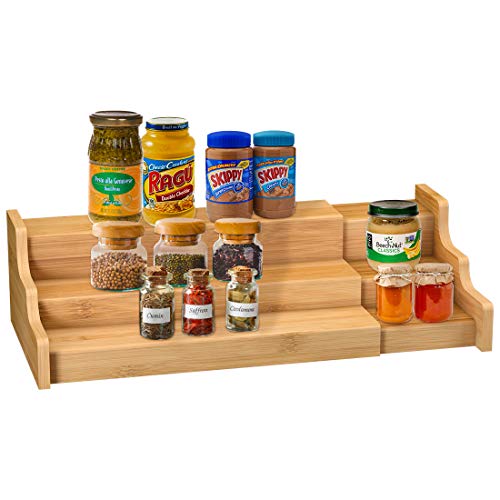
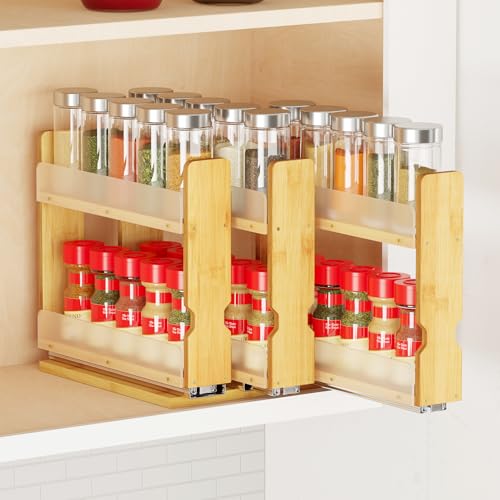
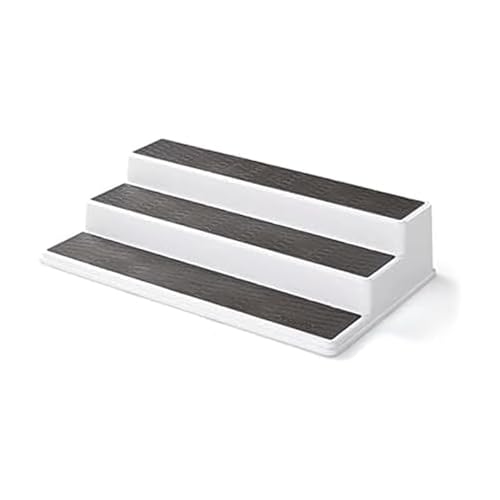

As an Amazon Associate we earn from qualifying purchases at no extra cost to you. Ratings are shown as listed on Amazon.
Quick picks by kitchen situation
| Kitchen situation | Best rack type | Typical capacity | Why it fits | Main compromise |
|---|---|---|---|---|
| Very limited counter space | Magnetic tins or a slim wall rack | 6–12 jars | Uses vertical space and keeps the worktop clear | Small tins may not hold bulk spices |
| Small rental kitchen | Over-door, adhesive, or freestanding tiered rack | 12–24 jars | No permanent drilling is required | Adhesive has weight and heat limits |
| Frequent everyday cooking | Countertop carousel or open two-tier shelf | 16–24 jars | Frequently used seasonings are visible and reachable | Uses counter or cabinet shelf space |
| Large spice collection | Pull-out cabinet organizer or wide drawer insert | 24–40 jars | Groups many containers without hiding the back row | Costs more and requires accurate measuring |
| Low-cost, permanent wall storage | Wooden ledge rack such as IKEA BEKVÄM | About 8–12 standard jars per rack | Simple construction and easy access | Needs suitable wall fixing and has limited depth |
What to measure before buying
Measure the actual space rather than relying on a rack’s advertised jar count. For a cabinet, record the usable width between hinges, the depth from the front edge to the back wall, and the clear height with the door closed. Subtract at least 1 inch from the measured width and depth so jars do not scrape when the door or drawer moves.
Standard spice jars are often around 1.5 to 2 inches in diameter and 3 to 5 inches tall, but containers vary widely. A rack advertised for 24 jars may hold only 18 of your wider glass bottles. If you buy in bags or refill containers, measure those too: a rack designed for narrow jars may not accommodate square containers or tall grinders.
For a shelf rack, calculate capacity using the usable shelf width. For example, a 20-inch shelf holding jars that average 2 inches wide has a theoretical capacity of 10 jars per row. Allowing a small gap for labels and removal reduces that to about 9 jars. A two-tier rack therefore holds approximately 18 jars, not 20 or more.
Head-to-head: the main rack styles
Wall-mounted ledge racks
Wall-mounted racks are usually the best balance for small kitchens because they turn unused wall area into storage. IKEA BEKVÄM is a familiar example of a simple wooden spice rack with a narrow ledge and front rail. Its open design makes labels easy to read, and multiple racks can be installed vertically.
Choose this style when you own standard-size jars and can locate a stud or use an appropriate wall anchor. Wood can be painted or sealed, but it should not be installed where steam or splashing water repeatedly reaches it. A front rail is important: without one, jars can slide off when the wall is bumped.
Freestanding tiered shelves
Two- and three-tier shelves are easy to install and move. They work particularly well inside a deep cabinet, where a flat single shelf would hide the rear containers. Look for shelves at least 8 inches deep and 3 to 4 inches of vertical clearance between levels. A raised back tier is more useful than a completely flat shelf because it exposes labels.
Metal racks are generally better for damp areas than unfinished wood, while powder-coated steel resists ordinary kitchen splashes. Check the feet: silicone or rubber pads reduce sliding and protect a smooth cabinet surface. The weakness of inexpensive tiered shelves is often flexing or a thin coating that chips around screw holes.
Countertop carousels
A rotating carousel is convenient when several people cook or when the rack must be shared between prep areas. A 16- to 20-jar carousel usually suits everyday seasonings such as salt, pepper, paprika, garlic powder, and dried herbs. It is less efficient for irregularly shaped jars because the circular layout leaves unused gaps.
Choose a broad, weighted base and a smooth rotation mechanism. A carousel that is 10 inches wide needs a clear area larger than 10 inches, especially if nearby appliances or a wall make turning difficult. It also places spices in the open, so it is not ideal beside a hot hob or in direct sunlight.
Drawer inserts and pull-out organizers
Drawers are excellent for a large collection because labels can face upward and the entire inventory can be viewed at once. Angled inserts are easier to scan than flat dividers. A 24-inch drawer with four rows of 2-inch-wide jars can theoretically hold 48 containers, but dividers, gaps, and jar variation commonly reduce practical capacity to about 32–40.
A pull-out cabinet organizer is a better choice when the cabinet is narrow and deep. Before purchasing, check the organizer’s full extension, not just its closed dimensions. Pipes, hinges, shelf pins, and face frames can prevent a unit from sliding out even when the cabinet opening appears wide enough.
Magnetic tins and adhesive racks
Magnetic tins are useful for frequently used spices and metal refrigerator sides, but they are usually a supplement rather than a complete storage system. Tins around 2.5 inches in diameter often hold less than a conventional jar, making them unsuitable for high-volume ingredients such as cumin or chili powder unless refilled often.
Adhesive-mounted racks are convenient in rented homes, but the mounting surface must be clean, smooth, dry, and free of grease. Do not mount a heavily loaded rack over a hob or rely on adhesive for large glass jars. Weight gradually increases as jars are refilled, and heat can weaken some adhesives.
Materials: what lasts and what wears first
- Powder-coated steel: A strong all-purpose option. Inspect edges and screw points for chips, where corrosion can begin.
- Stainless steel: Suitable for humid kitchens and easy to wipe, although fingerprints and water marks are more visible.
- Bamboo or solid wood: Warm-looking and repairable, but it needs protection from standing water and steam.
- Plastic: Light and inexpensive, with easy cleaning. Thin shelves may bow under heavy glass jars.
- Acrylic: Keeps labels visible and suits drawers or cabinets, but it can scratch and may crack if overtightened.
The first parts to wear are commonly carousel bearings, adhesive pads, drawer slides, and painted edges. A rack with replaceable screws or standard drawer hardware is easier to maintain than one that depends on a sealed proprietary mechanism.
How to organize the rack so it stays useful
- Discard or relocate duplicates. Combine identical spices only when their dates and condition are clear. Keep unopened backup containers elsewhere.
- Group by use. Put everyday seasonings at eye level, baking spices together, and specialty ingredients in a less accessible section.
- Face labels outward. For drawers, label the lid; for shelves, use matching label positions so scanning takes seconds.
- Keep jars below the rack’s height limit. A tall grinder can block a tier above it even when its diameter fits.
- Leave a small access gap. Filling every inch makes the rack appear efficient but forces you to remove several jars to reach one.
Clean spills promptly with a barely damp cloth, then dry the rack completely. Avoid soaking wooden racks or putting adhesive-mounted units under running water. Once or twice a year, remove every container, wipe the shelf, and check for clumping, damaged lids, faded labels, or spices that no longer smell fresh.
How much should you spend?
Basic plastic organizers and simple wooden racks generally cost about $10–$30. Better metal shelves, carousels, and magnetic systems commonly fall around $25–$70. Custom-fit drawer inserts and pull-out cabinet organizers can range from $50 to more than $150 depending on width, hardware, and finish.
Price per jar is a useful comparison. A $40 rack that holds 20 jars costs $2 per storage position; a $25 rack that holds 8 wide jars costs $3.13 per position. The cheaper rack is not necessarily better if it leaves half your collection on the counter. For most kitchens, paying more for accurate dimensions, stable mounting, and easy cleaning is more valuable than paying for maximum advertised capacity.
Final recommendation
Choose a wall-mounted ledge rack when floor and counter space are scarce, a freestanding tiered shelf when you need flexibility, a carousel for a compact everyday collection, and a drawer or pull-out organizer for 25 or more jars. The best spice rack is the one that fits your measured space with room to remove each jar, uses a material suited to your kitchen’s moisture and heat, and keeps your most-used ingredients visible without making the rest of the collection difficult to reach.




Write Your Review
No reviews yet. Be the first to share your experience!