

Key takeaways
- Choose the Delta Leland for broad sink coverage and faster filling, the Moen Arbor for a balanced everyday faucet with a less imposing profile, and the Kohler Simplice for a large basin where reach matters most. Choose the Kraus Bolden when commercial styling and repeated…
The best kitchen faucets with pull down sprayer depend on your sink depth, cabinet clearance, preferred spray reach, and tolerance for installation work: for most households, the Delta Leland is the strongest all-around choice, the Moen Arbor is a polished mid-range alternative, the Kohler Simplice suits busy sinks, and a compact single-handle faucet is safer for shallow or unusually shaped basins.
Pull-down faucets look similar in listings, but the practical differences are substantial. A long hose does not always produce useful reach, a tall commercial-style neck can collide with an open window, and a high flow rate may not help if your home’s water pressure is weak. The comparison below focuses on the details that affect daily use rather than appearance alone.
Our top picks
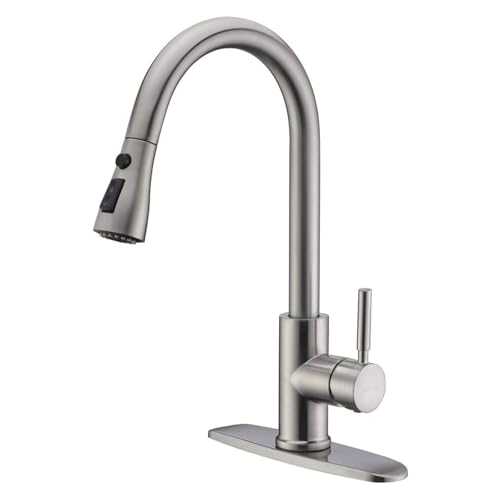
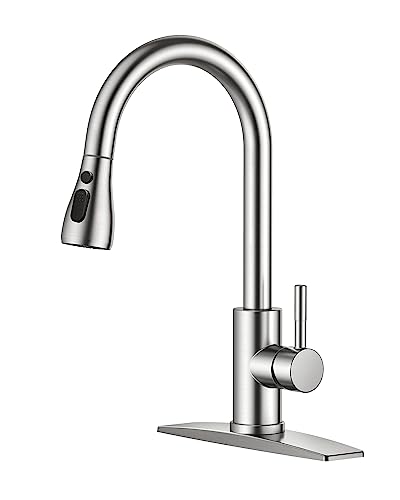


As an Amazon Associate we earn from qualifying purchases at no extra cost to you. Ratings are shown as listed on Amazon.
Quick comparison of the leading choices
| Faucet | Approx. height | Spout reach | Flow rate | Best fit | Installation level |
|---|---|---|---|---|---|
| Delta Leland 9178 | 15.5 in | 9.2 in | 1.8 gpm | Deep, frequently used sinks | Moderate |
| Moen Arbor 7594 | 15.5 in | 7.9 in | 1.5 gpm | Standard kitchens and lower water use | Moderate |
| Kohler Simplice 596 | 16.6 in | 9.0 in | 1.5 gpm | Large basins and heavy rinsing | Moderate |
| Kraus Bolden KPF-1610 | 16.3 in | 8.75 in | 1.8 gpm | Commercial look and strong reach | Moderate to difficult |
| Compact single-handle pull-down type | 12–14 in | 7–8 in | 1.5 gpm | Low cabinets, shelves, or windows | Easy to moderate |
Dimensions and flow ratings can vary by finish, region, and model revision. Measure the exact product drawing before ordering, particularly if the faucet will sit beneath a shelf or beside a backsplash.
Best overall: Delta Leland
The Delta Leland 9178 is a strong choice when you want a useful combination of reach, conventional styling, and a relatively generous 1.8-gallons-per-minute flow rating. Its roughly 9.2-inch reach is more practical than a shorter spout for filling stockpots or rinsing the far side of a double-bowl sink.
Delta’s magnetic docking system is designed to pull the spray head back into position, while the ShieldSpray feature concentrates water into a tighter jet to reduce splash during stuck-on-food cleanup. The trade-off is height: at about 15.5 inches, it may be too tall for a cabinet or shelf directly above the sink.
Choose the Leland if you wash large cookware often, have a medium-to-deep sink, and want more rinsing capacity than a 1.5-gpm faucet provides. It is less compelling for a shallow bar sink, where its reach and spray force can throw water onto the countertop.
Best for balanced everyday use: Moen Arbor
The Moen Arbor 7594 combines a familiar high-arc shape with a pull-down head, a retracting hose, and a 1.5-gpm flow rate. The lower flow is adequate for ordinary dishwashing and can reduce water use compared with 1.8-gpm alternatives, although it will fill a large pot more slowly.
Its approximately 7.9-inch reach works well in a single-bowl sink around 30 inches wide. The Power Boost version can temporarily increase spray force, but buyers should check the exact model because not every Arbor configuration includes the same feature. Moen’s Reflex hose system is intended to guide the head smoothly back to the spout; if the hose rubs against stored items beneath the sink, retraction can become less reliable.
The Arbor is a sensible pick for a standard kitchen where the faucet will be used several times a day but not subjected to constant oversized-pan washing. It is also a safer visual choice than an industrial spring-coil faucet in a traditional or transitional kitchen.
Best for a large sink: Kohler Simplice
The Kohler Simplice 596 has a tall profile of roughly 16.6 inches and a reach near 9 inches. That combination gives it excellent coverage across a broad single-bowl sink, especially when the mounting hole is toward the rear edge of the counter.
Its 1.5-gpm flow is efficient rather than exceptionally fast. The three-function head typically offers stream, sweep-style spray, and pause controls, making it useful for switching between filling, rinsing, and reducing water flow while repositioning a pan.
Height is the main limitation. Check the vertical clearance from the countertop to the underside of nearby cabinets, not merely the cabinet door height. Leave room for the spray head to dock without striking the cabinet face. The Simplice is a poor fit when the faucet must sit under a low shelf or in front of a window that opens inward.
Best commercial-style option: Kraus Bolden
The Kraus Bolden KPF-1610 brings a more industrial profile, a roughly 16.3-inch height, an 8.75-inch reach, and a 1.8-gpm flow rating. Its open spring-style neck can make the spray head easier to grab repeatedly, which is useful for cooks who rinse ingredients and cookware throughout the day.
That design also creates more surfaces for grease and mineral deposits. The exposed coil needs occasional wiping, and the head may not retract with the same concealed magnetic feel as a more conventional residential faucet. Installation can be less forgiving because the faucet is heavy and the under-counter mounting area must be accessible enough to tighten the hardware securely.
Select it for a deep sink, an industrial kitchen aesthetic, and frequent use. Avoid it when low maintenance, a quiet visual profile, or limited cabinet clearance matters more than maximum access.
Decision matrix: which type matches your situation?
| Your situation | Recommended direction | Why |
|---|---|---|
| Budget-conscious replacement | Basic 1.5-gpm pull-down faucet | Fewer spray modes and standard finishes reduce cost and replacement-part complexity. |
| Deep single-bowl sink | 9-inch reach, 15–17-inch height | Improves coverage and makes filling large vessels easier. |
| Shallow sink or low shelf | 12–14-inch compact faucet | Reduces backsplash splashing and clearance problems. |
| Frequent cooking and pan washing | 1.8-gpm faucet with docking support | Fills cookware faster and keeps the head secure between uses. |
| First plumbing project | Single-hole faucet with quick-connect hoses | Usually requires less under-sink assembly and fewer alignment steps. |
| Hard-water home | Brushed finish with removable aerator | Mineral spots are less visible and the aerator is easier to clean. |
How to check sink compatibility before buying
First, count the countertop holes. A single-handle pull-down faucet normally uses one hole, but many packages include an optional deck plate for a three-hole installation. Measure the hole diameter and the distance from the hole center to the backsplash; a handle that tilts backward may hit the wall or trim.
Next, measure the usable sink area. A faucet with a 9-inch reach covers a circle with an 18-inch diameter in ideal conditions, but the actual spray path is limited by the hose angle and the sink walls. For example, if the faucet hole is 3 inches behind the sink rim and the basin is 20 inches front-to-back, a 9-inch reach may still leave the front portion difficult to rinse unless the head pulls down several additional inches.
Finally, check clearance above the mounting surface. Add at least 1–2 inches beyond the listed faucet height if the spray head docks into a taller position or if the cabinet door opens directly over it.
Installation difficulty and common mistakes
Most single-hole pull-down faucets can be installed with an adjustable wrench, basin wrench, screwdriver, plumber’s tape where specified, and a flashlight. Shut off both supply valves, remove the old faucet, clean the countertop opening, and feed the new supply lines through the hole. From below, install the gasket and mounting bracket, center the faucet, and tighten it without distorting the countertop.
Connect hot and cold lines without crossing them, then attach the pull-down hose and its counterweight according to the instructions. The weight needs enough unobstructed travel to retract the hose; placing a cleaning bottle directly beneath it is a common reason the head stops docking.
Flush the lines before attaching or reinstalling the aerator. Open each supply valve slowly, inspect every connection with a dry paper towel, and run the faucet for several minutes. A slow leak may appear only when the hose is pulled forward, so test both docked and extended positions.
Finish durability and ownership costs
Brushed stainless and brushed nickel generally hide fingerprints and small water marks better than polished chrome. Matte black can look clean when new but tends to show mineral spots and scratches more clearly. PVD finishes are usually a better durability choice than painted finishes, though no coating should be scrubbed with abrasive powder, steel wool, or a scouring pad.
The parts that typically wear first are the spray-head button, the hose seal, the docking magnet or clip, and the cartridge. Mineral buildup can make the spray pattern uneven long before the cartridge fails. Remove and soak the aerator or spray head in diluted white vinegar only when the manufacturer’s instructions allow it; prolonged soaking can damage some finishes and internal components.
As a simple water-use comparison, running a 1.5-gpm faucet for 10 minutes uses about 15 gallons. A 1.8-gpm model uses about 18 gallons in the same period, a difference of 3 gallons. If your household runs the faucet for 10 minutes daily, the higher-flow model uses approximately 1,095 additional gallons per year. The faster filling speed may be worthwhile for frequent cooking, but a 1.5-gpm model is usually sufficient for routine rinsing.
Bottom line
Choose the Delta Leland for broad sink coverage and faster filling, the Moen Arbor for a balanced everyday faucet with a less imposing profile, and the Kohler Simplice for a large basin where reach matters most. Choose the Kraus Bolden when commercial styling and repeated spray-head access outweigh easy cleaning. Whatever the brand, prioritize the correct height, a hose that can move freely beneath the sink, a finish suited to your water quality, and a flow rate that matches how you actually wash and fill.



Write Your Review
No reviews yet. Be the first to share your experience!