

Key takeaways
- Electrical access: Under-sink tanks need a grounded outlet in the cabinet. Do not use an overloaded extension lead in a damp cabinet.
- Faucet space: A dedicated hot-water faucet usually needs a spare sink or countertop hole. Drilling stone, quartz, or porcelain may require a professional.
- Cold-water connection: The tank normally connects to the cold-water supply through a supplied or compatible valve. Check pipe size before starting.
- Clearance: Leave room around the tank for ventilation and enough access to inspect fittings or replace the filter.
- Countertop stability: A full 4-litre boiler weighs more than 9 pounds before adding the appliance itself. Place it on a level, dry surface away from the counter edge.
- Drainage: Some installation layouts need a pressure-relief or discharge arrangement. Follow the manufacturer’s instructions rather than improvising plumbing connections.
The best instant hot water dispensers depend on whether you want near-boiling water from a plumbed-in faucet or a countertop boiler that stores several litres; for most kitchens, a filtered under-sink system offers the fastest cup-filling, while a Zojirushi or similar countertop boiler is easier to install and better for frequent, high-volume use.
Our top picks

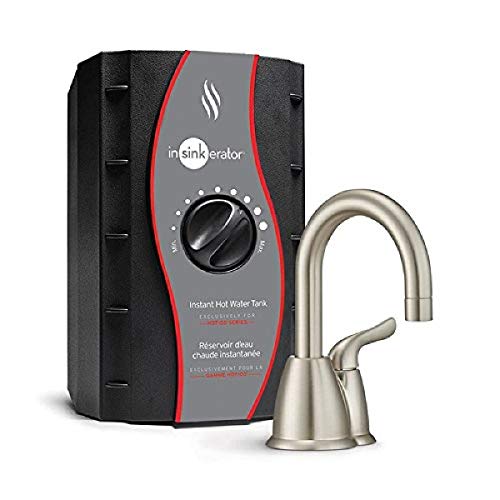


As an Amazon Associate we earn from qualifying purchases at no extra cost to you. Ratings are shown as listed on Amazon.
Quick picks by kitchen situation
| Kitchen situation | Best choice | Why it fits | Main compromise |
|---|---|---|---|
| Clean built-in appearance and occasional cups | InSinkErator HC1100 with a compatible filtered faucet | Under-sink tank, dedicated dispenser, and water filtration | Requires plumbing, cabinet space, and a separate faucet hole |
| Frequent tea, coffee, or cooking-water use | Zojirushi 4 L hybrid water boiler and warmer | Several temperature settings, large reservoir, and programmable dispensing | Uses counter space and reheats stored water continuously |
| Rental, office, or no-plumbing kitchen | Countertop electric hot-water dispenser | Fill it manually and plug it into a standard outlet | Usually lacks built-in filtration and may not deliver truly instant water |
| Very limited counter space | Under-sink instant dispenser | Most of the equipment stays inside the cabinet | Installation is more involved than a countertop appliance |
What “instant” means in this category
A plumbed-in instant hot water dispenser keeps a small insulated tank hot beneath the sink. Opening its dedicated lever sends heated water to the faucet with little waiting. Models such as the InSinkErator HC1100 generally produce water around 200°F, although the exact output varies with the thermostat setting, incoming water temperature, and whether the tank has just been heavily used.
A countertop hot-water boiler works differently. It heats a reservoir, often 3 to 5 litres, and then maintains that water at a selected temperature. It is instant after the initial heating cycle, but not necessarily instant when filled with cold water. A full 4-litre tank can require roughly 30 to 60 minutes to heat, depending on its heating element and starting temperature.
This distinction matters: choose an under-sink dispenser for a cup or two whenever you need it, and choose a countertop boiler when you need repeated servings throughout the day.
Head-to-head comparison
| System type or example | Dispensing temperatures | Typical capacity | Filtration | Child lock | Approximate footprint | Installation |
|---|---|---|---|---|---|---|
| InSinkErator HC1100 under-sink system | Near-boiling, approximately 200°F | About 0.67 gal / 2.5 L tank | Usually paired with an InSinkErator filtration system | Available on compatible safety-style faucets; verify faucet model | Tank occupies roughly 6–8 in wide by 8–10 in deep cabinet space | Cold-water line, electrical outlet, faucet hole, and under-sink mounting |
| Zojirushi 4 L water boiler and warmer | Common settings include approximately 160°F, 175°F, 195°F, and 208°F | 4 L / 4.2 qt | Removable mesh filter; not a substitute for drinking-water filtration | Yes, electronic dispense lock | Approximately 8–9 in wide by 11–12 in deep; about 12–15 in high | Fill manually and plug into an outlet |
| Panasonic NC-EG4000-style boiler | Multiple selectable settings around 160°F to 208°F | 4 L / 4.2 qt | Internal mesh filter | Yes, model-dependent | Approximately 9 in wide by 11 in deep | Countertop outlet; no plumbing |
| Tiger 4 L electric water boiler | Typically four settings in the approximately 160°F–208°F range | 4 L / 4.2 qt | Internal filter or filter screen, depending on model | Yes on many current models | Approximately 9 in wide by 11 in deep | Countertop outlet; no plumbing |
Dimensions and controls vary by regional model, so confirm the exact specification sheet before ordering. The table is most useful for comparing the design trade-offs: an under-sink tank saves visible counter space but adds installation work, whereas a countertop boiler provides more capacity and temperature choice but occupies a permanent appliance-sized area.
Temperature: near-boiling versus selectable heat
Under-sink dispensers are strongest when you want very hot water quickly for instant coffee, cooking, dissolving ingredients, or filling a mug without waiting for a kettle. Their narrow temperature range is usually an advantage for speed, but less useful if you regularly want warm water, green tea, powdered drinks, or a lower-temperature setting.
Countertop boilers are more flexible. A setting near 160°F can reduce cooling time for delicate drinks, while 195°F–208°F settings suit black tea, cooking, and general hot-water use. The trade-off is energy consumption: maintaining several litres at temperature all day can use more electricity than heating one kettle only when needed.
Capacity and a useful sizing calculation
Estimate capacity from your daily use rather than choosing the largest tank. A typical mug may use 10 ounces, or 0.30 litres. Ten mugs therefore require about 3 litres before allowing for cooking or refill losses:
10 mugs × 0.30 L = 3.0 L
A 4-litre countertop boiler leaves roughly 1 litre of reserve, so it suits a household making around eight to twelve hot drinks daily. An under-sink tank of about 2.5 litres does not mean you receive only 2.5 litres per day; it reheats after dispensing. However, repeated large draws can temporarily reduce the output temperature.
For occasional use, a smaller tank reduces standing heat. For a busy household, choose capacity based on consecutive servings, not just the number of people in the home.
Filtration: what it does and does not solve
Some under-sink systems use replaceable carbon filters to reduce chlorine taste, odour, and certain particulate matter. Filter compatibility is important: the filter must match the system’s flow rate and replacement specification. A filter cartridge is a consumable, not a permanent upgrade.
Countertop boilers usually include a mesh screen that catches particles and protects the pump or dispensing path. This is not equivalent to a certified drinking-water filter. If taste, sediment, or a known water-quality issue is your concern, use a separate certified filtration system and follow local water-advice guidance rather than assuming the boiler’s screen purifies the water.
Installation requirements that are easy to overlook
- Electrical access: Under-sink tanks need a grounded outlet in the cabinet. Do not use an overloaded extension lead in a damp cabinet.
- Faucet space: A dedicated hot-water faucet usually needs a spare sink or countertop hole. Drilling stone, quartz, or porcelain may require a professional.
- Cold-water connection: The tank normally connects to the cold-water supply through a supplied or compatible valve. Check pipe size before starting.
- Clearance: Leave room around the tank for ventilation and enough access to inspect fittings or replace the filter.
- Countertop stability: A full 4-litre boiler weighs more than 9 pounds before adding the appliance itself. Place it on a level, dry surface away from the counter edge.
- Drainage: Some installation layouts need a pressure-relief or discharge arrangement. Follow the manufacturer’s instructions rather than improvising plumbing connections.
Ownership realities: cleaning, scaling, and safety
Limescale is usually the first maintenance problem, especially in hard-water areas. It can slow heating, affect dispensing, and create flakes in the reservoir. Descale on the schedule stated by the manufacturer; do not assume that a water filter eliminates mineral buildup. Emptying and rinsing the tank periodically also prevents stale-tasting water.
Replace carbon cartridges on time. An old cartridge can restrict flow and undermine taste improvement even when the dispenser still appears to work. Check tubing and compression fittings for moisture during the first few days after installation and after any filter change.
Child locks are valuable, but they are not a substitute for supervision. Near-boiling water can cause serious scalds. Prefer a dispenser with a deliberate two-step release or electronic lock if children can reach the controls, and keep cups, stools, and appliance cords away from the dispensing area.
Final buying recommendation
Choose the best instant hot water dispensers by matching the system to the way you use hot water. Pick an InSinkErator-style under-sink dispenser when a tidy counter, fast single-cup service, and filtered water matter most. Pick a Zojirushi, Panasonic, or Tiger countertop boiler when you need multiple temperature settings and several litres available throughout the day. If you rent or do not have a spare plumbing connection, accept the larger footprint of a countertop unit in exchange for simple setup.
Before purchasing, measure the cabinet or counter, confirm the electrical outlet, calculate your daily volume, check replacement-filter availability, and verify the child-lock design. Those practical details matter more than a small difference in headline heating temperature.


Write Your Review
No reviews yet. Be the first to share your experience!