

Key takeaways
- Best for everyday cooking: hard maple or beech, five to seven essential tools, smooth matte finish.
- Best for appearance and serving: olive wood, especially for salad servers and serving spoons.
- Best for wet environments: teak, provided it is responsibly sourced and properly maintained.
- Best for a low budget: beech or rubberwood, with a simple countertop crock rather than decorative storage.
- Best for small kitchens: a four- or five-piece nesting set with a wall loop or compact stand.
The best wooden utensil set for kitchen cooking is a 5- to 7-piece set made from tightly grained maple, beech, or olive wood, with smoothly sanded surfaces, food-safe finish, a slotted turner, a broad spoon, a cornered spatula, and a storage solution that keeps tools dry between uses.
Our top picks


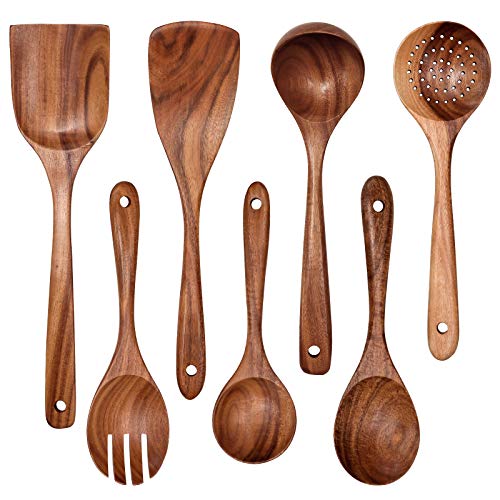

As an Amazon Associate we earn from qualifying purchases at no extra cost to you. Ratings are shown as listed on Amazon.
Quick verdict: which wooden utensil set should you buy?
For most daily cooks, choose a hard maple or beech set with utensils measuring about 12 to 14 inches long. These woods offer a useful balance of strength, weight, neutral appearance, and affordability. Look for a solid, one-piece construction or securely joined handle, rounded edges, and no rough grain around the working ends.
- Best for everyday cooking: hard maple or beech, five to seven essential tools, smooth matte finish.
- Best for appearance and serving: olive wood, especially for salad servers and serving spoons.
- Best for wet environments: teak, provided it is responsibly sourced and properly maintained.
- Best for a low budget: beech or rubberwood, with a simple countertop crock rather than decorative storage.
- Best for small kitchens: a four- or five-piece nesting set with a wall loop or compact stand.
Wooden utensils are naturally gentle on seasoned cast iron, enamel, ceramic, and nonstick surfaces. They are not maintenance-free, however: repeated soaking, dishwasher cycles, and storage while damp shorten their useful life.
Wood species compared for daily use
| Wood species | Typical feel | Best qualities | Main drawbacks | Typical set price |
|---|---|---|---|---|
| Hard maple | Light, moderately dense | Good wear resistance, neutral color, gentle on cookware | Can dry out if neglected | $20–$55 |
| Beech | Light, smooth, slightly flexible | Affordable, even grain, comfortable for long stirring | May stain more visibly than darker woods | $15–$45 |
| Olive wood | Dense, heavier, highly figured | Attractive grain, firm working edge, good for serving | Usually more expensive; irregular grain needs careful sanding | $30–$90 |
| Teak | Dense, oily, substantial | Good moisture resistance and durability | May feel heavy; sourcing matters; not ideal for every budget | $25–$75 |
| Rubberwood | Medium weight, uniform | Often economical and smoothly machined | Can show wear sooner than hard maple or teak | $12–$35 |
Density alone does not determine quality. A very hard utensil with sharp or poorly finished edges can damage delicate cookware, while a well-sanded beech tool may perform better in everyday use. Grain direction also matters: a spoon or spatula with long, continuous grain through the handle is less likely to split than one made from a short cross-grain blank.
The utensil shapes that earn their space
1. Broad cooking spoon
A spoon around 2.5 to 3 inches wide is the most versatile piece in a set. It works for soups, grains, sauces, and sautéed vegetables. A moderately deep bowl carries food more effectively than a nearly flat spoon, but an excessively deep bowl is awkward for scraping a pan.
2. Cornered or square-ended spatula
The best wooden spatula for frying pans has a thin leading edge and one angled corner. The thin edge slides beneath eggs and pancakes, while the corner reaches into the junction between a pan’s base and sidewall. A completely blunt, thick-ended spatula is less useful for turning food.
3. Slotted turner
Slots let oil and liquid drain while lifting vegetables, dumplings, or fried foods. Aim for slots about 3 to 5 millimeters wide: very narrow slots clog with soft food, while very wide openings allow smaller pieces to fall through.
4. Fork or multi-prong tool
A wooden fork is useful for tossing pasta and separating meat while it cooks, but it is less essential than a spoon and spatula. Choose one with rounded, flexible tines rather than thin points that can chip.
5. Scraper and small spoon
A narrow scraper is valuable for deglazing and clearing stuck bits from pan corners. A small spoon, roughly 9 to 11 inches long, is useful for tasting, stirring sauces, and working in small saucepans. Sets that include both are often more practical than decorative tools such as a honey dipper or oversized salad fork.
Finish quality, heat resistance, and construction
A good finish should feel smooth but not thick or plastic-like. Food-safe mineral oil and beeswax blends leave a natural surface that can be renewed. Some makers use a cured food-safe coating for greater stain resistance. Either approach can work if the surface is intact and the manufacturer’s care instructions are clear.
- Run a clean cloth over the utensil. It should not catch on raised grain or splinters.
- Inspect the bowl and spatula edge for sanding scratches, cracks, and dark gaps.
- Check that handles are free of loose joints and that hanging holes do not have sharp edges.
- Avoid heavily glossy coatings that are already flaking or forming bubbles near the working end.
- Prefer a single piece of wood for spoons and spatulas when available; fewer joints mean fewer places for moisture to enter.
Wooden utensils tolerate the heat of normal stovetop cooking, but they should not be left resting against a hot burner, placed directly on a heating element, or used inside an oven as a permanent tool. The working surface may withstand brief contact with a hot pan, while the handle can scorch, crack, or become uncomfortably hot if exposed continuously.
Dishwasher restrictions and the maintenance reality
Most wooden utensil sets should be hand-washed, even when a listing uses vague language such as “easy to clean.” Dishwasher heat, detergent, and prolonged moisture can roughen the grain, fade the finish, open joints, and eventually split the handle. A utensil labeled dishwasher-safe may survive occasional cycles, but hand washing remains the lower-risk choice for long ownership.
A two-minute cleaning routine
- Rinse food residue soon after cooking so sauces do not dry into the grain.
- Wash with warm water and a small amount of dish soap using a soft sponge.
- Do not soak the utensil or leave it submerged in a sink.
- Dry immediately with a towel, then allow air circulation before storing it.
- Every few months, apply a thin coat of food-safe mineral oil when the wood looks pale, dry, or slightly rough.
Do not use vegetable or olive oil as a conditioning treatment. Those oils can oxidize and become sticky or rancid. Sanding is appropriate only for genuine roughness or raised grain; use fine sandpaper, remove all dust, and re-oil afterward. Deep cracks, blackened areas, loosened joints, or persistent odors are signs that replacement is safer than continued use.
Storage: crock, rack, drawer, or hanging loop?
| Storage method | Space needed | Advantages | Common problem |
|---|---|---|---|
| Countertop crock | About 5–7 inches of counter width | Fast access; keeps handles visible | Tools stored damp can develop odor at the bottom |
| Wall rail with hooks | About 16–24 inches of wall length | Good airflow and efficient counter use | Requires suitable wall mounting and regular dusting |
| Drawer organizer | One standard utensil drawer | Clean appearance; useful in open kitchens | Traps moisture if tools are put away wet |
| Nesting stand | About 4–6 inches of counter width | Compact and coordinated | Harder to clean if the stand has narrow slots |
For a countertop crock, choose one with drainage or a removable liner and enough height that handles do not slide out. A narrow drawer is better for a compact kitchen, but allow utensils to cool and dry completely first. Storage is part of the purchase: an excellent set that is routinely crammed into a wet drawer will wear faster.
Decision matrix by cooking situation
| Your situation | Recommended set | Why |
|---|---|---|
| Budget-conscious beginner | Five-piece beech or rubberwood set | Covers stirring, scraping, turning, serving, and draining without unused extras |
| Daily home cook | Six- or seven-piece maple set | Better shape selection and durable tools for repeated stovetop use |
| Small kitchen | Four- or five-piece nesting set with hanging loops | Reduces counter and drawer congestion |
| Frequent high-heat cooking | Dense maple or teak with thick handles and thin spatula edges | Balances heat exposure, stiffness, and precise pan work |
| Mostly serving and entertaining | Olive wood serving spoon and fork set | Prioritizes appearance and comfortable presentation over pan scraping |
What wears out first, and the cost of ownership
The working edge of a spatula usually shows wear first, followed by raised grain on spoons and discoloration around handles. A $30 set used five times per week for three years costs about $0.04 per use per utensil when divided across six pieces: $30 ÷ (6 × 5 × 52 × 3) = approximately $0.006 per utensil use, or about 0.6 cents. The calculation is only useful if the set is maintained; replacing a cracked set after one year changes the value substantially.
Do not choose a larger set simply because it costs little more. Seven similar spoons create clutter, while one well-shaped spatula may be used every day. Prioritize the tools that match your pans, cooking frequency, and storage space. For most kitchens, a carefully finished five- or six-piece set in maple or beech is the strongest combination of usefulness, durability, and manageable care.

Write Your Review
No reviews yet. Be the first to share your experience!