

Key takeaways
- Best overall: A nested stoneware set with approximately 1.5-, 2.5-, and 4-quart dishes.
- Best for serving: A glazed ceramic set with wide, shallow profiles and integrated handles.
- Best for small kitchens: A porcelain set with stackable dishes between 0.75 and 2.5 quarts.
- Best for family cooking: A 3.5- to 4.5-quart oval or rectangular stoneware dish, plus a smaller 1- to 1.5-quart dish.
- Best budget approach: Buy two useful sizes rather than a four-piece set containing dishes too small for normal meals.
The best gratin dish set for oven use is usually a three-piece stoneware set for strong heat retention and everyday durability, while ceramic is the better choice for attractive serving and porcelain is best when you want lighter weight, thinner walls, and easier storage.
Our top picks


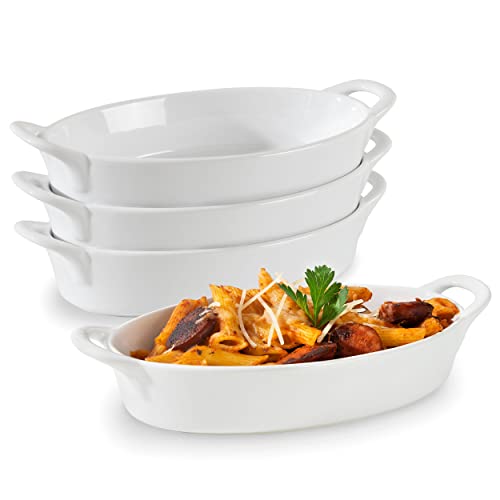
As an Amazon Associate we earn from qualifying purchases at no extra cost to you. Ratings are shown as listed on Amazon.
Best gratin dish set for oven: the short answer
Choose stoneware if you bake gratins, roasted vegetables, cobblers, or baked pasta regularly and want food to stay hot at the table. Choose ceramic if presentation matters most and you prefer a broad range of colors and shapes. Choose porcelain for frequent handling, compact kitchens, and recipes where quick, even heating is more useful than maximum heat retention.
- Best overall: A nested stoneware set with approximately 1.5-, 2.5-, and 4-quart dishes.
- Best for serving: A glazed ceramic set with wide, shallow profiles and integrated handles.
- Best for small kitchens: A porcelain set with stackable dishes between 0.75 and 2.5 quarts.
- Best for family cooking: A 3.5- to 4.5-quart oval or rectangular stoneware dish, plus a smaller 1- to 1.5-quart dish.
- Best budget approach: Buy two useful sizes rather than a four-piece set containing dishes too small for normal meals.
Ceramic vs stoneware vs porcelain
These terms overlap in everyday product descriptions, so the label alone does not determine performance. Stoneware is a dense, fired ceramic commonly made with thicker walls. “Ceramic” is a broad category that may describe earthenware, stoneware, or a manufacturer’s own clay formulation. Porcelain is generally fired at a higher temperature and tends to be denser, smoother, and thinner.
| Material | Typical wall thickness | Useful capacity range | Heat retention | Typical empty weight | Best suited to |
|---|---|---|---|---|---|
| Stoneware | 8–14 mm | 1.5–4.5 qt | Very good | 3–7 lb | Family meals and table serving |
| Glazed ceramic | 7–12 mm | 1–4 qt | Good | 2.5–6 lb | Presentation and moderate use |
| Porcelain | 4–8 mm | 0.75–3 qt | Moderate | 1.5–4.5 lb | Quick heating and easy handling |
The figures above are practical ranges rather than a specification for every dish. A thick porcelain dish can retain heat better than a thin ceramic one, and a lightweight stoneware dish may cool faster than expected. Compare actual dimensions, weight, and capacity whenever the manufacturer provides them.
What capacity do you really need?
Capacity is more important than an impressive exterior measurement. A gratin needs some headroom so cream, cheese, or bubbling sauce does not overflow. As a working guide, fill the dish to about two-thirds or three-quarters of its internal capacity.
| Dish capacity | Practical serving use | Approximate uncooked quantity | Recommended internal footprint |
|---|---|---|---|
| 0.75–1 qt | 1–2 portions or side dish | 12–16 oz | 6–8 in wide |
| 1.5–2 qt | 2–4 portions | 1–1.5 lb | 8–10 in wide |
| 2.5–3 qt | 4–6 portions | 2–2.5 lb | 10–12 in wide |
| 3.5–4.5 qt | 6–8 portions or a main course | 3–4 lb | 12–14 in wide |
For example, if a recipe contains 2 quarts of sliced potatoes, sauce, and cheese, a 3-quart dish is a safer choice than a 2-quart dish. The extra capacity allows for expansion and makes it easier to carry the dish from oven to table without sloshing. A deeper dish may hold more, but a shallow dish usually produces a larger browned surface and more even gratin layers.
Head-to-head: which material wins?
Stoneware: best for heat retention and repeated family meals
Stoneware’s thicker body absorbs and stores substantial heat, so a finished gratin remains warm longer after leaving the oven. This is useful when dinner is served in stages or when the dish travels a short distance to the table. The trade-off is weight: a large stoneware dish filled with food can weigh more than 10 pounds, so side handles are valuable.
Stoneware is also less forgiving of sudden temperature changes than thin metal cookware. Do not move a hot dish onto a wet or cold stone surface, pour cold liquid into it, or transfer it directly from a refrigerator into a fully heated oven unless the manufacturer specifically permits that use. Hairline cracks in the glaze are often the first visible sign of thermal stress.
Ceramic: best when appearance and serving matter
Glazed ceramic dishes are available in many colors and often have attractive rims or handles that suit a dining table. They usually provide good heat retention without being as heavy as the thickest stoneware. Ceramic is a sensible middle ground for someone who cooks gratins once or twice a month but wants the dish to function as serveware.
Inspect the glaze before buying. A very decorative finish may show utensil marks or discoloration more readily than a plain, matte interior. Dark sauces and baked-on cheese are easier to clean from a smooth, light-colored cooking surface.
Porcelain: best for lighter handling and compact storage
Porcelain dishes are usually thinner and lighter, making them easier to lift when full. Their smooth, nonporous surface is convenient for creamy sauces, and many porcelain sets have simple profiles that stack efficiently. They may respond more quickly to oven heat, but they generally do not keep food hot as long as heavy stoneware.
Porcelain is not automatically fragile. Properly fired porcelain can be highly durable in normal oven use, but thin edges and corners remain vulnerable to knocks. If your dishwasher is crowded or storage is tight, a set with rolled rims and protective spacing between nested dishes is preferable.
Decision matrix by cooking situation
| Your situation | Best choice | Why | Size to prioritize |
|---|---|---|---|
| Weekly family cooking | Stoneware | Retains heat and handles substantial portions | 3–4.5 qt |
| Small household or occasional use | Porcelain | Light, easy to store, quick to handle | 1.5–2.5 qt |
| Entertaining and table presentation | Glazed ceramic | Decorative finishes and serving-friendly shapes | 2.5–3.5 qt |
| Limited cabinet space | Porcelain or thin ceramic | Lower weight and more efficient stacking | 0.75–2.5 qt nested set |
| Frequent oven-to-table use | Stoneware with handles | Stable, heat-retentive, and easier to carry | 2.5–4 qt |
| Lowest purchase cost | Basic ceramic or porcelain | Often available in sets around $25–$60 | Two practical sizes |
Features worth paying for
- Clear oven rating: Look for a stated maximum temperature, commonly 450–500°F, rather than relying on the word “oven-safe.”
- Thermal-shock guidance: The instructions should explain whether refrigerator-to-oven use is allowed.
- Wide, secure handles: Allow at least 1 inch of finger clearance with oven mitts.
- Smooth interior glaze: This reduces staining and makes baked cheese easier to remove.
- Dishwasher guidance: Dishwasher-safe does not mean immune to metal marks, abrasive detergent, or edge chipping.
- Nested dimensions: Measure cabinet height and shelf depth; a large oval dish may not fit where a rectangular one does.
Durability, cleaning, and common mistakes
The first parts to wear are usually exposed rims, corners, and the glaze around handles—not the central cooking surface. Avoid dragging dishes across a countertop, stacking them without a towel or separator, and using metal knives to cut directly inside the dish. A nonabrasive cleaner and a short soak are safer than aggressive scouring.
For baked-on residue, let the dish cool naturally, add warm water and a small amount of dish soap, and soak for 20–30 minutes. A nylon brush can remove softened cheese without scratching the glaze. Do not pour boiling water into a cold dish. Similarly, do not place a hot dish on a wet towel; trapped moisture can create an uneven cooling zone.
Check the base after every few months of frequent use. A rough or chipped foot can scratch a glass cooktop or dining table. Stop using a dish if it develops a structural crack, sharp chip, or visible separation beneath the glaze.
Final buying recommendation
For most households, the most useful best gratin dish set for oven cooking is a nested stoneware set containing roughly 1.5-, 2.5-, and 3.5- to 4-quart dishes. It covers individual sides, a two-to-four-person meal, and a larger family bake without forcing every recipe into one oversized pan. Select ceramic instead when color and presentation are central, or porcelain when low weight and compact storage matter more than lingering table heat. Whichever material you choose, prioritize verified oven limits, usable internal capacity, smooth glazing, and a shape that fits your oven and cabinets.





Write Your Review
No reviews yet. Be the first to share your experience!