

Key takeaways
- Advantages: easy to wipe, resistant to absorbing ordinary spills, visually authentic, and less likely than loose-weave fabric to hold pet hair.
- Trade-offs: can feel cool or slippery at first, may show scratches, and needs protection from strong sunlight and nearby heat sources.
- Best colour choices: dark brown, oxblood, tan, and black suit traditional rooms; lighter tan shows patina but also marks more clearly.
Best Chesterfield Sofas for Classic Living Rooms
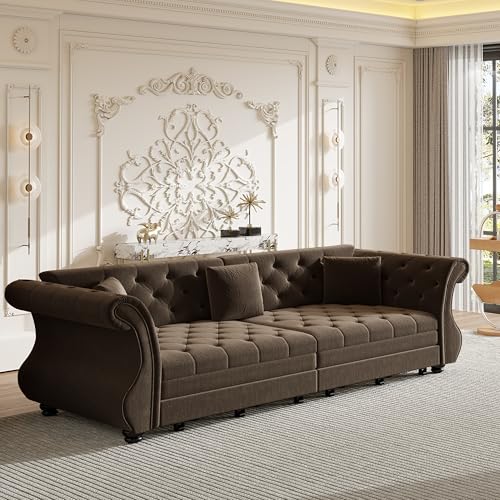
The best Chesterfield sofas are the ones that match your room’s scale, daily use, and preferred upholstery: full-grain or top-grain leather for long-term character, tightly woven fabric for softer colour and lower entry cost, and a seat construction that supports you without making the sofa feel rigid.
Quick picks by living-room situation
| Living-room situation | Best Chesterfield type | Useful target specifications | Why it suits the situation |
|---|---|---|---|
| Compact flat or narrow sitting room | Two-seat, shallow-profile Chesterfield | 150–180 cm wide; 88–98 cm deep; 44–48 cm seat height | Preserves walking space while retaining the rolled-arm silhouette |
| Family living room used every day | Performance fabric or protected leather | 190–230 cm wide; 52–62 cm usable seat depth; removable seat covers if available | Balances comfort, cleanability, and generous seating |
| Formal lounge or study | Deep-button leather Chesterfield | 180–220 cm wide; dense foam or foam-and-fibre cushions; 2.5–3.5 mm leather | Prioritises traditional appearance and structured support |
| Large open-plan room | Three-seat or four-seat model, sometimes with matching footstool | 220–280 cm wide; at least 90 cm clearance around main routes | Provides visual weight without looking undersized |
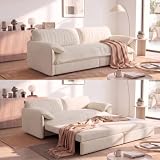
| Occasional guests or overnight use | Chesterfield-style sofa bed | At least 120 cm mattress width; verify the unfolded length before buying | Adds sleeping capacity, although its mechanism changes the seat feel |
Leather versus fabric: which is better?
Leather Chesterfield sofas
Leather is the most recognisable Chesterfield finish and usually the stronger choice when the sofa is intended to last for many years. Full-grain leather keeps the natural surface and develops patina as it is handled. Top-grain leather has been lightly corrected for consistency but can still offer a durable, premium covering. Corrected-grain and split leather are generally less expensive; their performance depends heavily on the coating and manufacturing quality.
Our top picks



As an Amazon Associate we earn from qualifying purchases at no extra cost to you. Ratings are shown as listed on Amazon.
Look for leather thickness of roughly 1.2–2.0 mm on many domestic sofas, with heavier upholstery leather around 2.0–3.5 mm. Thickness alone does not prove quality, because the backing, finish, stitching, and frame also matter. Ask whether the visible outer panels use the same leather as the high-wear seating areas. “Leather match” commonly means leather on contact surfaces with a synthetic material elsewhere.
- Advantages: easy to wipe, resistant to absorbing ordinary spills, visually authentic, and less likely than loose-weave fabric to hold pet hair.
- Trade-offs: can feel cool or slippery at first, may show scratches, and needs protection from strong sunlight and nearby heat sources.
- Best colour choices: dark brown, oxblood, tan, and black suit traditional rooms; lighter tan shows patina but also marks more clearly.
Fabric Chesterfield sofas
Fabric broadens the colour and texture options considerably. Velvet creates the richest formal appearance, while linen-look, cotton-blend, wool-blend, and tightly woven polyester fabrics can make the buttoned shape feel less imposing. For a frequently used family sofa, inspect the abrasion rating: a domestic upholstery fabric rated around 20,000–30,000 double rubs is a sensible baseline, while 40,000 or more offers additional margin for heavy use. Ratings are not a complete durability guarantee, but they provide more useful information than appearance alone.
Choose a tightly woven, solution-dyed, or performance-treated fabric if children, pets, or frequent entertaining are involved. Removable covers are valuable, but confirm whether they can be machine-washed and whether replacement covers remain available. Fixed deep-button upholstery can be difficult to clean because crumbs and dust settle around the buttons.
- Advantages: warmer feel, greater colour choice, less visible scratching, and often a lower purchase price than premium leather.
- Trade-offs: absorbs spills more quickly, can retain odours, and may show compression or pile shading in heavily used seats.
- Best practical option: a tightly woven mid-tone fabric with removable seat covers and a stain-resistant finish.
Seat dimensions that determine real comfort
Published width can be misleading because rolled arms and thick back cushions consume space. A 210 cm sofa may provide only 150–165 cm of usable seat width. Measure the interior seat width, not just the outside edge.
| Dimension | Compact model | Standard model | Generous model | What it changes |
|---|---|---|---|---|
| Overall width | 150–180 cm | 190–230 cm | 240–280 cm | Number of people and wall space required |
| Overall depth | 88–98 cm | 95–108 cm | 105–120 cm | How far the sofa projects into the room |
| Usable seat depth | 48–54 cm | 52–62 cm | 60–70 cm | Upright posture versus lounging |
| Seat height | 44–48 cm | 45–50 cm | 46–51 cm | Ease of standing and relationship to tables |
| Seat width per person | Approximately 55–65 cm | Allow more for relaxed seating or bulky clothing | ||
For a formal living room, a 50–56 cm usable seat depth encourages an upright position. If you prefer curling up or lying across the sofa, look closer to 58–65 cm, but check that the back cushion does not push you too far forward. A useful fit calculation is to add the sofa’s depth to the required passage in front. For example, a 102 cm deep sofa with a 75 cm walkway needs about 177 cm from the wall to the next obstruction. In a room with only 165 cm available, choose a shallower model or reduce the walkway only where it will not be a main route.
Tufting quality and cushion support
Good tufting is more than a pattern of buttons. The folds should be reasonably even, with no loose fabric pockets, strained stitching, or buttons that tilt noticeably. Deep buttoning uses more upholstery material and creates a firmer, more structured surface. It also reduces the amount of flat seating area, so a heavily tufted seat may feel firmer than a plain-cushion sofa of the same size.
Inspect the construction details where possible:
- Frame: kiln-dried hardwood or a properly engineered hardwood frame is preferable to an unspecified softwood frame. Corner blocks and reinforced joints help resist movement.
- Suspension: hand-tied springs can provide a traditional, resilient feel; serpentine springs are common and can perform well when correctly installed. Ask about spacing and reinforcement rather than relying on the label alone.
- Seat filling: high-resilience foam around 30–40 kg/m³ typically gives firmer, consistent support. Foam wrapped in fibre adds softness but may need regular plumping.
- Back filling: fibre backs feel relaxed but compress more quickly; foam or structured fibre backs hold a neater shape.
- Legs: solid wood or metal legs should be securely fixed and level. Exposed legs make cleaning easier and visually lighten a large sofa.
For everyday television use, medium-firm foam-and-fibre cushions are usually a safer compromise than very soft feather-filled cushions. Feather can feel luxurious but requires frequent plumping and may flatten unevenly. Fixed buttoned seats look formal and resist cushion movement, while loose cushions are easier to rotate and replace.
Room-size fit: avoid buying the wrong scale
In a small room, the arms are often the problem rather than the seat count. A compact two-seat Chesterfield with narrow arms can provide more usable space than a wider “loveseat” with oversized rolled arms. Use masking tape on the floor to mark the sofa’s full footprint, then add the door-opening and walking clearances. Check stairwells, lifts, hallways, and turns; the sofa may fit the room but not the delivery route.
In a large room, a very small sofa can look disconnected. A three-seat sofa around 210–230 cm wide usually gives better visual balance, especially when paired with a substantial rug. Avoid pushing every piece against the wall: leaving a modest gap behind the sofa or floating it within an open-plan area can make the room feel more intentional.
Ownership costs and maintenance realities
General market pricing in 2026 ranges from roughly £900–£1,800 or $1,200–$2,400 for simpler fabric Chesterfields, £1,500–£3,500 or $2,000–$4,700 for better-built fabric or protected-leather versions, and £2,500–£6,000 or $3,300–$8,000-plus for premium leather, bespoke sizing, or traditional hand-built construction. Delivery, fabric upgrades, stain protection, and matching chairs can add substantially to the total.
Budget for maintenance, not only the purchase price. Vacuum fabric with a soft upholstery attachment every few weeks and clean spills by blotting rather than rubbing. For leather, dust regularly and use a suitable conditioner sparingly according to the manufacturer’s guidance; household detergents can damage the finish. Keep the sofa out of direct sunlight where possible.
The first visible wear usually appears on the front edge of the seat, arm caps, button surrounds, and the places where people repeatedly sit. Rotate loose cushions, change seating positions, and avoid sitting on the arms. A useful replacement calculation is to divide the purchase price by expected years of service: a £2,400 sofa used for 10 years costs about £240 per year before maintenance, while a £1,200 sofa lasting four years costs £300 per year. That makes frame, suspension, and upholstery specifications more important than the lowest initial price.
Final buying recommendation
Choose leather when patina, wipe-clean practicality, and traditional character matter most. Choose performance fabric when you want more colour, a softer feel, or a lower price for a busy household. For the best all-round Chesterfield, prioritise a usable seat depth of about 52–62 cm, a medium-firm cushion, even tufting, a reinforced frame, and enough clearance for delivery and daily movement. The most attractive silhouette will still disappoint if its arms consume the seating area or its cushions collapse under ordinary use.



Write Your Review
No reviews yet. Be the first to share your experience!