

Key takeaways
- Performance polyester: Usually the most practical choice for frequent use. It resists everyday staining and is available in tightly woven textures, but some fabrics can attract lint or develop visible wear at the seat edge.
- Solution-dyed acrylic or similar performance fabric: Useful in bright rooms or homes where colorfastness matters. Confirm the manufacturer’s cleaning instructions because “performance” does not mean every stain can be removed.
- Leather: Easy to wipe and often durable, but it can scratch, show marks, and feel cooler in winter or warmer in direct sun. Aniline leather develops patina and requires more care than protected leather.
- Velvet and soft chenille: Comfortable and visually rich, but pile shading, crushed nap, and pressure marks are normal. They require more careful brushing and spot cleaning.
- Removable covers: Valuable for long-term ownership, especially on seat and back cushions. Verify whether replacement covers are sold and whether the covers are machine washable or dry-clean only.
The best U shaped sectional sofas for large rooms are modular, deep-seated designs that leave at least 30–36 inches of walking space, with the right choice depending on your room’s usable dimensions, preferred seat depth, upholstery needs, and whether you may rearrange the layout later.
Our top picks

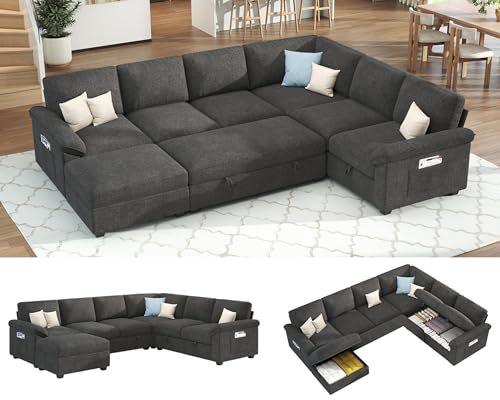


As an Amazon Associate we earn from qualifying purchases at no extra cost to you. Ratings are shown as listed on Amazon.
Quick picks by shopping situation
| Shopping situation | Best sectional type | Target dimensions | Why it fits |
|---|---|---|---|
| Frequent entertaining | Large modular U shape with washable or performance fabric | 144–180 inches wide; 100–120 inches deep | Seats 6–9 people and adapts to parties or movie nights |
| Family room with children or pets | Removable-cover modular sectional | 120–156 inches wide; 90–110 inches deep | Individual covers can be cleaned or replaced without replacing the frame |
| Relaxed lounging | Deep-seat U sectional with chaise ends | Seat depth of 24–30 inches | Provides room to curl up, stretch out, or share a chaise |
| Occasional use in a very large room | Lower-cost fixed-frame U sectional | 132–168 inches wide; 95–115 inches deep | Offers generous seating without paying for a highly reconfigurable system |
| Uncertain future layout | Modular sectional with movable corner and armless units | Individual modules generally 30–40 inches wide | Can become an L shape, separated chairs, or a longer sofa |
What makes the best U shaped sectional sofas different?
A U shaped sectional has a central sofa run and two returns projecting into the room. Compared with an L sectional, it creates a conversation area with seating on three sides, but it also consumes considerably more floor space. The best designs balance generous seating with enough open area for movement.
Look for a kiln-dried hardwood or reinforced engineered-wood frame, metal or hardwood support legs, high-resilience foam cushions, and corner modules that do not rely on a single loose connector. Seat cushions should be removable or at least reversible where possible. A reversible cushion can distribute wear, while a removable cover makes spills less stressful.
Modular systems from brands such as Lovesac, Burrow, and 7th Avenue are useful examples of the reconfigurable approach. Traditional fixed-frame sectionals from brands including Crate & Barrel, West Elm, and Room & Board may be preferable when you already know the exact layout you want. Availability, upholstery choices, and configurations vary, so confirm the current specification before ordering.
Head-to-head comparison: size, depth, fabric, and flexibility
| Sectional style | Typical overall size | Typical seat depth | Upholstery strengths | Configuration flexibility |
|---|---|---|---|---|
| Compact U sectional | 108–132 inches wide; 80–96 inches deep | 21–24 inches | Performance polyester, tightly woven microfiber | Usually limited; best for a dedicated layout |
| Standard family-size U sectional | 132–168 inches wide; 90–115 inches deep | 23–27 inches | Performance chenille, polyester blends, top-grain or corrected-grain leather | Moderate; some chaise or return choices |
| Large modular U sectional | 156–204 inches wide; 100–132 inches deep | 24–30 inches | Removable covers, solution-dyed performance fabrics, leather | High; can often become an L, sofa, or separated seats |
| Deep lounge U sectional | 144–192 inches wide; 105–130 inches deep | 27–32 inches | Soft chenille, velvet, brushed polyester | Low to moderate; comfort is prioritized over compactness |
How to choose the right dimensions
1. Measure usable space, not the entire room
Measure from the walls to the nearest obstruction, such as a fireplace hearth, media console, doorway, window trim, or heating vent. Then reserve at least 30 inches for a normal passageway. Increase that clearance to 36–42 inches around the main route through the room.
For example, suppose a room is 18 feet wide, or 216 inches. A 156-inch-wide sectional leaves 60 inches. If the sectional is centered, that is approximately 30 inches on each side, which is workable but tight. A 144-inch model leaves 72 inches, or 36 inches per side, giving a more comfortable circulation zone.
2. Account for the sectional’s projection
The depth of a U sectional is not only the sofa’s published depth. Include the return depth, side tables, and space behind anyone sitting on the outer ends. A sectional projecting 108 inches into a 16-foot room leaves 84 inches, or 42 inches, for the opposite zone. That may accommodate a coffee table and walkway, but a 126-inch projection would reduce the remaining space to only 66 inches.
3. Use the coffee-table clearance test
Leave roughly 14–18 inches between the front edge of the seat and the coffee table. For a sectional with a 30-inch seat depth and a 16-inch table gap, the table’s near edge sits about 46 inches from the back of the sofa. Add the table’s width and the opposite clearance before deciding whether the room can handle the arrangement.
Seat depth: spacious versus supportive
Seat depth is one of the most important differences between a sectional that feels luxurious and one that is difficult to sit on. A 21–23-inch usable seat depth suits upright sitting and works well for shorter users. A 24–27-inch depth is a versatile family-room range. At 28–32 inches, the sofa becomes a lounging piece; shorter users may need a lumbar pillow or footstool.
Check usable seat depth rather than the overall sofa depth. Thick back cushions can reduce a published 30-inch depth to 23 or 24 inches of actual sitting space. Also compare seat height: approximately 17–19 inches works for most adults, while very low seats can make standing up less convenient.
Upholstery choices that hold up in daily use
- Performance polyester: Usually the most practical choice for frequent use. It resists everyday staining and is available in tightly woven textures, but some fabrics can attract lint or develop visible wear at the seat edge.
- Solution-dyed acrylic or similar performance fabric: Useful in bright rooms or homes where colorfastness matters. Confirm the manufacturer’s cleaning instructions because “performance” does not mean every stain can be removed.
- Leather: Easy to wipe and often durable, but it can scratch, show marks, and feel cooler in winter or warmer in direct sun. Aniline leather develops patina and requires more care than protected leather.
- Velvet and soft chenille: Comfortable and visually rich, but pile shading, crushed nap, and pressure marks are normal. They require more careful brushing and spot cleaning.
- Removable covers: Valuable for long-term ownership, especially on seat and back cushions. Verify whether replacement covers are sold and whether the covers are machine washable or dry-clean only.
Reversible and modular configurations
Do not assume that a sectional described as “reversible” can become every possible arrangement. Some models reverse only the chaise; others allow an entire return to move from left to right. A genuinely modular system usually separates into armless seats, arms, corners, ottomans, or chaises and uses connectors underneath.
Modularity is worthwhile when you expect to move, redecorate, or use the room for different activities. It is less important when the sectional will remain against the same walls for many years. More pieces also mean more seams, connectors, and opportunities for modules to drift apart, so check whether the joining hardware is accessible and robust.
Durability and ownership realities
The first visible wear usually appears on the seat cushions, front edges, and high-contact arms rather than on the frame. Rotate reversible cushions every one to three months, fluff loose-fill cushions weekly, and vacuum under the cushions monthly. Avoid sitting repeatedly on the same arm or edge because that concentrates stress on the frame and upholstery.
Before ordering, ask about cushion construction. High-resilience foam generally keeps its shape more consistently than very soft fiber fill, while feather or down blends feel relaxed but need frequent refluffing. A sectional with zippered cushion covers is easier to maintain than one with permanently upholstered cushions.
Check delivery access before purchasing. A U sectional may arrive in several cartons, but a large corner piece can still fail to fit through a narrow doorway, stair turn, elevator, or hallway. Measure the narrowest passage and compare it with the packaged dimensions, not only the assembled dimensions. Professional assembly may be worthwhile for heavy modular pieces, particularly in multistory homes.
Which type should you buy?
Choose a large modular U sectional if flexibility, future moves, or separate seating arrangements matter most. Choose a fixed-frame family-size U sectional if you have a stable layout and want fewer seams and connectors. Choose a deep lounge model for movie nights and relaxed reclining, provided everyone who uses it is comfortable with the extra depth. Choose a performance-fabric model with removable covers for the best balance of everyday practicality and long-term maintenance.
The right purchase is not the widest sectional that fits on paper. It is the largest design that preserves comfortable circulation, leaves enough room around the coffee table, matches the users’ preferred seat depth, and offers upholstery and configuration features suited to how the room is actually used.
Frequently asked questions
How large should a room be for a U shaped sectional?
Many full-size U sectionals work best in rooms of roughly 250–350 square feet, although the required area depends on the sectional’s projection and the location of doors and windows. Measure circulation paths first rather than relying only on room area.
Are U shaped sectionals comfortable for everyday sitting?
Yes, if the seat depth, height, and cushion firmness suit the household. A 24–27-inch usable seat depth is the safest general-purpose range; deeper models are better for reclining and lounging than upright sitting.
Is leather or fabric better for a large sectional?
Leather is easy to wipe and can age well, while performance fabric offers more color and texture choices and may feel less temperature-sensitive. The better option depends on sunlight, pets, cleaning habits, and whether you prefer natural patina or replaceable covers.




Write Your Review
No reviews yet. Be the first to share your experience!