

Key takeaways
- Independent controls: Each zone should have its own thermostat, display, and sensor rather than a single control with a claimed temperature gradient.
- Front ventilation: Essential for undercounter installation. Confirm the vent location before designing cabinetry.
- Adjustable or removable shelves: These allow the same cabinet to handle cans, wine bottles, mixers, and taller containers.
- Reversible door: Useful when the hinge side conflicts with a wall, counter, or neighboring appliance.
- Insulated glass: Double-pane glass reduces heat transfer and condensation compared with thin single-pane doors.
- Door alarm and child lock: Helpful in busy homes and prevents a partially closed door from warming the cabinet.
- Low-temperature memory: A power-loss memory feature can restore settings after a brief outage, although it does not keep beverages cold without electricity.
- Leveling feet: A level cabinet closes its door more reliably and reduces vibration.
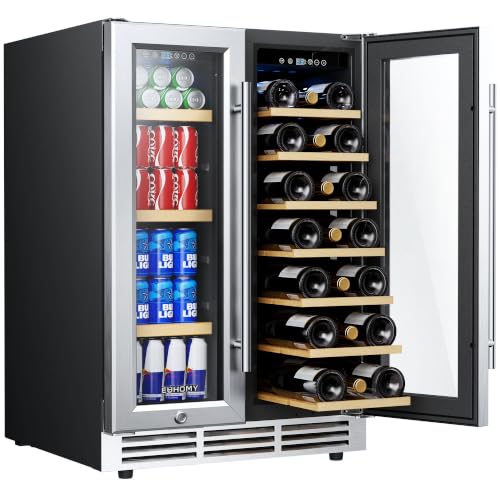
The best dual zone beverage refrigerators are front-venting undercounter models when you need a permanent home-bar installation, while freestanding dual-zone cabinets are the better value for renters, occasional entertaining, and larger can-and-bottle storage.
Our top picks


As an Amazon Associate we earn from qualifying purchases at no extra cost to you. Ratings are shown as listed on Amazon.
Quick picks by home-bar situation
| Situation | Best configuration | Typical capacity | Typical dimensions | Why it fits |
|---|---|---|---|---|
| Built-in bar or kitchen island | 24-inch front-venting beverage center | 90–120 cans, or 30–50 bottles | 23.5–24 in. W × 23–25 in. D × 34–35 in. H | Fits standard undercounter openings and vents from the front |
| Apartment, rental, or flexible room | Freestanding dual-zone cabinet | 60–100 cans, or 24–40 bottles | 19–24 in. W × 22–27 in. D × 32–35 in. H | Usually costs less and can be relocated |
| Wine plus mixers | Wine-oriented dual-zone refrigerator | 28–46 standard wine bottles | 19–24 in. W × 23–27 in. D × 32–35 in. H | Wood or metal racks protect bottles better than flat can shelves |
| Frequent parties and mostly cans | Wide beverage-center layout with adjustable shelves | 100–160 cans | 24–30 in. W × 23–28 in. D × 34–35 in. H | Uses shelves and pull-out bins more efficiently than wine racks |
These are planning ranges rather than guarantees. Interior shelves, bottle shape, can orientation, and the manufacturer’s counting method can change usable capacity considerably.
What “dual zone” should mean
A true dual-zone refrigerator has two separately controlled compartments, each with its own temperature sensor and cooling control. Look for two digital temperature displays and two independent adjustment ranges. A cabinet with one thermostat and a warm/cold gradient is not equivalent, even if it is marketed as having two zones.
For a mixed home bar, useful temperature ranges are approximately 36–50°F in the colder zone and 46–64°F in the warmer zone. The colder compartment suits beer, soda, sparkling wine, and mixers. The warmer compartment is more appropriate for red wine, white wine that will be chilled before serving, or beverages that do not need to be near refrigerator temperature.
Do not assume that every dual-zone unit can maintain its lowest advertised temperature in both compartments at once. Thermoelectric designs are often quieter but more sensitive to room temperature and may have narrower ranges. Compressor models generally cool more consistently, especially in a warm room, but can produce a noticeable hum and vibration.
Built-in versus freestanding: the installation decision
Choose built-in when the cabinet is permanent
A built-in beverage center vents heat through the front grille, allowing it to sit beneath a counter. This is the safer choice for an island, bar cabinet, or kitchen run. Measure the opening, not just the appliance listing: allow for door swing, handle projection, leveling feet, and the manufacturer’s specified side or rear clearance.
A nominal 24-inch model may be about 23.5 inches wide, but a tight opening can still create problems if the door needs extra space to open or the hinge cannot be reversed. Confirm whether the unit is designed for zero-clearance installation before planning a flush fit.
Choose freestanding when value and mobility matter
Freestanding models normally release heat at the back or sides. They need ventilation space and should not be enclosed tightly in cabinetry. A practical planning allowance is at least 1–2 inches around the sides and back unless the manual specifies otherwise. Placing one inside an unventilated cabinet can increase energy use, shorten compressor life, and make the interior struggle to reach its set temperature.
Freestanding cabinets are often less expensive and offer better capacity per dollar. They also make sense if you move, remodel, or want to store the refrigerator in a dining room during parties. Their disadvantages are a less integrated appearance, visible ventilation gaps, and more sensitivity to surrounding room temperature.
Head-to-head comparison of the main layouts
| Feature | 24-inch built-in beverage center | Freestanding dual-zone cabinet | Wine-first dual-zone cooler |
|---|---|---|---|
| Typical exterior width | 23.5–24 in. | 19–24 in. | 19–24 in. |
| Typical usable height | 32–34 in. under counter | 32–35 in. | 32–35 in. |
| Cooling system | Usually compressor | Compressor or thermoelectric | Compressor or thermoelectric |
| Best storage format | Cans, bottles, and mixed shelves | Cans and mixed beverages | Wine bottles, with limited cans |
| Typical noise range | About 39–45 dBA | About 38–48 dBA | About 38–46 dBA |
| Common price range | $700–$1,800 | $400–$1,200 | $450–$1,500 |
| Installation risk | High if ventilation requirements are ignored | High if placed inside tight cabinetry | Moderate; racks limit storage flexibility |
Capacity: calculate for the way you actually shop
Published capacity is often optimistic because it assumes identical cans or standard bottles with no gaps. A useful estimate is to reserve 15–25% of the listed capacity for irregular packaging and air circulation.
For example, a refrigerator advertised for 120 cans may provide approximately:
120 × 0.80 = 96 practical can spaces.
If your household uses 18 cans per week and you want a two-week supply plus a small entertaining buffer, the target is:
(18 × 2) + 12 = 48 cans.
A 60-can practical capacity would therefore be enough. Paying for a 160-can cabinet would add bulk without solving a real storage problem unless you regularly host larger gatherings.
Remember that a 750-milliliter wine bottle is roughly 3 inches in diameter, while a standard 12-ounce can is about 2.6 inches wide. Champagne bottles, tall cans, growlers, and half-bottles can reduce capacity quickly. Adjustable shelves are more valuable than a large headline number if your drinks vary.
Features worth paying for
- Independent controls: Each zone should have its own thermostat, display, and sensor rather than a single control with a claimed temperature gradient.
- Front ventilation: Essential for undercounter installation. Confirm the vent location before designing cabinetry.
- Adjustable or removable shelves: These allow the same cabinet to handle cans, wine bottles, mixers, and taller containers.
- Reversible door: Useful when the hinge side conflicts with a wall, counter, or neighboring appliance.
- Insulated glass: Double-pane glass reduces heat transfer and condensation compared with thin single-pane doors.
- Door alarm and child lock: Helpful in busy homes and prevents a partially closed door from warming the cabinet.
- Low-temperature memory: A power-loss memory feature can restore settings after a brief outage, although it does not keep beverages cold without electricity.
- Leveling feet: A level cabinet closes its door more reliably and reduces vibration.
Ownership realities: cleaning, noise, and early wear
The door gasket is one of the first parts to inspect when performance declines. Crumbs, sticky drink residue, and a twisted seal can allow warm air into the cabinet. Wipe the gasket with mild soapy water, dry it completely, and check that a sheet of paper held in the closed door offers light resistance around the perimeter.
Dust on a rear condenser or lower grille also reduces heat removal. Unplug the unit and clean accessible vents with a soft brush or vacuum every three to six months, more often in a dusty bar area. Never block the internal air channels with cans or bottles; a crowded shelf can create warm pockets even when the display shows the target temperature.
Compressor refrigerators commonly make a start-up click, a low hum, and occasional brief gurgling as refrigerant moves through the system. Those sounds are not automatically faults. Persistent rattling usually indicates contact with a wall, an unlevel cabinet, or loose shelving. Thermoelectric models avoid compressor vibration but may run their fans continuously.
Keep the refrigerator away from ovens, radiators, direct sun, and unconditioned garages. If the room is regularly hotter than the unit’s rated ambient temperature, the colder zone may not reach its advertised minimum.
Our buying recommendation
For most finished home bars, choose a 24-inch front-venting compressor model with two independently controlled zones, a practical capacity of at least 80 cans, and adjustable shelves. For a rental or occasional-use room, choose a freestanding compressor unit and spend less on built-in styling. If wine is the priority, select a wine-first cabinet with stable racks rather than forcing cans into curved bottle shelves.
The best dual zone beverage refrigerators are not necessarily the largest or coldest models. The right choice is the one whose temperature ranges match your drinks, whose usable capacity matches your consumption, and whose ventilation and dimensions suit the space without improvisation.
Frequently asked questions
Can one zone hold beer and the other hold wine?
Yes. Set the beer and mixer zone colder, commonly around 36–42°F, and use the other zone for wine or less-chilled beverages. Check the manufacturer’s minimum and maximum settings before buying.
Is a dual-zone refrigerator worth it for cans only?
Usually only if you regularly store drinks at two different temperatures. For cans alone, a single-zone beverage center often provides more capacity and lower cost. Dual zones become more useful when you combine beer, soda, sparkling wine, and red or white wine.
Can a freestanding model go under a counter?
Only if the manufacturer specifically approves built-in installation and provides front ventilation. Otherwise, leave the specified clearance around the cabinet and do not enclose the rear or sides.



Write Your Review
No reviews yet. Be the first to share your experience!