

Key takeaways
- Usable interior: compare the internal dimensions, not the exterior product name.
- Door clearance: confirm that the door can swing or slide without hitting a wall or sofa.
- Tray access: a removable tray is valuable for cleaning; check that it can be removed without dismantling the furniture.
- Bar and slat spacing: the dog should not be able to push its head through or catch a paw.
- Ventilation area: avoid designs with decorative panels covering most of the sides.
- Floor protection: use level feet or a mat, but do not block lower vents with a thick rug.
- Weight capacity: distinguish the dog-weight recommendation from the tabletop load limit. A tabletop rated for 40 pounds is not a containment rating for a 40-pound dog.
- Hardware: look for sturdy hinges, rounded edges, and fasteners that do not project into the interior.
The best dog crate furniture is the one that matches your dog’s measured sleeping space, not simply the weight printed on the box: choose a ventilated crate with enough room to stand, turn, and lie flat, then use a furniture-style enclosure only if your dog is already comfortable in a crate.
Our top picks


As an Amazon Associate we earn from qualifying purchases at no extra cost to you. Ratings are shown as listed on Amazon.
Best dog crate furniture by situation
| Situation | Best choice | Why it fits | Typical market range |
|---|---|---|---|
| Occasional daytime use and a modest budget | Wire crate with a separate wood-look cover | Usually the lowest-cost route, with strong airflow and easy cleaning | $60–$180 total |
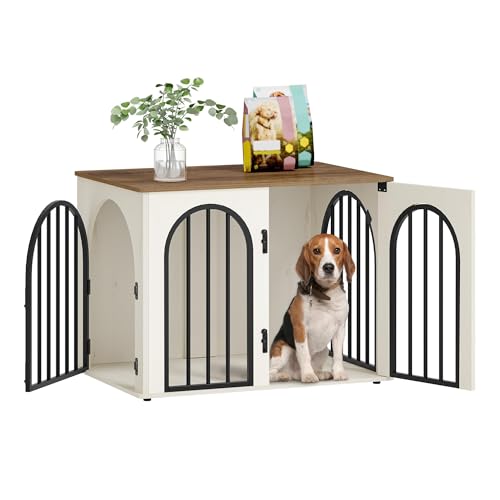
| Living-room crate for a calm, crate-trained dog | Wood or engineered-wood end-table crate | Looks most like furniture and can provide a useful tabletop | $150–$450 |
| Large dog or frequent daily use | Heavy-duty wire crate inside a ventilated furniture surround | Combines structural strength, visibility, and replaceable parts | $180–$550 |
| Puppy, chewer, or accident-prone dog | Metal crate with a washable cover or open furniture console nearby | Less vulnerable to urine, chewing, and repeated scrubbing | $80–$300 |
| Small dog in a carefully planned room | Compact wood-look crate table with removable tray | Can replace an end table without consuming much floor space | $120–$350 |
Start with the interior, not the exterior
Furniture-style crates often have thicker walls, corner posts, and trim than ordinary wire crates. A product listed as “30 inches” may therefore provide considerably less than 30 inches of usable interior length. Measure the actual inside length, width, and height from the manufacturer’s diagram or assembly instructions.
Measure your dog while standing naturally. Add approximately 4 inches to the nose-to-base-of-tail length for interior length, and add 4 inches to the floor-to-top-of-head height for interior height. For width, use the dog’s shoulder width or the widest part of the body and add at least 4 inches. These are starting points rather than rigid rules: a long-backed dog may need the next crate size even if its weight falls within the listed limit.
| Nominal crate size | Common interior range | Approximate dog weight range | Best suited to |
|---|---|---|---|
| 24-inch | 22–24 L × 16–18 W × 18–20 H in | Up to about 25 lb | Many toy and small breeds |
| 30-inch | 28–30 L × 18–20 W × 21–24 H in | About 25–40 lb | Compact small and medium dogs |
| 36-inch | 34–36 L × 22–24 W × 25–27 H in | About 40–70 lb | Medium and some larger, slender dogs |
| 42-inch | 40–42 L × 27–29 W × 30–32 H in | About 70–90 lb | Large dogs with adequate room to turn |
| 48-inch | 46–48 L × 28–30 W × 31–33 H in | About 90 lb and above | Very large or long-bodied dogs |
Weight ranges are only screening estimates. A 45-pound greyhound and a 45-pound bulldog can require very different interiors. If the crate is for a growing puppy, a divider is useful in a wire model; a fixed furniture crate may force you to buy another enclosure as the puppy grows.
Wood versus MDF: the durability decision
Solid wood
Solid wood furniture crates generally tolerate screw tightening, minor knocks, and repeated assembly better than fiberboard. Scratches can sometimes be touched up, and a quality finish can make the crate blend with a living-room table or cabinet. The trade-offs are higher weight, higher price, and vulnerability to urine or standing water if the finish is damaged.
MDF and particleboard
MDF and particleboard are common because they produce flat, consistent panels at a lower cost. They can look polished when laminated or painted, but exposed edges and screw holes are the weak points. Swelling can begin after a single substantial accident if liquid reaches an unsealed edge. Repeatedly removing and reinstalling hardware can also loosen the panel material.
Engineered wood is not automatically a poor choice. For a reliably house-trained, calm dog, a well-sealed MDF crate can be practical. Look for a removable plastic or metal tray, sealed lower edges, metal ventilation bars, and hardware that is accessible for retightening. Avoid relying on a wood floor alone as the only barrier against accidents.
Ventilation and escape safety matter more than the furniture finish
A crate surround should not turn a breathable crate into a closed cabinet. Prefer openings on more than one side, visible gaps between bars or slats, and a design that does not press tightly against a wall. Keep the back and side vents clear of curtains, cushions, and storage baskets.
Furniture crates are usually better for dogs that rest quietly and do not try to push, paw, or chew their way out. A determined dog can damage slats, ingest splinters, or dislodge panels. For dogs with a history of escape attempts, use a properly sized metal crate and treat any furniture surround as decoration rather than containment.
Do not place the crate in direct sun, beside a radiator, or where an open door could strike it. The furniture form can make heat and airflow less obvious, so check the interior on warm days and leave enough clearance for the door to open fully.
Head-to-head: furniture crate versus covered wire crate
| Factor | Furniture-style crate | Wire crate with cover |
|---|---|---|
| Living-room appearance | Most integrated; can resemble an end table | Acceptable with a tailored cover, but still visibly a crate |
| Ventilation | Depends on slat spacing and the amount of open area | Usually excellent when uncovered or lightly covered |
| Cleaning after accidents | More difficult if liquid reaches panels or joints | Removable tray and washable surfaces are usually simpler |
| Growing puppy | Often requires replacement at maturity | Divider allows the interior to expand |
| Chewing or escape risk | Wood and MDF can be vulnerable | Metal is generally the safer containment material |
| Moving and storage | Heavier and often less convenient to fold | Typically easier to fold, carry, and store |
What to inspect before buying
- Usable interior: compare the internal dimensions, not the exterior product name.
- Door clearance: confirm that the door can swing or slide without hitting a wall or sofa.
- Tray access: a removable tray is valuable for cleaning; check that it can be removed without dismantling the furniture.
- Bar and slat spacing: the dog should not be able to push its head through or catch a paw.
- Ventilation area: avoid designs with decorative panels covering most of the sides.
- Floor protection: use level feet or a mat, but do not block lower vents with a thick rug.
- Weight capacity: distinguish the dog-weight recommendation from the tabletop load limit. A tabletop rated for 40 pounds is not a containment rating for a 40-pound dog.
- Hardware: look for sturdy hinges, rounded edges, and fasteners that do not project into the interior.
A practical setup and maintenance routine
- Assemble the crate in its final location. Furniture-style models can be awkward to move once loaded, and moving them repeatedly can loosen joints.
- Check every interior surface. Run a cloth over seams and fasteners to find rough edges before your dog enters.
- Add a washable bed that leaves room to turn. A thick bed should not reduce the usable height enough to make the dog crouch.
- Introduce it with the door open. Feed treats or meals near the entrance, then inside, rather than forcing a dog into an unfamiliar enclosure.
- Clean spills immediately. Remove the tray, blot liquid, use a pet-safe cleaner compatible with the finish, and dry all edges completely.
- Inspect monthly. Check swollen panels, loose screws, cracked slats, rust, damaged tray edges, and bedding that has become too small.
One common mistake is buying a furniture crate based on the dog’s current weight while ignoring its sleeping posture. Another is treating attractive wood panels as proof of durability. The most dependable setup is often a metal crate with a removable, ventilated cover—especially for puppies, frequent users, and dogs that have not yet demonstrated calm crate behavior.
Bottom line
Choose a furniture-style wood or MDF crate when appearance and occasional indoor use are priorities, the dog is calm and house-trained, and the measured interior provides genuine room to stand, turn, and lie down. Choose a wire crate with a cover when ventilation, cleaning, growth, portability, or escape resistance matters more. The best dog crate furniture is therefore a fit-and-safety decision first and a decorating decision second.



Write Your Review
No reviews yet. Be the first to share your experience!