

Key takeaways
- Inspect the wheels: Remove embedded gravel, staples, and metal shards before rolling across wood or tile.
- Protect the route: Use moving blankets, hardboard sheets, or purpose-made floor runners over vulnerable areas, especially at doorways.
- Protect the deck: Add a dense moving blanket or rubber mat between the furniture and the platform. Avoid loose fabric that can slide out during a turn.
- Control the load: Strap tall furniture to the dolly, but do not compress fragile panels or doors excessively.
- Lift rather than drag: If a wheel jams, stop and reposition the load. Dragging can transfer grit beneath the caster and leave a long scratch.
The best furniture dollies for heavy moves are low-profile four-wheel platform dollies with at least a 1,000-pound rated capacity, non-marking swivel casters, and a padded or carpeted deck; choose rubber wheels for wood and tile, and larger hard casters for thick carpet or thresholds.
The right dolly depends less on the largest advertised weight than on four practical details: whether the platform supports the furniture’s footprint, whether the wheels roll over your floor and doorways, how easily you can steer it, and whether the deck or casters can damage finished surfaces. A 1,500-pound rating is not useful if a narrow platform tips under a tall cabinet or small casters stop at a carpet transition.
Our top picks


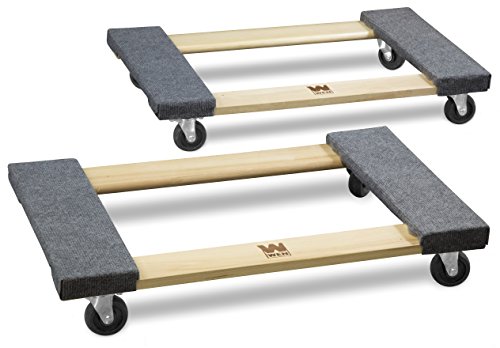

As an Amazon Associate we earn from qualifying purchases at no extra cost to you. Ratings are shown as listed on Amazon.
Best furniture dollies by moving situation
| Moving situation | Best dolly type | Recommended specifications | Why it fits |
|---|---|---|---|
| Occasional home moves on wood or tile | Padded platform dolly | 18–24 in. deck, 800–1,200 lb capacity, 4–5 in. soft rubber or polyurethane casters | Protects finished floors while handling sofas, appliances, and packed boxes |
| Heavy appliances or solid-wood furniture | Steel platform dolly with corner padding | 24–30 in. deck, 1,200–2,000 lb capacity, 5–6 in. non-marking wheels | Provides more stability and a larger safety margin |
| Thick carpet and frequent thresholds | Large-wheel furniture dolly | 6–8 in. wheels, 1,000–1,500 lb capacity, rigid rear wheels plus swivel front wheels | Larger wheels reduce drag and climb transitions more reliably |
| Tight rooms and frequent direction changes | Compact all-swivel platform dolly | 16–20 in. deck, four swivel casters, 600–1,000 lb capacity | Turns in confined spaces, although it is less stable at speed |
| Very tall or narrow furniture | Appliance or furniture hand truck with stair-climber features | 600–1,000 lb capacity, 8–10 in. wheels, strap points | Better control than a flat platform when the load’s height creates a tipping risk |
Platform size: measure the load, not just the room
A platform should support the furniture’s strongest lower frame, not merely touch two corners. Measure the base or the locations where the load will rest, then look for a deck that leaves roughly 2–4 inches of margin on each supported side. Too little support increases tipping risk; too much unused deck can make the dolly harder to position in narrow doorways.
For a typical sofa, a 24-by-18-inch platform can work if the weight is concentrated on a strong frame and the sofa is secured. A bookcase, chest, or appliance usually benefits from a 24-by-24-inch or larger deck. Before buying, measure the narrowest doorway and subtract the dolly’s deck width, the load’s overhang, and a few inches for steering clearance.
A low deck—often about 4–7 inches from the floor—makes lifting easier and lowers the center of gravity. However, very low casters can catch on thresholds. If your route includes door saddles or uneven flooring, prioritize wheel diameter and clearance over the lowest possible deck.
Wheel types compared for wood, tile, and carpet
Soft rubber wheels
Soft rubber casters are a strong choice for sealed hardwood, laminate, and tile because they reduce vibration and are less likely to leave marks than hard plastic wheels. They can develop flat spots if a heavy load remains parked for weeks, and they may feel sluggish on thick carpet.
Polyurethane casters
Polyurethane wheels offer a useful middle ground. They are usually quieter than steel or hard nylon, resist many oils and cleaners, and roll more easily on smooth floors. Non-marking polyurethane is preferable for light-colored tile and finished wood, but inspect the wheel material rather than assuming every polyurethane caster is floor-safe.
Nylon or hard plastic wheels
Hard wheels roll efficiently on warehouse floors and low-pile carpet, but they transmit more impact through tile grout lines and can scratch or mark some wood finishes. They are best reserved for unfinished utility floors or routes where floor protection is less important.
Steel wheels
Steel wheels are intended for industrial environments and very high loads. They can damage residential flooring and are usually excessive for moving household furniture. Unless the route is concrete or another highly durable surface, choose a non-marking alternative.
Capacity: leave room for uncertainty
Use the dolly’s rated capacity as a ceiling, not as a target. A practical household rule is to keep the estimated load at no more than 70–80% of the published rating. This accounts for uneven weight distribution, bumps, starting force, and the possibility that the furniture weighs more than expected.
For example, suppose a solid-wood cabinet is estimated at 650 pounds and contains 100 pounds of drawers or contents. The working load is:
650 + 100 = 750 pounds
At an 80% target, the minimum rated capacity is:
750 ÷ 0.8 = 938 pounds
In this case, a 1,000-pound dolly is the reasonable minimum, while a 1,200- or 1,500-pound model provides more margin. Do not assume four casters each carry exactly one-quarter of the load: floors are rarely perfectly level, and one wheel may carry much more during a turn.
Floor protection is a system, not just a wheel specification
- Inspect the wheels: Remove embedded gravel, staples, and metal shards before rolling across wood or tile.
- Protect the route: Use moving blankets, hardboard sheets, or purpose-made floor runners over vulnerable areas, especially at doorways.
- Protect the deck: Add a dense moving blanket or rubber mat between the furniture and the platform. Avoid loose fabric that can slide out during a turn.
- Control the load: Strap tall furniture to the dolly, but do not compress fragile panels or doors excessively.
- Lift rather than drag: If a wheel jams, stop and reposition the load. Dragging can transfer grit beneath the caster and leave a long scratch.
On tile, the main risk is often impact at grout lines rather than rolling friction. On wood, grit and a seized caster are bigger concerns. On carpet, the problem is usually resistance: forcing a small caster can make the load lurch, strain the operator, or pull the furniture off-center.
Which steering layout is easiest to control?
Four swivel casters provide the smallest turning circle and work well in bedrooms, storage rooms, and tight hallways. They can wander when pushed quickly, though, and a heavy load may rotate unexpectedly.
Two swivel casters and two rigid casters track more predictably. This layout is better for long, straight routes and heavy appliances, especially when one person needs to keep the load aligned. A pair of fixed wheels also reduces sideways movement on carpet.
A furniture hand truck is preferable when the item is tall, narrow, or must be tipped slightly to pass through a doorway. A platform dolly is preferable when the item has a broad, stable base and can be lifted or placed onto the deck without unsafe tilting.
Ownership realities: what wears out first
Casters and bearings usually wear before the steel or wood platform. Look for wobble, grinding, uneven wheel wear, or a caster that no longer swivels freely. Replace a damaged caster rather than continuing with three smooth wheels and one dragging wheel.
Deck carpeting becomes compressed and may collect grit. Replace it when the furniture can slide or when exposed fasteners could contact the load. Inspect welds, corner guards, handles, and strap points after every heavy move. Keep the dolly dry, wipe wheels with a damp cloth, and use only the lubricant recommended by the caster manufacturer; excess oil can attract dust and transfer onto flooring.
Store the dolly with no heavy load on it. Long-term compression can create flat spots in rubber wheels and shorten bearing life. If a platform has retractable handles or folding parts, check their locking pins before each use.
Bottom line
For most homeowners, the best furniture dolly is a 24-by-18- to 24-by-24-inch padded platform with a 1,000- to 1,500-pound rating and non-marking rubber or polyurethane casters. Choose larger 6- to 8-inch wheels for carpet and thresholds, a two-swivel/two-rigid layout for predictable travel, and four swivels for tight spaces. If the furniture is tall, unstable, or difficult to lift onto a platform, use a properly rated hand truck instead. The safest choice is the one that fits the load, leaves capacity margin, and protects the entire route—not simply the dolly with the highest number on its label.





Write Your Review
No reviews yet. Be the first to share your experience!