

Key takeaways
- Ignoring the stated weight rating and relying on appearance.
- Choosing a stand that is only as wide as the TV, so the TV tips more easily.
- Skipping the anti-tip strap, a safety essential in homes with children or pets.
- Buying glass doors, then discovering the remote does not work through them.
- Forgetting ventilation. Game consoles need clearance of at least 2-4 inches around vents.
The best TV stand for most living rooms is one that is at least 4 inches wider than your TV, rated for at least 1.5 times your TV’s weight, and sized so the screen center lands near seated eye level. For a 55-65 inch TV, that usually means a 58-70 inch wide console with a top shelf rated 100 lb or more. Wall-mounted TVs, fireplaces, and small apartments change the answer, so the picks below are organized by those situations.
Our top picks



As an Amazon Associate we earn from qualifying purchases at no extra cost to you.
Quick Comparison of the Best TV Stand Types
| Pick | Best for | Typical width | Typical weight rating | Price range |
|---|---|---|---|---|
| Media console with doors and shelves | Best overall | 58-70 in | 100-150 lb top | Mid-range |
| Low-profile cabinet | Best for modern living rooms | 55-75 in | 100-200 lb top | Mid-range to upper-mid |
| Corner TV stand | Best for small rooms | 40-55 in | 60-100 lb | Budget to mid-range |
| Entertainment center with hutch | Best for storage | 60-80 in | 100-150 lb | Mid-range to upper-mid |
| Fireplace TV stand | Best for ambiance | 58-72 in | 100-150 lb | Mid-range |
| Floating wall shelf | Best for clean floors | 48-70 in | Depends on wall mount | Budget to mid-range |
Best Overall: Media Console With Doors and Shelves
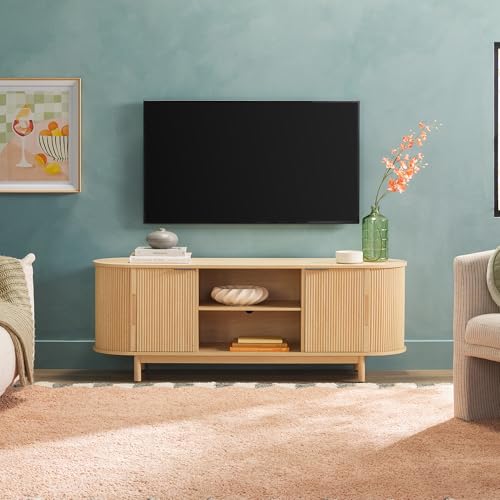
A console between 58 and 70 inches wide is the sweet spot for 55-65 inch TVs. Mixed storage, with closed cabinets for game consoles and open shelves for a soundbar or streaming box, handles most living-room needs. Popular examples include the IKEA BESTA and EKET systems, Walker Edison’s console series, and Sauder’s Cannery Bridge line. Look for cable pass-throughs in the back panel, adjustable shelves, and a stated weight rating on the top.
Trade-off: many consoles use particleboard, which has limits under heavy loads. A 65 inch OLED can weigh 50-70 lb with its stand, while a large 85 inch TV can exceed 100 lb. Always check the rated top load instead of guessing.
Best for Modern Rooms: Low-Profile Cabinet
Low cabinets stand 16-22 inches tall and keep the TV lower, which suits modern rooms and wall-hung art above. They often feature drawers, slatted doors, and metal legs. Choose models with a stated weight rating of 150 lb or higher if you plan to place a larger TV on the stand. A low profile looks sleek but can place a TV too low if you sit on a high sofa, so check viewing height.
Best for Small Rooms: Corner TV Stand
A corner unit tucks into a space that is otherwise wasted and works well for TVs up to 50 inches. Triangle designs with a 40-55 inch top reduce wall clutter and allow angled viewing. The drawbacks are limited storage and sizing: many corner stands max out at a 55 inch TV, and the TV’s feet may overhang the sides, so measure the foot spacing before buying.
Best for Storage: Entertainment Center With Hutch
An entertainment center adds side towers or an upper hutch to hold media, books, and decor. These are the best choice when you have a large media library or multiple consoles. They also hide cables well. The trade-off is bulk: expect depths of 16-20 inches and total heights of 60-72 inches. They are heavy, so plan to anchor them to the wall.
Best for Ambiance: Fireplace TV Stand
Electric fireplace stands add a heater and a flame effect to a standard console, often with a 1,500-watt heater on a standard 120-volt outlet. They suit cold living rooms or bedrooms. Check that the TV is not directly over a heating element, and that the manufacturer states the maximum TV size and weight. Some designs expect a TV to be wall-mounted above rather than placed on top.
Best for Clean Floors: Floating Wall Shelf
A floating media shelf stands off the floor and keeps cables hidden behind the wall. Choose a model rated for your TV’s weight and secure it to wall studs. It allows robot vacuums to pass and feels airy, but it requires drilling and professional-grade mounting for heavy TVs.
How to Choose a TV Stand
Match Width to TV Size
The stand should be wider than the TV so the screen does not appear to hang over the edge. Measure the TV’s width, not its diagonal. A 65 inch TV is about 57 inches wide, so a stand of at least 60 inches, and ideally 65, looks balanced.
| TV diagonal | Approx. TV width | Minimum stand width | Recommended stand width |
|---|---|---|---|
| 43 in | 38 in | 40 in | 42-48 in |
| 55 in | 48 in | 50 in | 54-60 in |
| 65 in | 57 in | 60 in | 62-70 in |
| 75 in | 65 in | 68 in | 70-78 in |
| 85 in | 74 in | 76 in | 78-85 in |
Check Weight Rating and Foot Spacing
Look up your TV’s weight in the manufacturer spec sheet and choose a stand rated for at least 1.5 times that. Also check the TV’s foot spacing, which can be 40-60 inches on large models. If the feet are placed at the edges, the stand’s top surface must extend beyond them.
Viewing Height
The center of the screen should sit at seated eye level, typically 40-44 inches from the floor. For a 65 inch TV (screen height about 32 inches), a 20 inch stand puts the center at about 36 inches, which is slightly low for tall sofas. If you sit high, consider a taller stand or mount the TV on the wall.
Soundbars and Streaming Gear
If you use a soundbar, leave 3-4 inches of space between the TV and shelf so it does not block the screen. Choose stands with open shelves, or ones with door fronts that allow infrared remote signals through, such as mesh or perforated panels.
Cable Management
Rear cutouts, grommets, and cord channels make a big difference. Without them, cables drape behind the stand and tangle. A separate surge protector with spaced outlets keeps adapters from blocking each other.
Ownership Realities and Mistakes to Avoid
- Ignoring the stated weight rating and relying on appearance.
- Choosing a stand that is only as wide as the TV, so the TV tips more easily.
- Skipping the anti-tip strap, a safety essential in homes with children or pets.
- Buying glass doors, then discovering the remote does not work through them.
- Forgetting ventilation. Game consoles need clearance of at least 2-4 inches around vents.
Frequently Asked Questions
How wide should a TV stand be?
The stand should be at least 4-6 inches wider than the TV, ideally 8-12 inches wider for a balanced look. Use the TV’s measured width, not its diagonal size.
How much weight can a TV stand hold?
It depends on the model. Many particleboard stands list 100-150 lb for the top, while solid wood and metal frames may carry 200 lb or more. Check the manufacturer’s rating and compare it with your TV’s weight.
How high should my TV be?
The screen center should be at eye level when you are seated, usually 40-44 inches from the floor. Mounting slightly higher than that causes neck strain over long sessions.
Can I put a TV on a console table?
Yes, if the table is rated for the weight, is stable, and is wide enough for the TV’s feet. Console tables are often shallower, so check the depth against the TV stand base.
Are fireplace TV stands safe?
They are safe when used according to the manufacturer’s instructions, which usually limit the TV size and require clearance above the heater. Use a dedicated outlet and do not cover the vents.






Write Your Review
No reviews yet. Be the first to share your experience!