

Key takeaways
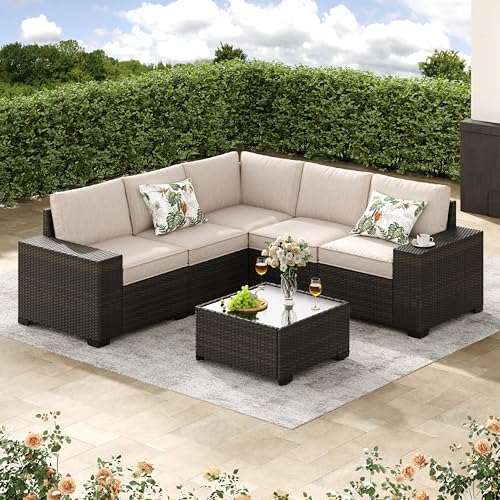
- L-shaped: The most versatile configuration for a corner, conversation area, or dining-adjacent patio. It usually provides five or six seats.
- U-shaped: Best for large groups and face-to-face conversation, but it can consume 120 inches or more in both directions.
- Linear modular: Useful against a long wall or railing. Several pieces can form a sofa, then separate into chairs when needed.
- Symmetrical corner set: A clean visual arrangement, though fixed left- and right-arm pieces offer less flexibility after purchase.
- Chaise sectional: Comfortable for lounging, but the chaise occupies space that cannot be used as a normal passage or dining seat.
The best outdoor sectional sofas are modular, powder-coated aluminum or high-quality teak designs with quick-drying cushions, removable covers, and enough clearance to move around the arrangement comfortably.
Our top picks



As an Amazon Associate we earn from qualifying purchases at no extra cost to you. Ratings are shown as listed on Amazon.
Best Outdoor Sectional Sofas by Patio Situation
| Patio situation | Best sectional type | Recommended size | Why it works | Typical market range |
|---|---|---|---|---|
| Small balcony or compact deck | Two-piece L-shaped sectional | 60–78 in. wide; seats 3–4 | Uses a corner without blocking the main walkway | $700–$1,800 |
| Average covered patio | Three-piece L-shaped sectional | 90–110 in. per side; seats 5–6 | Balances conversation seating with manageable footprint | $1,200–$3,000 |
| Large uncovered terrace | Four- to six-piece modular sectional | 110–150 in. per side; seats 6–9 | Can be separated, reconfigured, or expanded | $2,000–$5,500 |
| Frequent entertaining | U-shaped or pit sectional | 120–180 in. overall; seats 7–10 | Maximizes seating around a central coffee table | $2,500–$6,500 |
| Windy or coastal location | Low-profile aluminum or teak modular set | Seat height 16–19 in.; seats 4–8 | Resists corrosion and is less vulnerable to tipping | $1,500–$5,000 |
Our Top Picks by Design and Construction
Best overall: modular powder-coated aluminum sectional
For most patios, a modular sectional with an aluminum frame offers the best balance of weight, weather resistance, and flexibility. Aluminum does not rust, and a powder-coated finish helps protect it from oxidation, scratches, and everyday moisture. A three-piece L-shaped configuration usually seats five or six people while leaving more usable floor area than a U-shaped design.
Look for frame rails with welded or mechanically reinforced joints, adjustable feet, and connectors that keep modules from separating. Thin decorative frames can look modern but may flex under heavy use. A practical target is a seat supporting at least 300 pounds per person, with a total weight that is substantial enough not to slide easily but manageable enough to reposition.
Best for a natural look: teak sectional
Teak is a strong choice when you want warm wood grain and a heavier, more grounded appearance. Its natural oils help it tolerate outdoor exposure, although it is not maintenance-free. Unfinished teak gradually turns silver-gray; cleaning and occasional teak treatment can preserve a warmer color.
Teak sectionals are generally heavier than aluminum models, which is useful in windy areas but inconvenient if you frequently rearrange the patio. Check whether the hardware is stainless steel and whether the wood is responsibly sourced. Avoid placing teak directly against constantly wet soil or standing water.
Best for low maintenance: all-weather resin or HDPE lumber
High-density polyethylene lumber and other outdoor resin materials do not require sealing, and they resist moisture, insects, and peeling paint. They are especially practical for uncovered patios or homes where furniture will remain outside year-round. The trade-off is weight: these frames can be difficult to move, and dark colors may become hot in direct sun.
Choose slatted or ventilated designs that allow rain to drain instead of collecting beneath cushions. Resin frames can last for years, but inexpensive plastic connectors, glides, and cushion fabric may wear before the frame does.
Configuration Matters More Than the Number of Seats
A sectional advertised as seating six may provide six upright seats but little room for people to enter or place drinks. Compare the arrangement as a floor plan, not just as a capacity label.
- L-shaped: The most versatile configuration for a corner, conversation area, or dining-adjacent patio. It usually provides five or six seats.
- U-shaped: Best for large groups and face-to-face conversation, but it can consume 120 inches or more in both directions.
- Linear modular: Useful against a long wall or railing. Several pieces can form a sofa, then separate into chairs when needed.
- Symmetrical corner set: A clean visual arrangement, though fixed left- and right-arm pieces offer less flexibility after purchase.
- Chaise sectional: Comfortable for lounging, but the chaise occupies space that cannot be used as a normal passage or dining seat.
For regular entertaining, prioritize separate seat cushions and movable ottomans. They let you create an extra seat without permanently enlarging the sectional. For everyday lounging, deeper seats of 23–27 inches are comfortable for many adults; shallower seats around 20–22 inches are easier to stand from and better suited to upright conversation.
Patio Clearance: Measure the Arrangement, Not the Sofa Alone
Use the manufacturer’s assembled dimensions, then add the operating space around the furniture. A comfortable planning rule is:
- Allow at least 30 inches for a basic walking path.
- Allow 36 inches where people frequently pass behind seated guests.
- Leave 14–18 inches between the sofa and a coffee table.
- Leave 24–30 inches between a coffee table and the edge of the walking route.
- Reserve at least 2 inches from walls for airflow and cushion removal.
- Keep doors, grills, gates, and storage access fully operable.
For example, an L-shaped sectional measuring 96 by 96 inches needs more than a 96-by-96-inch corner. Adding 30 inches of access on the open sides produces a practical planning area of approximately 126 by 126 inches, or 110 square feet. If a coffee table is included, the usable footprint may approach 140 by 140 inches depending on its diameter.
Cushion Construction and Weather Protection
Outdoor cushions fail most often at the seams, zipper, foam core, and underside—not necessarily on the visible top surface. The best designs use solution-dyed acrylic or comparable outdoor fabric, high-density foam, polyester fiber wrap, and a mesh or slatted base that lets water escape.
Quick-drying foam is valuable in humid or rainy climates because it reduces the time cushions remain wet. It does not make them waterproof. Store cushions under cover during prolonged storms, and stand them on edge after rain so air can reach all sides.
Examine the cushion details before buying:
- Removable, machine-washable covers are easier to maintain than permanently attached upholstery.
- Double-stitched seams and covered zippers reduce water entry and fraying.
- At least 4 inches of seat foam generally feels more supportive than thin fiber-filled pads.
- Separate back and seat cushions are easier to replace individually.
- Light colors show fewer heat-related problems, while darker fabrics may fade faster in intense sun.
A fitted cover protects against dust and ultraviolet light, but it must be breathable and properly secured. A nonbreathable tarp can trap condensation and encourage mildew. Covers should not be used as a substitute for draining wet cushions.
Decision Matrix: Which Sectional Fits Your Priorities?
| Priority | Choose | Be cautious about |
|---|---|---|
| Lowest upkeep | Powder-coated aluminum or HDPE frame with solution-dyed fabric | Untreated wood and cushions that cannot be removed |
| Frequent layout changes | Four or more identical armless modules with clips | Fixed left/right arms and permanently joined frames |
| Small space | Two- or three-piece L-shape under 100 inches per side | Deep chaise ends and oversized coffee tables |
| Strong wind | Heavy teak or resin frame, low profile, and anchoring points | Lightweight unanchored aluminum modules |
| Limited budget | Simple aluminum frame with replaceable cushions | Paying for extra modules you will rarely use |
| Year-round outdoor use | Corrosion-resistant frame, quick-dry foam, breathable cover | Steel without robust rust protection |
Ownership Costs and Maintenance Realities
The frame usually outlasts the soft goods. Cushion covers may fade or lose their shape after several seasons of strong sun, while feet, clips, and zipper pulls can wear sooner in wet or sandy environments. Before choosing a set, confirm that replacement covers and cushions can be ordered individually rather than requiring a complete new sectional.
For routine care, brush away debris weekly, wipe spills promptly with mild soap and water, and rinse salt or chlorine residue with clean water. Never pressure-wash cushions, and avoid bleach unless the fabric manufacturer specifically permits it. Inspect fasteners at the beginning and end of each season, tighten loose hardware, and replace cracked glides before a frame starts rocking.
One useful cost calculation is cost per season. A $2,400 sectional used for eight months each year over six years costs approximately $50 per month of active use, before replacement cushions or maintenance. A cheaper set that needs new cushions after two seasons may cost less initially but more over its useful life.
What to Check Before Ordering
- Measure elevators, gates, stair turns, and door openings—not only the patio.
- Confirm whether the quoted dimensions include clips, side tables, or arm caps.
- Check module weights if you will store the set seasonally.
- Verify the frame warranty separately from the fabric warranty.
- Ask whether replacement cushions, covers, feet, and connectors are available.
- Confirm the sectional’s left- and right-hand orientation or select reversible modules.
- Plan where cushions will go during rain, winter, smoke, or extended periods away.
For most buyers, the strongest choice is a three-piece, powder-coated aluminum L-sectional with quick-drying, removable cushions and at least 30 inches of circulation space. Choose teak when appearance and wind resistance matter more than weight, or HDPE lumber when minimum frame maintenance is the priority. The right configuration is the one that fits your actual patio clearances, not simply the one with the highest advertised seat count.





Write Your Review
No reviews yet. Be the first to share your experience!