

Key takeaways
- Class A: paper, wood, cloth, cardboard, and many plastics.
- Class B: gasoline, oil, paint, solvents, and other flammable liquids.
- Class C: fires involving energized electrical equipment in the U.S. classification system. Once power is disconnected, the remaining material may be a Class A or B fuel.
- Class D: combustible metals such as magnesium or titanium. These require specialized agents and are unusual in ordinary homes.
- Class K: cooking oils and fats, particularly in deep fryers and commercial-style kitchens.
The best fire extinguishers for home safety are listed, multipurpose ABC extinguishers sized for the room, with a readable pressure indicator, a secure wall or cabinet mount, and a maintenance schedule you will actually follow.
Our top picks


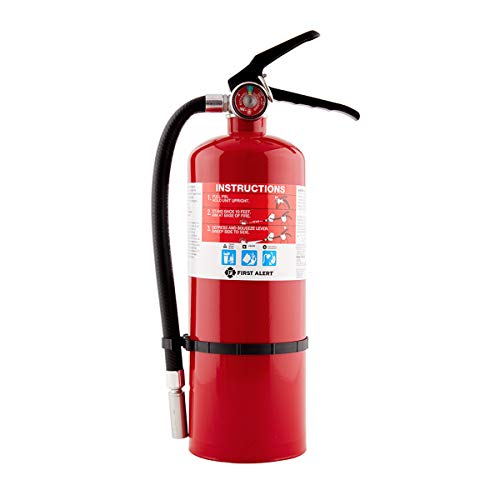

As an Amazon Associate we earn from qualifying purchases at no extra cost to you. Ratings are shown as listed on Amazon.
Quick picks by household situation
| Situation | Best choice | Why it fits | Typical market range |
|---|---|---|---|
| Small apartment or first purchase | 2-A:10-B:C, 2.5- to 5-pound ABC unit | Compact enough for an entryway, yet suitable for ordinary combustibles, liquids, and energized electrical equipment | $25–$60 |
| Large kitchen or open-plan home | 5-pound ABC unit near the exit, plus a lid or approved Class K extinguisher for cooking-oil risk | Provides more agent and reach without relying on an extinguisher beside the stove | $45–$150 total |
| Garage or workshop | 5- to 10-pound 3-A:40-B:C ABC unit | Greater capacity for fuel, paint, solvents, wood, and electrical equipment | $60–$180 |
| Wood stove, fireplace, or rural property | 5- or 10-pound ABC unit, with an additional unit on the route to an exterior door | Improves access when ash, logs, or nearby furnishings create a higher ordinary-combustible load | $60–$180 per unit |
| Commercial-style cooking equipment | UL-listed Class K wet-chemical extinguisher sized by the installation requirements | Designed for hot cooking oils and fats; an ABC unit alone is not the right kitchen solution | $100–$300 |
These are buying ranges, not performance guarantees. Look for an independent certification mark such as UL and confirm that the extinguisher is approved for the hazards in your home. Brands such as Kidde, First Alert, Amerex, and Buckeye offer established residential or commercial lines, but the label, rating, condition, and serviceability matter more than the name on the cylinder.
Understand the fire classes before choosing
- Class A: paper, wood, cloth, cardboard, and many plastics.
- Class B: gasoline, oil, paint, solvents, and other flammable liquids.
- Class C: fires involving energized electrical equipment in the U.S. classification system. Once power is disconnected, the remaining material may be a Class A or B fuel.
- Class D: combustible metals such as magnesium or titanium. These require specialized agents and are unusual in ordinary homes.
- Class K: cooking oils and fats, particularly in deep fryers and commercial-style kitchens.
A household ABC extinguisher is the sensible general-purpose choice because it covers Classes A, B, and C. Its dry chemical agent can make a mess and may damage sensitive electronics if it enters equipment, but using the correct extinguisher is more important than avoiding cleanup. Never throw water onto burning oil or an energized electrical fire.
How to read an extinguisher rating
A label such as 2-A:10-B:C contains useful information. The number before A represents an approximate relative extinguishing capability against Class A fires; a higher number indicates greater capacity. The number before B indicates the approximate square-foot rating for a trained operator under standardized conditions. The letter C confirms suitability for energized electrical equipment, but it does not mean the cylinder contains a separate electrical-fire chemical.
Do not treat the rating as a guarantee that a homeowner can safely fight a fire of that size. Smoke, heat, hidden fire, wind, and panic can make a small fire dangerous within seconds. Use an extinguisher only when the fire is small and contained, everyone is leaving, emergency services have been called, and you have a clear escape route behind you.
Size, weight, and discharge time
The cylinder’s agent weight is not the same as its total carrying weight. A “5-pound” extinguisher may weigh roughly 8 to 10 pounds when full, depending on its cylinder and valve. Choose a unit every adult in the home can lift, aim, and carry with one hand while operating the handle with the other.
| Nominal agent size | Approximate full weight | Typical discharge time | Practical use |
|---|---|---|---|
| 2.5 pounds | 4–5 pounds | 8–12 seconds | Apartment, bedroom-level exit route, or supplemental unit |
| 5 pounds | 8–10 pounds | 12–20 seconds | Best all-around size for many homes and garages |
| 10 pounds | 16–20 pounds | 20–30 seconds | Workshop, detached garage, or larger hazard area |
| Class K, 1.5 gallons | 20–25 pounds | 40–60 seconds | Higher-volume cooking-oil hazard; size according to the cooking installation |
Manufacturers and models vary, so use the printed specification as the final authority. A simple fit calculation helps: if an adult can comfortably carry 10 pounds but struggles with 18 pounds, two 5-pound units placed along separate escape routes are usually more useful than one heavy cylinder that nobody wants to retrieve.
Where to put extinguishers in each room
Kitchen
Do not mount an extinguisher directly beside the cooktop or behind the stove. A fire could block access. Place an ABC unit near the kitchen exit or on an adjacent wall, several steps away from the cooking area. If deep-frying or large amounts of oil are routine, add a Class K unit where it can be reached without leaning over the appliance. A pan lid or baking sheet is often useful for smothering a small contained pan fire; never move a burning pan.
Garage and workshop
Mount a 5- or 10-pound ABC extinguisher near the pedestrian door, not next to gasoline cans, a furnace, welding equipment, or a workbench where a fire could cut off access. Keep it visible and protected from vehicle impact. If metal dusts or powders are used, consult a fire-safety professional about a Class D extinguisher rather than assuming ABC is adequate.
Living room and bedrooms
Place an extinguisher along the route to an exterior door, where it can be seen without entering a smoke-filled room. A compact 2.5- or 5-pound ABC model is usually more practical than a large unit in a hallway or beside furniture. Do not hide it inside a closet, behind curtains, or inside a locked cabinet.
Utility room and home office
An ABC extinguisher near the door covers paper, cardboard, wiring, and many household devices. Keep clearance around electrical panels and heating equipment, and never block access to a shutoff switch. For expensive electronics, prevention and rapid power disconnection are preferable to spraying an extinguisher into equipment.
Pressure gauges, mounting, and installation details
Most stored-pressure residential extinguishers have a gauge with a green operating zone. Check that the needle remains in the specified zone, the pull pin and tamper seal are intact, the hose or nozzle is unobstructed, and the cylinder has no corrosion, dents, leakage, or powder buildup. A green needle does not prove that the agent is usable; it only indicates pressure at that moment.
Some specialty extinguishers use a pressure indicator or different valve arrangement. Do not press the test mechanism, discharge the unit “to see if it works,” or recharge a disposable model yourself. Replace a disposable extinguisher after any discharge, even a brief one.
Use the manufacturer’s bracket or a listed wall hanger attached to a stud or suitable masonry anchor. Keep the handle easy to reach and the instructions facing outward. A common installation height is with the handle no more than about 5 feet above the floor for lighter units, while heavier units should be mounted lower so they can be removed safely. Follow local fire-code and manufacturer requirements, especially in shared buildings.
Maintenance dates and ownership costs
Write the purchase date on your household safety calendar and perform a visual check at least monthly. Look for corrosion, damage, missing labels, a discharged gauge, blocked access, and changes in the surrounding hazard. An annual inspection by a qualified professional may be required by local rules, building type, or the extinguisher’s service instructions.
Rechargeable units generally cost more initially but can be serviced after use. Disposable units may be cheaper and are often replaced rather than recharged. Many dry-chemical extinguishers require periodic internal maintenance and hydrostatic testing at intervals determined by their construction and agent; common intervals include five or twelve years, but the label and service technician’s schedule control. Do not rely on a date stamped on the cylinder without understanding whether it is a manufacture date, service date, or replacement recommendation.
Dry chemical can settle or compact after vibration and age. If the manufacturer specifically instructs it, gently turn the cylinder upside down and back during routine inspection; never do this if the instructions prohibit it, and never strike the cylinder. Keep all extinguishers away from freezing temperatures, extreme heat, corrosive chemicals, and direct weather unless the model is rated for those conditions.
Final buying checklist
- Choose ABC for general home coverage, Class K for substantial cooking-oil hazards, and specialized D equipment only for combustible metals.
- Buy a size every intended user can carry; two accessible medium units can outperform one oversized unit.
- Confirm the rating, certification mark, agent type, manufacture or service information, and operating temperature range.
- Select a readable gauge when the model uses one, but still inspect the cylinder, seal, pin, hose, and label.
- Mount each extinguisher on an escape route, away from the likely fire source and never behind furniture.
- Call emergency services first and evacuate if the fire is spreading, producing heavy smoke, blocking an exit, or larger than a small wastebasket-sized fire.
The best fire extinguisher is the correctly rated unit that is visible, reachable, maintained, and small enough for the people in your home to use safely. It is a last-resort tool—not a substitute for working smoke alarms, carbon-monoxide alarms, an evacuation plan, and professional fire-safety advice when your property has unusual hazards.



Write Your Review
No reviews yet. Be the first to share your experience!