

Key takeaways
- Hydraulic seals: Slow lowering, oil around the ram, or a saddle that sinks under load can indicate seal wear or trapped air. Follow the manufacturer’s bleeding procedure instead of adding random hydraulic fluid.
- Wheels and casters: Metal chips and concrete dust can make casters drag. Clean the axles and lubricate only where the manual permits.
- Saddle pad: Rubber pads tear, flatten, or become oily. Replace damaged pads rather than stacking improvised wood or rubber pieces.
- Handle socket and release valve: Excessive force can bend the handle or damage the release mechanism. Lower the jack with controlled valve movement.
- Frame corrosion: Wipe off water, road salt, and brake cleaner. Store the jack with the ram retracted and protected from rain.
The best floor jacks for DIY garages are a 3-ton low-profile steel jack for most cars, a lightweight aluminum model for frequent repositioning, and a high-lift truck jack only when your vehicle’s ride height demands it.
Our top picks
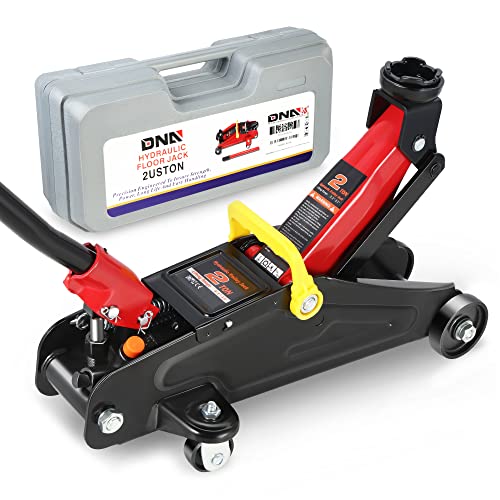

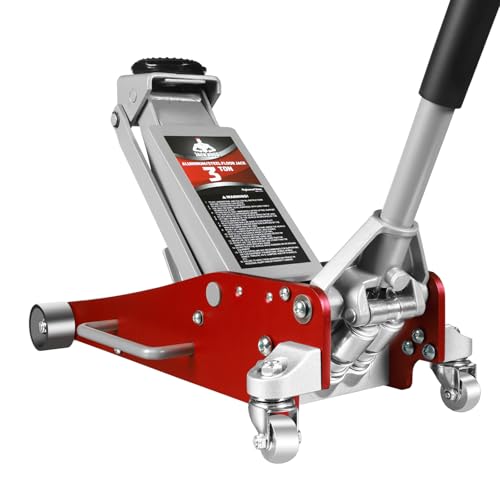
As an Amazon Associate we earn from qualifying purchases at no extra cost to you. Ratings are shown as listed on Amazon.
Quick picks by garage situation
| Garage situation | Best jack type | Useful target specifications | Why it fits |
|---|---|---|---|
| One daily driver or small SUV | 3-ton low-profile steel | 2.75–3.00 in minimum height; 19–21 in maximum height; 70–100 lb | Good reach, stable chassis, and enough capacity for routine wheel and brake work |
| Sports car or lowered car | Low-profile racing-style jack | 2.00–2.50 in minimum height; 18–20 in maximum height; 50–75 lb | Fits beneath low rocker panels without requiring ramps |
| Frequent repositioning around a small garage | Aluminum or hybrid 2.5–3-ton jack | 55–75 lb; 3–5 in saddle diameter; swivel rear casters | Much easier to roll and angle than a heavy shop jack |
| Pickup, 4×4, or crossover with substantial suspension travel | High-lift 3- or 4-ton floor jack | 4–5 in minimum height; 22–25 in maximum height; 90–120 lb | Provides the extra saddle height needed at factory lift points |
| Occasional emergency use on a tight budget | Compact 2- or 3-ton service jack | 3–4 in minimum height; 14–18 in maximum height; 45–70 lb | Lower purchase cost, although reach and stability are more limited |
Best floor jacks compared
Best all-around choice: 3-ton low-profile steel floor jack
A 3-ton low-profile steel jack is the most sensible starting point for a mixed DIY garage. Models such as the Daytona 3 Ton Low-Profile Floor Jack, Sunex 6603LP, and Torin BlackJack B6350 represent this category. Their published specifications commonly fall near a 6,000-pound rated capacity, a minimum height of roughly 2.75 to 3 inches, and a maximum height of approximately 19 to 21 inches.
The main advantage is balanced geometry. The long chassis reaches inward beneath a vehicle, while the broad front wheels and rear swivel casters keep the jack comparatively stable as the saddle rises. Steel does make these jacks heavy—often 70 to 100 pounds—but that weight reduces unwanted movement on a sound concrete floor.
Choose this type if you service sedans, hatchbacks, minivans, and moderate-size SUVs several times a year. A 3-ton rating is not permission to lift any 6,000-pound vehicle anywhere you like; the rating applies to the jack’s design and must be used within its instructions, on a level surface, with the load centered.
Best for low cars: 2- to 3-ton ultra-low-profile jack
Lowered cars and many factory sports cars need a different priority: minimum height. A jack that starts at 3.5 inches may not fit beneath the designated lifting point, even if its capacity is excellent. Low-profile racing-style jacks typically begin around 2 to 2.5 inches and lift to roughly 18 to 20 inches.
The trade-off is chassis length and weight. Some compact low-profile designs have a smaller saddle and less maximum height than a general-purpose 3-ton jack. Measure the distance from the floor to the actual lifting point—not merely to the plastic side skirt—and leave clearance for a slightly uneven floor or a flat tire.
Sunex 6603LP is a well-known example of the low-profile 3-ton class. Similar products may use steel, aluminum, or a steel-aluminum hybrid. Aluminum reduces rolling weight, but the frame may show scratches and can feel less planted than a heavy steel chassis.
Best for portability: aluminum or hybrid floor jack
If you regularly move the jack between bays, store it on a shelf, or work in a narrow garage, weight becomes a practical specification rather than a detail. Aluminum and hybrid jacks commonly weigh about 50 to 75 pounds, compared with 70 to 120 pounds for many full-size steel models.
Look for a long handle, smooth rear swivel casters, and a saddle that remains aligned with the lifting point as the arm rises. A light jack is easier to position, but it can roll or twist more readily if the concrete is cracked or the load is not centered. For that reason, portability should not outweigh chassis width and caster quality when you work on tall SUVs or heavy trucks.
Best for trucks: high-lift 3- or 4-ton floor jack
Truck owners should compare maximum height before capacity. A 3-ton jack that rises only 18 inches may lift a car successfully but leave a pickup’s tire touching the ground. High-lift floor jacks commonly reach 22 to 25 inches and may start around 4 to 5 inches high.
The extra reach is useful for frame rails, axle housings, and manufacturer-approved lift points. It also creates a larger storage footprint and typically raises weight into the 90- to 120-pound range. A 4-ton rating can add a useful margin for larger vehicles, but it does not replace jack stands or make an unsuitable lifting point safe.
What the specifications mean in real use
Lifting capacity
A vehicle’s curb weight is distributed across four contact areas, so a jack normally lifts only part of the vehicle. That does not mean a 2-ton jack is automatically appropriate for a 4,000-pound car. During lifting, weight shifts, cargo may be present, and the load can become uneven. For a general DIY garage, 3 tons is a useful middle ground; select 4 tons for heavier trucks when the manufacturer permits it.
Minimum and maximum height
Minimum height determines whether the saddle can reach the lift point. Maximum height determines whether the wheel or suspension component clears the floor. Compare both numbers with your vehicle’s service points. If you need to lift a wheel 16 inches off the floor, a jack with a 17-inch maximum height may have little practical margin once the saddle and suspension geometry are considered.
Saddle size and lift-point fit
Most floor jacks use a round saddle approximately 3 to 5 inches across. A larger saddle spreads load but may not fit into a narrow factory notch. A smaller saddle fits confined points but concentrates force and can damage a seam if positioned incorrectly. A removable rubber saddle pad can protect painted or coated lift points, but it must not raise the jack so much that minimum-height clearance is lost.
Chassis clearance
The saddle is not the only part that must fit. The front edge of the jack, lift arm, and handle linkage also need clearance beneath the bumper, rocker panel, exhaust, and underbody shields. Long-reach jacks can access a central crossmember without placing the wheels against the bumper, while short compact jacks may be easier to store but harder to position correctly.
Weight and maneuverability
Large front wheels roll more easily over small floor joints than small casters. Rear swivel casters help you angle the jack, but they should rotate without binding. A long handle improves leverage and lets you pump from outside the vehicle; it also needs enough overhead and side clearance to swing. In a single-car garage, measure the jack’s width and handle arc, not just its folded storage dimensions.
A simple sizing calculation
Suppose your crossover weighs 4,200 pounds and you plan to lift one end. The static share at that end might be about 2,100 pounds, but suspension layout, cargo, slope, and movement can change the load. A 3-ton jack has a nominal 6,000-pound capacity, leaving a substantial rating margin for that one-end lift when used exactly as instructed.
For a two-wheel lift, the more important check is height: if the wheel must rise 14 inches and the jack’s saddle reaches 19 inches, the theoretical 5-inch difference may be reduced by the vehicle’s suspension movement and the height of the lift point. Confirm clearance with the vehicle specifications rather than relying on capacity alone.
Ownership realities: what wears first
- Hydraulic seals: Slow lowering, oil around the ram, or a saddle that sinks under load can indicate seal wear or trapped air. Follow the manufacturer’s bleeding procedure instead of adding random hydraulic fluid.
- Wheels and casters: Metal chips and concrete dust can make casters drag. Clean the axles and lubricate only where the manual permits.
- Saddle pad: Rubber pads tear, flatten, or become oily. Replace damaged pads rather than stacking improvised wood or rubber pieces.
- Handle socket and release valve: Excessive force can bend the handle or damage the release mechanism. Lower the jack with controlled valve movement.
- Frame corrosion: Wipe off water, road salt, and brake cleaner. Store the jack with the ram retracted and protected from rain.
Never work beneath a vehicle supported only by a floor jack. Raise it at the approved points, place properly rated jack stands on solid structural locations, and lower the vehicle onto the stands before beginning work. Chock wheels that remain on the ground and keep the jack available only as a secondary support if the service procedure calls for it.
Final buying recommendation
For most DIY garages, buy a 3-ton low-profile steel jack with a minimum height near 3 inches, a maximum height around 20 inches, a 3- to 4-inch saddle, broad front rollers, and rear swivel casters. Expect a general market price of roughly $150–$350, with lighter aluminum and premium long-reach designs often costing more.
Choose a lower-profile racing-style jack only when your vehicle’s clearance requires it, and choose a high-lift 3- or 4-ton model when your truck’s approved lifting point sits too high for a standard jack. The best floor jack is the one whose minimum height, saddle shape, maximum reach, and rolling footprint all match your vehicle and your garage—not simply the one with the largest capacity number.



Write Your Review
No reviews yet. Be the first to share your experience!