

Key takeaways
- Compare the best bread knives for sourdough, sandwich loaves and crusty bakes, with blade lengths, serration styles, handle picks and simple care tips.
A good bread knife does one job better than any other blade in the drawer: it saws through a crackling crust without crushing the soft crumb underneath. A chef’s knife presses down and tears; a serrated bread knife grips the crust with its teeth, then glides back and forth so the slice comes away clean, even and intact. That difference matters most with homemade sourdough, rustic boules and crusty baguettes, but the same long, toothed edge also handles soft sandwich loaves, tomatoes, melons and layer cakes without dragging.
The five knives below are all single bread knives, not sets, and they cover the main styles worth considering: a wide wavy edge from Mercer Culinary, the professional Fibrox Pro handle from Victorinox, a light Japanese slicer from Tojiro, a forged double-serrated blade from Wüsthof, and a Damascus-clad Shun Classic. They range from 9 to 10.25 inches of blade, which is the useful span for everything from a baguette to a wide country loaf.
As an Amazon Associate, I earn from qualifying purchases.
How to Choose a Bread Knife
Blade length. Most bread knives run from 8 to 10.25 inches. A 9-inch blade suits standard sandwich loaves and smaller boules, while a 10-inch or longer blade keeps your knuckles clear of the board on wide, round loaves and lets the teeth do the work in long strokes instead of short, cramped sawing. If you bake large sourdough rounds, lean longer; if you mostly slice rolls and bagels, a shorter blade is easier to control.
Serration style. Pointed teeth bite into hard crust quickly but can shred a tender crumb. A wavy or scalloped edge is gentler on soft loaves while still gripping crust. Double-serrated edges, with smaller serrations cut inside the larger ones, stay effective for longer and need less downward pressure. For a mixed baking habit, a wavy or double-serrated edge is the most forgiving choice.
Blade shape and offset. A wide blade gives the edge room to travel through tall loaves without the spine dragging. Some bread knives have an offset handle that raises your hand above the board so you can finish a slice without rapping your knuckles; the five picks here use straight handles, which feel familiar and store easily, but they reward a board with a little height.
Steel and construction. Stamped blades, like the Mercer Culinary and Victorinox below, are light, thin and easy to maintain. Forged blades, like the Wüsthof, add weight and a sturdier feel. Japanese options such as the Tojiro and Shun use harder steel and thinner edges for a cleaner cut through delicate crumb. None of these edges can be maintained on a standard sharpening steel the way a straight edge can, so serration quality matters from day one.
Handle comfort. Bread slicing is a repetitive sawing motion, so the handle should fill the hand without hot spots. Textured synthetic handles (Santoprene, Fibrox) grip well with damp hands, while wood and PakkaWood handles feel warmer and more traditional. If you slice several loaves in a session, comfort beats looks.
Care. Hand washing and drying right away keeps any of these edges in good shape. Store the knife in a block, on a magnetic strip or with a blade guard; loose in a drawer, the teeth dull against other tools and become a hazard to reaching fingers.
The 5 Best Bread Knives
1. Mercer Culinary Millennia 10-Inch Wide Wavy Edge Bread Knife (M23210)
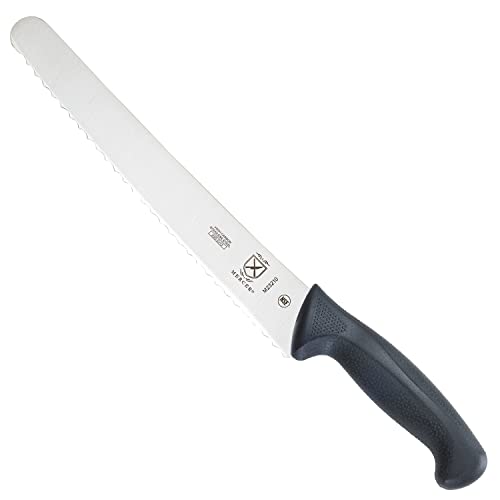
The Millennia bread knife is the workhorse of the group: a 10-inch stamped blade with a wide wavy edge that moves through crusty loaves without tearing the crumb, and a handle built for long sessions at the board. The blade is high-carbon Japanese stainless steel, ground with a wide serration pattern that gives each stroke plenty of bite on hard crust while staying smooth on soft interiors.
The handle pairs a Santoprene grip with a polypropylene core and textured finger points, so it stays secure with flour-dusted or damp hands. At roughly 4.8 ounces it is light for its size, which suits bakers who slice several loaves in a row. It is NSF certified, a detail borrowed from its professional kitchen roots, and the one-piece construction leaves no seams where dough or crumbs can lodge.
Specs
- Blade length: 10 inches
- Model: M23210
- Steel: High-carbon Japanese stainless steel
- Edge: Wide wavy serration
- Handle: Santoprene and polypropylene with textured finger points
- Construction: Stamped, one piece
- Certification: NSF certified
- Weight: About 4.8 ounces
2. Victorinox Fibrox Pro 10.25-Inch Bread Knife

Victorinox’s Fibrox Pro bread knife is the longest blade here at 10.25 inches, and that extra length pays off on wide boules and long sandwich loaves: fewer strokes, straighter slices. The serrated edge is cut into high-carbon stainless steel that is ice tempered, a treatment Victorinox uses across its professional line to help the edge hold up through heavy daily use.
The Fibrox Pro handle is a textured thermoplastic elastomer that stays grippy when wet, and its shape keeps the hand behind the edge during the sawing motion. At about 4.8 ounces the knife feels nimble rather than hefty, and the handle design is approved by the National Sanitary Foundation. For home bakers who want the knife many bakeries reach for, this is the straightforward pick.
Specs
- Blade length: 10.25 inches
- Steel: High-carbon stainless steel, ice tempered
- Edge: Serrated
- Handle: Fibrox Pro thermoplastic elastomer, non-slip texture
- Weight: About 4.8 ounces
- Handle approval: NSF (National Sanitary Foundation)
- Origin: Switzerland
3. Tojiro Bread Slicer 235mm (F-737)

The Tojiro F-737 takes a different approach: a thin, light Japanese blade of 235mm (about 9.25 inches) on a simple natural wood handle, with a total length of 14.75 inches and a weight of only about 110 grams. That featherweight feel, paired with a fine wave edge, makes it especially good on delicate crumb — soft milk bread, brioche and sponge cakes slice cleanly with almost no downward pressure.
The blade is stainless steel, and the reinforced laminated wood handle keeps the traditional look of a Japanese kitchen knife. Because the edge is thin and the serrations fine, this slicer rewards a light touch and long strokes rather than force. Bakers who found heavier knives tiring, or who slice a lot of tender loaves, will appreciate how little effort it asks for.
Specs
- Blade length: 235mm (about 9.25 inches)
- Model: F-737
- Overall length: 14.75 inches (375mm)
- Steel: Stainless steel
- Edge: Fine wave serration
- Handle: Natural wood, reinforced laminated material
- Weight: About 110 grams (3.9 ounces)
- Origin: Japan
4. Wüsthof Classic 9-Inch Double Serrated Bread Knife (4152)

The Wüsthof Classic is the forged option in this group, precision forged from a single piece of high-carbon stainless steel with a full tang and a hardness of 58 on the Rockwell scale. Its signature feature is the double-serrated edge: smaller serrations are cut within the larger ones, so the edge keeps biting longer and needs less pressure to start a cut through a hard, floury crust.
At 9 inches, the blade suits standard loaves, baguettes and cakes, and the forged build gives it a balanced, substantial feel that stamped knives do not match. The triple-riveted synthetic handle is 4.4 inches long and shaped to stay comfortable through a full loaf. Made in Solingen, Germany, it is the pick for buyers who want one bread knife with a lifetime-tool feel.
Specs
- Blade length: 9 inches
- Model: 4152/23
- Steel: High-carbon stainless steel, precision forged, full tang
- Hardness: 58 HRC
- Edge: Double serrated
- Handle: Triple-riveted synthetic, 4.4 inches
- Origin: Solingen, Germany
5. Shun Classic 9-Inch Bread Knife (DM0705)

The Shun Classic pairs Japanese steelwork with a bread-specific edge. Its 9-inch blade has a VG-MAX cutting core clad in Damascus stainless steel, and the wide, bold serrations are shaped to saw through crust while treating the crumb gently — Shun spaces and rounds the teeth so they push crumbs aside instead of tearing them out.
The D-shaped handle is ebony PakkaWood, a resin-impregnated hardwood that resists moisture and fits the hand in a traditional Japanese grip. Handcrafted in Japan, the knife has the fit and finish of the Classic line, with the layered steel visible along the blade. It is the premium pick here, suited to bakers who want a bread knife that matches a Japanese knife collection and slices delicate loaves with minimal effort.
Specs
- Blade length: 9 inches (23 cm)
- Model: DM0705
- Steel: VG-MAX core with Damascus stainless cladding
- Edge: Wide serration
- Handle: D-shaped ebony PakkaWood
- Construction: Handcrafted
- Origin: Japan
Comparison Table
| Knife | Blade Length | Edge Style | Handle | Origin |
|---|---|---|---|---|
| Mercer Culinary Millennia M23210 | 10 in | Wide wavy | Santoprene / polypropylene | — |
| Victorinox Fibrox Pro | 10.25 in | Serrated | Fibrox Pro elastomer | Switzerland |
| Tojiro Bread Slicer F-737 | 9.25 in (235mm) | Fine wave | Natural wood | Japan |
| Wüsthof Classic 4152 | 9 in | Double serrated | Triple-riveted synthetic | Germany |
| Shun Classic DM0705 | 9 in | Wide serration | Ebony PakkaWood | Japan |
In short: choose the Mercer Culinary or Victorinox for long blades and easygoing daily use, the Tojiro for the lightest touch on tender crumb, the Wüsthof for a forged build and a long-lived double edge, and the Shun for Japanese steel and finish.
Frequently Asked Questions
What size bread knife is best for homemade sourdough?
A blade of 10 inches or longer suits most homemade sourdough boules, because the extra length lets you saw in long strokes and keeps your knuckles clear of the board on wide loaves. The Mercer Culinary at 10 inches and the Victorinox at 10.25 inches fit that pattern. For smaller loaves and baguettes, a 9-inch blade like the Wüsthof or Shun is easier to guide.
Can a serrated bread knife be sharpened?
Not on a regular honing steel or flat stone the way a straight edge can. Each serration is a small curve, so sharpening means working the individual gullets with a tapered rod, a slow and fiddly job. Most home bakers simply replace a bread knife when it dulls, which is one reason durable edges — the Wüsthof’s double serration, the Victorinox’s ice-tempered steel — are worth paying attention to when you choose.
Is a bread knife good for tomatoes and melons too?
Yes. The same teeth that grip a crust will bite through tomato skin without squashing the flesh, and a long bread knife is handy for halving melons, pineapples and winter squash with a controlled sawing motion. Fine wave edges like the Tojiro’s are especially neat on soft fruit. Just keep the blade for produce and bread rather than frozen food, which can chip any serrated edge.
How should I store and clean a bread knife?
Hand wash it, dry it straight away, and store it in a knife block, on a magnetic strip or with a blade guard over the teeth. Left loose in a drawer, the serrations knock against other utensils and dull quickly, and the exposed teeth are easy to catch a finger on. Wood-handled knives like the Tojiro should never soak in the sink.
Conclusion
Every knife on this list will slice bread far better than a straight-edged blade pressed into service. Start with length: 10 inches or more for big crusty loaves, 9 inches for everyday loaves. Then pick your style — the light stamped practicality of the Mercer Culinary and Victorinox, the featherweight Japanese finesse of the Tojiro, the forged double-serrated Wüsthof, or the Damascus-clad Shun Classic. Match the knife to the loaves you bake most, keep it washed, dry and stored with the edge protected, and clean, even slices become the default rather than the exception.
More from Amazon
Programs that pair well with the guide above. Offers and eligibility are set by Amazon and may change.
Collect the home and kitchen items you want in one registry that guests can shop from.
Create a wedding registrySet up recurring deliveries of everyday items on eligible products. Terms and savings are set by Amazon.
Explore Subscribe & SaveFree shipping on eligible items, Prime Video and more. Eligible new members can start with a free trial.
Start a Prime free trialAudiobooks and podcasts to listen to on the go. Eligible new members can start with a free trial.
Try Audible freeAs an Amazon Associate we earn from qualifying purchases.
Write Your Review
No reviews yet. Be the first to share your experience!