

Key takeaways
- Compare the best pasta makers for home kitchens, from Italian hand-crank rollers and mixer attachments to automatic extruders with shaping discs.
Fresh pasta cooks in minutes, holds sauce differently than dried noodles, and turns flour and a few eggs into the centerpiece of a meal. A pasta maker takes the hardest part of the job, rolling dough to an even thickness, and makes it repeatable. Rollers flatten dough into sheets for lasagna, ravioli and cut noodles, while extruders mix, knead and push dough through shaping discs for spaghetti, penne-style tubes and shapes a roller cannot form.
This guide compares five pasta makers across the three main formats: two Italian hand-crank roller machines, a roller and cutter set that runs on a stand mixer, and two fully automatic extruders. Between them they cover lasagna sheets, tagliolini, filled pasta and extruded noodles, so the right pick depends on the shapes you cook and how much work you want the machine to do.
As an Amazon Associate, I earn from qualifying purchases.
How to Choose Pasta Makers
Roller or extruder: decide by the shapes you cook
Roller machines flatten dough into a sheet, and everything else follows from that sheet: cut it wide for lasagna, run it through a cutter for fettuccine or tagliolini, or lay it over a mold for ravioli. Rollers give full control over thickness and handle egg dough beautifully, but cannot make hollow or ridged shapes. Extruders force dough through a die, producing spaghetti, fusilli, penne-style tubes and macaroni shapes directly. If your cooking leans toward sheet and filled pasta, choose a roller; for shaped noodles, choose an extruder.
Manual crank, mixer attachment or fully automatic
A hand-crank roller is the simplest machine: one hand turns the crank while the other feeds and catches the sheet. A stand mixer attachment moves the power to the mixer, freeing both hands for guiding the dough, which suits longer sessions and bigger batches. A fully automatic extruder mixes and kneads as well, so the job becomes measuring flour and liquid, waiting for the cycle, and cutting noodles as they emerge. Automation shortens the active work but fixes batch size to the chamber.
Sheet width and thickness settings
Most home rollers produce a sheet about 6 inches (150 mm) wide, enough for lasagna noodles and standard ravioli molds. Thickness range matters as much as width: a range from under 1 mm to nearly 5 mm covers delicate thin sheets at one end and rustic, chewy noodles at the other. More settings mean smaller steps between thicknesses, helping dough thin gradually without tearing. For extruders, the equivalent choice is the disc set: count the shaping discs included, and check whether extras are available for shapes you want later.
Build, clamping and cleaning
Steel rollers and a steel body stand up to firm dough without flexing, and weight helps a machine stay put while cranking. Hand-crank models need a sturdy clamp and a counter edge thick enough to grip. Dough should never be washed off rollers with water; let residue dry and brush it away, so a cleaning brush in the box is genuinely useful. Extruders come apart for washing, and dishwasher-safe parts simplify cleaning shaped dies.
The 5 Best Pasta Makers
1. Marcato Atlas 150 Classic Manual Pasta Maker Machine

Specs
- Type: Manual hand-crank roller machine
- Material: Chrome-plated steel body
- Sheet width: 150 mm (6 inches)
- Thickness settings: 10 positions, 0.8 mm to 4.8 mm sheet thickness
- Included cuts: Lasagna sheet, fettuccine, tagliolini
- Dimensions: 8 x 8 x 7 inches
- Weight: 5.72 lb
- Model number: 8320
- Origin: Made in Italy
The Atlas 150 is the reference point for hand-crank pasta machines, built in Italy from chrome-plated steel with a black hand crank. Its rollers produce a 150 mm sheet with a slightly rough surface that the maker notes helps sauces cling to the finished pasta. The dial runs through 10 thickness positions, from 4.8 mm down to 0.8 mm, so one machine handles thick ribbons, fettuccine and thin sheets for filled pasta.
The cutting side covers the three classic sheet shapes: the plain roller for lasagna, plus built-in fettuccine and tagliolini cutters. Thirteen add-on accessories extend the range to other cuts, and the machine accepts the separately available Pastadrive motor. At 5.72 lb it stays steady once clamped. Cleaning is traditional: let it sit about 30 minutes so residue dries, then brush it away; water stays away from the rollers.
2. Imperia Pasta Maker Machine Model 190

Specs
- Type: Manual hand-crank roller machine
- Material: Heavy duty steel construction
- Thickness settings: 6, adjusted with an easy lock dial
- Handle: Wood grip crank handle
- Included extras: Recipe book
- Operation: Manual, counter clamp mount
- Manufacturer: CucinaPro (Imperia)
- UPC: 803090657105
Imperia has built pasta machines in Italy for close to a century, and the Model 190 follows the classic formula: a heavy duty steel body, a smooth crank with a wood grip handle, and a thickness dial that locks at each setting so the gap does not drift while you roll. Six settings cover the everyday range from lasagna sheets down to fine noodles.
The easy lock dial defines this machine in use. Rolling is a repeated cycle of feeding the sheet, narrowing the gap and feeding again, and a dial that clicks into place keeps each pass predictable. The included recipe book gives starting dough ratios for beginners. Like the Marcato, it clamps to the counter edge and cleans up with a brush rather than water.
3. KitchenAid KSMPRA 3-Piece Pasta Roller and Cutter Set

Specs
- Type: Stand mixer attachment set (mixer sold separately)
- Pieces: Pasta roller, fettuccine cutter, spaghetti cutter, cleaning brush
- Material: Commercial style stainless steel rollers and cutters
- Sheet width: 6 inches
- Thickness settings: 8 on the roller
- Compatibility: Fits all household KitchenAid stand mixers
- Dimensions: 9.7 x 3.8 x 2.2 inches
- Weight: 7.5 lb
- Model number: KSMPRA
For a kitchen that already runs a KitchenAid stand mixer, the KSMPRA set turns that mixer into the pasta machine, so there is no extra appliance to store and no cranking. It has three working pieces: a roller that produces 6-inch sheets with 8 thickness settings, a fettuccine cutter for hearty ribbons, and a spaghetti cutter for round noodles, plus a cleaning brush for the cutters.
The commercial style stainless steel rollers and cutters give smooth rolling and clean cuts while the mixer supplies steady power. Both hands stay free, one to feed the dough and one to catch the sheet, making long sheets and larger batches easier than with a crank. The trade-offs are structural: the set only works with a household KitchenAid mixer, the mixer is sold separately, and the pieces are not dishwasher safe, so cleanup is brush-and-wipe after residue dries.
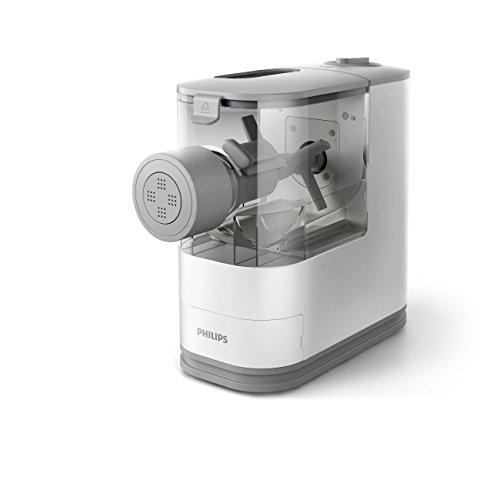
4. Philips Compact Pasta and Noodle Maker, Viva Collection HR2370/05
Specs
- Type: Fully automatic extruder
- Functions: Mixes, kneads and extrudes automatically
- Cycle output: 2 to 3 servings (7 to 14 oz) in about 18 minutes
- Shaping discs: 3 included (spaghetti, fettuccine and penne style shapes)
- Material: Plastic body with stainless steel blade
- Dimensions: 15.5 x 13 x 11.9 inches
- Weight: 10.36 lb
- Included extras: Recipe book
- Model number: HR2370/05
The Philips Viva Compact removes rolling entirely. Flour and liquid go into the chamber, and the machine mixes, kneads and extrudes fresh pasta in about 18 minutes, producing 2 to 3 servings per cycle. Three shaping discs cover spaghetti, fettuccine and a penne style shape, so the output is shaped noodles rather than sheets. An angled stirring bar works flour and liquid together from the corners of the chamber, and a long kneading tube develops the dough before extrusion.
Its compact footprint is the other half of the appeal: at roughly 15.5 by 13 inches it can live on the counter, suiting the small, frequent batches it is designed for. The detachable components come apart for cleaning and are dishwasher safe, a practical point because extruder discs need attention before dough dries in the holes. The recipe book includes gluten free variations using buckwheat, quinoa and chickpea flours, and the chamber accepts egg, spinach or carrot juice for colored noodles.
5. Hamilton Beach Electric Pasta Maker and Noodle Machine 86650

Specs
- Type: Fully automatic electric extruder
- Shaping discs: 7 molds for spaghetti, fettuccine and more
- Cycle output: 2 to 3 servings in about 15 minutes
- Batch capacity: Up to 1.5 lb of flour per batch
- Power: 150 watts
- Dimensions: 17.88 x 9.63 x 13.75 inches
- Weight: 11.5 lb
- Color: White
- Model number: 86650
The Hamilton Beach 86650 follows the same automatic formula as the Philips, but it widens the shape library: seven molds cover spaghetti, fettuccine and a spread of additional noodle shapes, so one machine handles more of the weekly pasta rotation. A cycle turns out 2 to 3 servings in about 15 minutes, and the chamber takes up to 1.5 lb of flour per batch, a practical size for family dinners.
At 150 watts the motor is sized for dough work rather than speed, pushing firm dough through the discs at a steady pace. The footprint is longer than it is tall, so measure shelf depth before choosing a storage spot. As with any extruder, rinse or soak the discs promptly, before dough hardens in the holes. For weeknight shaped pasta with the least active work, this is the broadest disc set in the group.
Comparison Table
| Product | Type | Shapes Included | Thickness / Discs | Sheet Width | Weight |
|---|---|---|---|---|---|
| Marcato Atlas 150 Classic | Manual roller | Lasagna, fettuccine, tagliolini | 10 settings, 0.8–4.8 mm | 150 mm | 5.72 lb |
| Imperia Model 190 | Manual roller | Lasagna sheet and noodle cuts | 6 settings, lock dial | 150 mm class | Steel body |
| KitchenAid KSMPRA Set | Mixer attachment | Sheets, fettuccine, spaghetti | 8 settings | 6 inches | 7.5 lb |
| Philips Viva Compact HR2370/05 | Automatic extruder | Spaghetti, fettuccine, penne style | 3 discs | n/a | 10.36 lb |
| Hamilton Beach 86650 | Automatic extruder | Spaghetti, fettuccine and more | 7 discs | n/a | 11.5 lb |
Frequently Asked Questions
Is a roller or an extruder better for homemade pasta?
Neither is better in general; they make different pasta. A roller produces sheets, which become lasagna, fettuccine, tagliolini and filled shapes like ravioli. An extruder produces shaped noodles such as spaghetti, fusilli and penne style tubes directly from dough. Choose by the dishes you cook most: only rollers make filled pasta, and only extruders make hollow shapes.
What flour works best in a pasta maker?
Rollers handle classic egg dough made with all-purpose flour, finely milled 00 flour, or a blend with semolina for extra bite. Extruders are more sensitive to hydration and perform best with semolina or a semolina blend mixed to a crumbly, sand-like consistency rather than a smooth ball. Either way, weigh flour and liquid for repeatable results, and rest roller dough wrapped for 30 minutes before rolling.
How do you clean a pasta maker?
Roller machines should never go in water. Let dough residue dry for around 30 minutes, then brush it out; dried flour dusts away cleanly. Mixer attachments follow the same rule and are not dishwasher safe. Extruders come apart so the chamber, stirring bar and discs can be washed, and the Philips parts are dishwasher safe. With any extruder disc, clear the holes before dough hardens, using a pin or the tool supplied.
How long does fresh pasta from a machine keep?
Fresh sheets and noodles cook the same day they are made, after a short rest on a floured surface. For keeping, dust noodles with semolina, form loose nests, and refrigerate for a day or two, or freeze the nests on a tray and bag them once solid; frozen pasta cooks straight from the freezer with a little extra time in the water. Extruded shapes dry less evenly than rolled noodles, so freezing suits them better.
Conclusion
The Marcato Atlas 150 is the pick for the classic Italian sheet roller: 10 thickness settings, a 150 mm sheet and steel construction suited to everything from lasagna to filled pasta. The Imperia Model 190 offers the same manual approach with a locking dial and recipe book. KitchenAid owners get the smoothest workflow from the KSMPRA set, which trades the crank for mixer power. On the automatic side, the Philips Viva Compact suits small batches of shaped pasta, while the Hamilton Beach 86650 brings the widest disc library and largest batch capacity.
More from Amazon
Programs that pair well with the guide above. Offers and eligibility are set by Amazon and may change.
Collect the home and kitchen items you want in one registry that guests can shop from.
Create a wedding registrySet up recurring deliveries of everyday items on eligible products. Terms and savings are set by Amazon.
Explore Subscribe & SaveFree shipping on eligible items, Prime Video and more. Eligible new members can start with a free trial.
Start a Prime free trialAudiobooks and podcasts to listen to on the go. Eligible new members can start with a free trial.
Try Audible freeAs an Amazon Associate we earn from qualifying purchases.
Write Your Review
No reviews yet. Be the first to share your experience!