

Key takeaways
- Leather: Often easy to wipe clean, but quality and finish vary. Direct sun, heat, and neglect can dry or damage some leather. Check care guidance for the specific upholstery; “leather” alone does not tell you which parts are genuine leather or how they are finished.
- Bonded or coated upholstery: May cost less and clean easily, but the surface can peel or crack with wear. Ask what the upholstery is made of and whether the warranty covers surface deterioration.
- Performance fabric: Can be a practical choice for frequent use or pets, but stain resistance is not the same as stain-proofing. Removable covers are useful only if the manufacturer confirms they can be washed.
- Manual recline: Avoids motors and power cords, and may simplify placement. The trade-off is that each user must operate the mechanism by hand; inspect the lever and footrest action for the intended users.
- Power recline: Offers button-controlled adjustment but adds electrical components, cords, and potential repair needs. Confirm outlet location, cord routing, and whether the chair can be operated during a power outage.
The best home theater seating recliners depend on the room’s usable depth, not just its floor area.
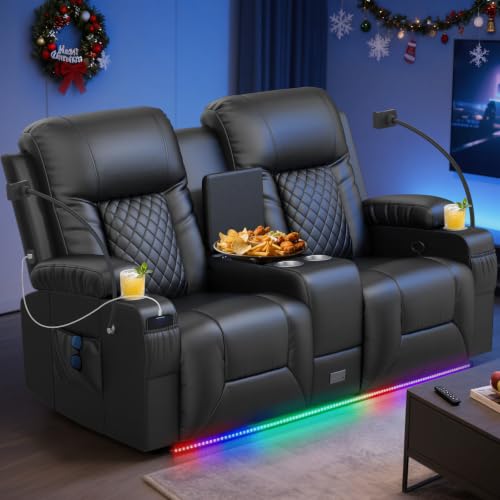
For a compact room, start with a two-seat row of wall-hugger recliners and confirm its fully reclined depth against your available space. In a larger room, a three-seat row or two rows can work—but only if you preserve a clear aisle and enough distance for the front row to recline without crowding the seats behind it. Measure the complete setup before choosing upholstery or features; those are costly compromises to discover after delivery.
Compare the room fit before comparing features
The ranges below are planning estimates, not dimensions for a particular model. Recliner depth, width, and wall clearance vary by design, so verify the manufacturer’s assembled and fully reclined measurements for the exact configuration.
Our top picks



As an Amazon Associate we earn from qualifying purchases at no extra cost to you. Ratings are shown as listed on Amazon.
| Room situation | Starting configuration | Planning width | Planning depth | Main trade-off |
|---|---|---|---|---|
| Small room or shared living space | Two seats in one row | 60–72 in. | 36–40 in. upright; 60–68 in. reclined | Wall-hugger designs can reduce rear clearance but may still need space to extend the footrest. |
| Medium dedicated theater | Three seats in one row | 90–108 in. | 36–40 in. upright; 60–68 in. reclined | More seats can mean less room for end tables and side access. |
| Large room with separate rows | Two rows of three seats | 90–108 in. per row | Allow 60–68 in. for recline, plus roughly 30–36 in. between rows | Requires substantial room depth; a raised rear platform may improve sightlines but adds cost and construction. |
These figures assume individual seats about 30–36 inches wide. Arm style, cupholders, shared consoles, and gaps between seats can change the total. A row’s listed width is not necessarily the width of each chair added together: check the seller’s dimensions for the assembled row, including any consoles.
Choose by room size and viewing habits
For a narrow or multipurpose room: two wall-hugger seats
Choose a two-seat row when a third chair would obstruct a doorway, walkway, or nearby furniture. A wall-hugger mechanism moves the seat forward as it reclines, potentially reducing the gap needed behind it. It does not eliminate the need for clearance in front, so measure from the chair’s back to the nearest obstacle in both upright and reclined positions.
This is usually the better fit for households that watch together occasionally or use the room for other activities. Skip bulky center consoles if they make the row too wide. A narrow seat can feel cramped during long viewing sessions, though, so compare the usable seat width—not only the outside width—before ordering.
For a medium room: one three-seat row
A single row is often simpler than adding a second row: it needs no riser, keeps circulation straightforward, and gives everyone a comparable view. A center console can provide shared storage and cupholders, but it also adds width and reduces flexibility if you later rearrange the seats. If the room has a side entrance, leave enough space to reach the end seats without squeezing past a reclined footrest.
For a large room: two rows only after a depth check
Two rows suit larger groups, but the room must fit more than two chair depths. As a rough check, add the front row’s reclined depth, a 30–36-inch passage between rows, and the rear row’s upright depth. For example, 64 + 32 + 38 = 134 inches, or just over 11 feet, before accounting for a screen, front walkway, or rear wall clearance. If the second row also reclines, check its full extension and the space behind it.
Tiered flooring can help rear viewers see over the front row, but it is not a substitute for planning seat spacing. Consider whether the platform will affect doors, wiring, floor outlets, or accessible circulation. For a flexible family room, a single row plus movable seating may be easier to adapt.
Material, mechanism, and ownership trade-offs
- Leather: Often easy to wipe clean, but quality and finish vary. Direct sun, heat, and neglect can dry or damage some leather. Check care guidance for the specific upholstery; “leather” alone does not tell you which parts are genuine leather or how they are finished.
- Bonded or coated upholstery: May cost less and clean easily, but the surface can peel or crack with wear. Ask what the upholstery is made of and whether the warranty covers surface deterioration.
- Performance fabric: Can be a practical choice for frequent use or pets, but stain resistance is not the same as stain-proofing. Removable covers are useful only if the manufacturer confirms they can be washed.
- Manual recline: Avoids motors and power cords, and may simplify placement. The trade-off is that each user must operate the mechanism by hand; inspect the lever and footrest action for the intended users.
- Power recline: Offers button-controlled adjustment but adds electrical components, cords, and potential repair needs. Confirm outlet location, cord routing, and whether the chair can be operated during a power outage.
In long-term use, moving parts and upholstery surfaces deserve more attention than add-on features. Footrests and reclining joints take repeated force; seams, arm tops, and seat fronts take friction. Keep crumbs out of moving mechanisms, avoid forcing a footrest shut, and tighten accessible fasteners only as the maker directs. For powered models, keep cords clear of pinch points and follow the specified electrical and cleaning instructions.
Assembly and delivery can determine whether the chairs fit at all
Before buying, measure the narrowest doorway, hallway, stair turn, and elevator on the route to the room—not just the theater doorway. Ask whether the chairs arrive as individual seats or as a linked row, and whether backs, arms, or consoles detach for delivery. A product can fit the final room and still be impossible to bring inside in one piece.
Confirm who assembles the row and whether linking hardware is included. Modular seats are easier to move and reconfigure, but they still need to be joined securely and aligned on a level floor. For a powered row, identify the outlet before positioning the seats so cords do not cross walking paths. Save the assembly instructions and hardware in case the layout changes or a part needs service.
A quick fit check before you order
- Sketch the room. Mark doors, windows, outlets, screen position, and routes people use to enter and leave.
- Mark the row’s full footprint. Use the exact assembled width, upright depth, and reclined depth from the model’s specifications. Add any stated wall clearance.
- Check circulation. Make sure a reclined footrest does not block a doorway or the only route past the seats. Leave an aisle that works for the household rather than relying on a tight squeeze.
- Test the delivery route on paper. Compare package and component dimensions with the tightest turn and opening. Ask the seller or manufacturer if those measurements are unclear.
- Match materials to use. Choose upholstery and a mechanism based on cleaning needs, how often the seats will be used, and your willingness to maintain or service moving parts.
Bottom line
For small rooms, a two-seat wall-hugger row is a sensible starting point, provided the fully reclined footprint and front clearance work. Medium rooms usually benefit from one three-seat row rather than a cramped second tier. Reserve two rows for a room deep enough to accommodate both reclined seating and a real passage between rows. In every case, prioritize exact configuration measurements, delivery access, and repairable construction over features that add width or complexity without improving your fit.



Write Your Review
No reviews yet. Be the first to share your experience!