

Key takeaways
- Best balance for a large bedroom or living room: a 4–6 liter evaporative humidifier with a rated coverage area of at least 500 square feet.
- Best quiet pick: a low-speed evaporative unit or a well-insulated ultrasonic humidifier operated below maximum output; target approximately 25–35 dB on its lowest setting.
- Best for maximum output: a 6-liter ultrasonic model such as the Levoit LV600S, particularly when warm-mist operation and app controls matter.
- Best for frequent, unattended use: a console evaporative model or whole-home humidifier with a tank or reservoir of at least 4 gallons.
- Best for reducing white dust: an evaporative or air-washing humidifier, including the Venta LW45, because minerals remain in the water rather than being dispersed as airborne mist.
The best humidifiers for large rooms are evaporative models when you want quieter, low-mist operation over roughly 500–900 square feet, while ultrasonic models offer more capacity and features for less money but can leave mineral dust unless you use low-mineral water.
Our top picks


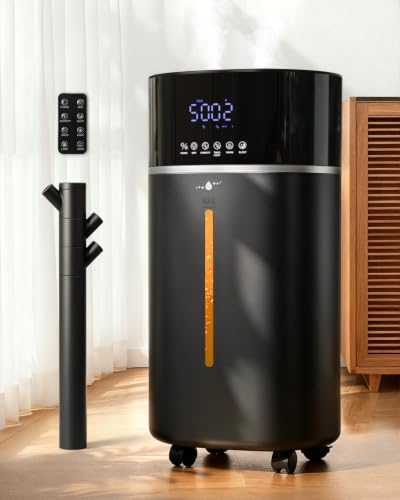
As an Amazon Associate we earn from qualifying purchases at no extra cost to you. Ratings are shown as listed on Amazon.
Quick picks by room and priority
- Best balance for a large bedroom or living room: a 4–6 liter evaporative humidifier with a rated coverage area of at least 500 square feet.
- Best quiet pick: a low-speed evaporative unit or a well-insulated ultrasonic humidifier operated below maximum output; target approximately 25–35 dB on its lowest setting.
- Best for maximum output: a 6-liter ultrasonic model such as the Levoit LV600S, particularly when warm-mist operation and app controls matter.
- Best for frequent, unattended use: a console evaporative model or whole-home humidifier with a tank or reservoir of at least 4 gallons.
- Best for reducing white dust: an evaporative or air-washing humidifier, including the Venta LW45, because minerals remain in the water rather than being dispersed as airborne mist.
How much tank capacity do you need?
Tank size affects refill frequency more reliably than advertised room coverage. A humidifier producing 250 milliliters per hour uses about 6 liters in 24 hours at continuous maximum output. In practice, a unit may run at a lower duty cycle once the room reaches its target humidity, so a 4-liter tank can often last overnight but may require daily filling in dry weather.
Use this estimate before buying:
Approximate runtime in hours = tank capacity in liters ÷ output in liters per hour.
For example, a 6-liter humidifier rated at 0.30 liters per hour has a theoretical maximum runtime of 20 hours. If its humidistat cycles the machine on and off, actual runtime can be longer. Conversely, warm mist and high-output settings may shorten it.
| Room size | Practical tank target | Useful output range | Coverage to look for | Likely refill pattern |
|---|---|---|---|---|
| Up to 300 sq. ft. | 2–3 liters | 100–200 ml/hour | 250–400 sq. ft. | Every 1–2 days |
| 300–600 sq. ft. | 3–5 liters | 200–300 ml/hour | 500–700 sq. ft. | Daily or every other day |
| 600–900 sq. ft. | 4–6 liters | 250–400 ml/hour | 700–1,000 sq. ft. | Daily at high output |
| 900–1,500 sq. ft. | 4–12 gallons | Console or whole-home class | 1,000 sq. ft. or more | Daily to several times weekly |
These are planning figures rather than guarantees. Open floor plans, high ceilings, drafts, forced-air heating, and very dry outdoor conditions can make a manufacturer’s coverage claim optimistic. For a 700-square-foot open room, choosing a model rated for 900–1,000 square feet gives useful headroom.
Large-room humidifiers compared
| Model or type | Capacity and coverage positioning | Noise expectation | Maintenance and durability trade-off | Best fit |
|---|---|---|---|---|
| Levoit LV600S ultrasonic | 6-liter tank; marketed for large rooms of roughly 500 sq. ft. or more, depending on configuration | Quiet on low; fan and bubbling sounds become more noticeable at high output | No wick to replace, but mineral buildup can affect the transducer and white dust can occur with hard water | Feature-rich bedrooms and living rooms needing high output |
| Venta LW45 air washer | Large-room positioning, commonly rated around 800 sq. ft.; water reservoir is about 3 gallons | Low speed is generally suited to bedrooms; higher speeds produce audible fan noise | Reusable rotating discs avoid disposable wicks, but regular cleaning and additive use are important | People prioritizing low mineral dispersion and long-term ownership |
| AIRCARE MA1201 console evaporative | About 3.6-gallon capacity; marketed for spaces up to approximately 3,600 sq. ft. under favorable conditions | Fan noise is more apparent than on compact bedroom humidifiers | Wick replacement is an ongoing cost; large cabinet is less convenient to move | Large open areas and homes needing substantial moisture output |
| Console evaporative humidifier, general class | 4–6 gallons; commonly suitable for 1,000–2,500 sq. ft. depending on airflow and layout | Usually a soft fan hum, with higher settings clearly audible | Wicks and water panels wear first, but mineral dust is usually lower than with ultrasonic units | Frequent winter use and practical whole-room coverage |
| 6-liter ultrasonic, general class | Typically advertised for 500–700 sq. ft.; output often 250–350 ml/hour | Approximately 26–36 dB on low for quieter designs | Low purchase and energy cost; requires more attention to water quality and cleaning | Budget-conscious users wanting visible mist and a small footprint |
Ultrasonic versus evaporative: the important trade-off
Choose ultrasonic for output and controls
Ultrasonic humidifiers use a vibrating membrane to turn water into fine mist. They are often compact, energy-efficient, and available with remote controls, timers, warm mist, and aromatherapy compartments. A 6-liter tank can provide overnight capacity even at a relatively high setting.
The drawback is water quality. Minerals in tap water can become white residue on furniture and electronics. If your water is hard, use distilled or appropriately filtered water when the manufacturer permits it, and wipe the room’s surfaces regularly. Never add essential oils to a tank unless the manual specifically identifies the tank as oil-compatible.
Choose evaporative for forgiving everyday ownership
Evaporative models draw air through a wet wick or water panel. Their natural evaporation rate tends to limit excessive humidity, and they generally distribute fewer minerals into the room. They are often the safer choice near wood furniture, televisions, and dark surfaces where white dust is conspicuous.
The price is a replaceable wick or water panel, plus fan noise. A wick can last from several weeks to a few months, depending on water hardness, runtime, and cleaning. A console evaporative unit may cost more to operate over a season than an ultrasonic model, but the consumable can be worthwhile if it prevents mineral buildup and daily surface cleaning.
Decision matrix for real rooms
| Your situation | Recommended choice | Why |
|---|---|---|
| Small budget, 400–600 sq. ft., occasional use | 4–6-liter ultrasonic | Strong capacity per dollar and no regular wick purchase |
| 700 sq. ft. bedroom or studio, light sleeper | Quiet evaporative or low-output ultrasonic with a humidistat | Automatic cycling matters more than maximum mist output |
| Hard water and dark furniture | Evaporative or air-washing model | Lower risk of visible mineral deposits |
| Open 1,000-square-foot living area | Console evaporative model | Larger reservoir and stronger air movement are more useful than a compact tank |
| Infrequent user who dislikes maintenance | Smaller, removable-tank evaporative model | Less stagnant water and an easier cleaning routine than a permanently installed system |
Noise: compare operating settings, not just the headline number
A quoted noise level usually applies to the lowest setting in a quiet room. A humidifier rated at 26 decibels may be considerably louder at maximum output. Ultrasonic units tend to avoid strong fan noise, but they can make intermittent clicks, water drips, or a faint buzzing sound. Evaporative units produce a steadier fan hum that many people find easier to ignore.
For a bedroom, look for a low setting below roughly 35 dB, an adjustable humidistat, and a display that can be dimmed or switched off. Place the machine on a stable, water-resistant surface at least a short distance from walls and electronics. Never aim mist directly at a headboard, upholstered furniture, books, or a wood tabletop.
Ownership costs and maintenance that determine lifespan
- Clean the water-contact parts frequently. Empty and rinse the reservoir daily or whenever the unit will sit unused. Follow the manual’s schedule for descaling and disinfecting; do not mix cleaning chemicals.
- Replace wicks before they become hard or discolored. A clogged wick reduces output and makes the fan work harder. Treat the replacement as part of the operating cost, not as an unexpected failure.
- Do not run an ultrasonic unit empty. Repeated dry operation can shorten the life of the vibrating assembly or trigger protective shutdowns.
- Measure room humidity. A separate hygrometer is useful because built-in sensors can read the air immediately around the machine rather than the room as a whole. Many households aim for approximately 30–50% relative humidity, adjusting for condensation and local conditions.
- Store it completely dry. Water left in a dark reservoir between seasons encourages odor and buildup. Clean, rinse, and air-dry every removable component before storage.
A practical cost comparison illustrates the trade-off. Suppose an ultrasonic humidifier uses 30 watts for 12 hours daily, while an evaporative model uses 25 watts for the same period. The evaporative unit may use slightly less electricity, but a wick costing a general market range of $10–$25 every one to three months can exceed the ultrasonic model’s energy cost. If hard water forces you to buy distilled water, the ultrasonic option may become more expensive overall. Your water quality and cleaning habits matter as much as the purchase price.
Bottom line
For a 300–600-square-foot room, start with a 3–5-liter humidifier rated above the room’s measured area. For 600–900 square feet, choose 4–6 liters and at least 250 ml/hour of output, with extra capacity for high ceilings or dry forced-air heating. Select an ultrasonic model such as the Levoit LV600S when high output and smart controls are priorities. Choose an evaporative console or an air-washing design such as the Venta LW45 when quiet low-speed operation, fewer mineral deposits, and predictable everyday ownership matter more than avoiding replacement parts.



Write Your Review
No reviews yet. Be the first to share your experience!