

Key takeaways
- Measure clear door width with the door fully open, excluding trim and hinges.
- Measure clear door height and the diagonal clearance above the threshold.
- Record hallway width and the distance between opposing walls at each turn.
- Ask whether the sofa arrives assembled, partially assembled, or boxed.
- Confirm the packed dimensions and shipping weight, not only the finished dimensions.
The best apartment size sofas are usually 68–78 inches wide, 34–38 inches deep, and no taller than 34 inches when a tight entry route matters; choose a loveseat for the easiest fit, a compact three-seat sofa for everyday lounging, or a sleeper only when overnight use justifies its extra weight and depth.
Our top picks
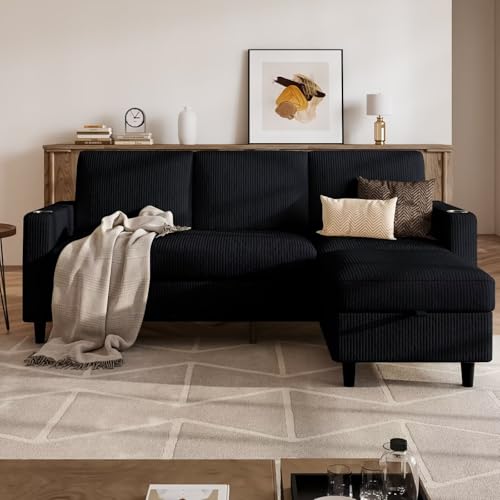


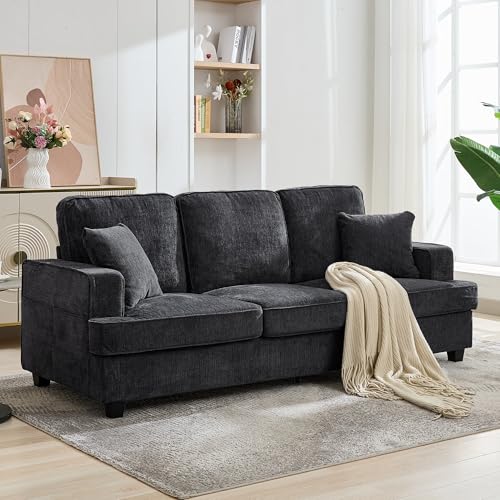
As an Amazon Associate we earn from qualifying purchases at no extra cost to you. Ratings are shown as listed on Amazon.
Quick picks by living-room situation
| Situation | Best sofa type | Target outside dimensions | Why it works |
|---|---|---|---|
| Very narrow room or difficult stairwell | Apartment loveseat | 52–65″W × 32–36″D × 30–34″H | Leaves more circulation space and is easier to rotate through doors |
| One- or two-person home needing a full sofa | Compact apartment sofa | 68–78″W × 34–38″D × 30–35″H | Provides two to three seats without the bulk of a standard sofa |
| Frequent overnight guests | Compact sleeper sofa | 72–80″W × 36–40″D × 31–36″H | Adds a bed, but requires more floor clearance and is heavier |
| Flexible layout or rented home | Armless modular loveseat or two-piece sofa | 60–76″W × 32–37″D × 28–34″H | Separate sections can be carried through awkward entrances |
How small is “apartment size”?
There is no universal industry dimension for an apartment sofa. In practice, the useful distinction is between a full-size sofa, commonly about 80–96 inches wide, and a compact model intended for restricted rooms, commonly about 60–78 inches wide.
Width is only one part of the decision. A sofa that is 72 inches wide but 41 inches deep can consume more usable room than an 80-inch sofa that is 35 inches deep. For most small living rooms, aim for a seat depth of 20–23 inches and an overall depth of 34–38 inches. Deeper cushions can feel comfortable for lounging, but they reduce the walking lane between the sofa, coffee table, and wall.
Measure the sofa’s outside dimensions, not only its seat width. Arms, reclining hardware, removable legs, and rear cushions can each change the actual footprint.
Loveseat versus compact sofa versus sleeper
Loveseat: easiest fit, least flexibility
A loveseat is typically 48–68 inches wide and seats two adults. It is the safest choice when the room is narrow, the sofa must sit near a doorway, or the building has a small elevator. A loveseat can also leave space for a separate lounge chair, which may be more useful than squeezing three seats into one long piece.
The compromise is personal space. Two people may sit comfortably, but a loveseat is less practical for stretching out or hosting several guests. Check the usable seat width: thick arms can reduce a 60-inch frame to less than 45 inches of sitting space.
Compact three-seat sofa: best everyday balance
A 68–78-inch sofa often gives the best balance for a small living room. Look for narrow arms, a straight back, and legs that lift the frame at least 4–6 inches off the floor. This combination preserves seating while making the room look less visually heavy and simplifying vacuuming underneath.
Do not assume that “three-seat” means three adults will have equal room. A compact sofa may have three cushions but only 60–66 inches of usable seat width. That is adequate for two people lounging and three people sitting briefly, but not equivalent to a full-size sofa.
Sleeper sofa: useful bed, demanding footprint
A sleeper is worth considering when guests stay overnight several times a year and there is no room for a dedicated guest bed. Its trade-offs are substantial: a mechanism adds weight, the frame is often deeper, and the opened bed may extend 78–90 inches into the room.
Measure the closed depth and the fully opened length. Also check the mattress width. A compact sleeper may use a mattress around 52–60 inches wide, while a larger model may approach a standard full or queen size. A narrower sleeper saves space but may be less comfortable for two adults. For occasional use, a sofa bed with a thinner mattress can be reasonable; for frequent use, prioritize a proper support system and a mattress thickness that the manufacturer specifies for regular sleeping.
Doorframe fit: calculate the route, not just the room
A sofa can fit the living room and still fail at the front door. Measure every restriction in sequence: building entrance, elevator, hallway, apartment door, stair landing, and the final turn into the room.
- Measure clear door width with the door fully open, excluding trim and hinges.
- Measure clear door height and the diagonal clearance above the threshold.
- Record hallway width and the distance between opposing walls at each turn.
- Ask whether the sofa arrives assembled, partially assembled, or boxed.
- Confirm the packed dimensions and shipping weight, not only the finished dimensions.
A useful first calculation is to compare the sofa’s smallest rigid dimension with the narrowest opening. For example, a 74-inch-wide sofa with a 35-inch body depth and 32-inch body height may pass through a 34-inch door when tilted, provided the arms and frame do not protrude beyond those dimensions. A fully assembled sofa with a rigid 38-inch height may not pass through that same door when rotated.
For a tight route, leave at least 1–2 inches of practical clearance rather than ordering a piece exactly equal to the opening. Door closers, uneven floors, packaging, and the delivery team’s turning angle can remove that margin. Removable legs and detachable backs are valuable, but verify that the back actually comes off; some “removable” cushions do not reduce the frame dimensions.
Decision matrix for a tight layout
| Your priority | Recommended choice | Dimensions to favor | Trade-off |
|---|---|---|---|
| Lowest purchase cost | Basic loveseat or compact fixed sofa | 56–72″W, 33–36″D | Usually simpler cushions and less flexible sleeping capacity |
| Daily lounging | Compact sofa with deeper seat | 70–78″W, 36–40″D; 21–23″ seat depth | Uses more floor area and can narrow walkways |
| Frequent moving or narrow stairs | Modular or knock-down sofa | Each section under 40″W and under 80 lb when possible | More connectors and seams to keep aligned |
| Guests sleep several times yearly | Compact sleeper | 72–80″W, 36–40″D; verify 78–90″ open length | Heavier, deeper, and less convenient to convert |
| Maximum visual openness | Raised-leg, narrow-arm sofa | Any width under 78″W; legs 4–6″H | Less enclosed storage and potentially less substantial frame |
Features that matter more than decorative style
Seat depth: A 20–22-inch seat depth suits upright sitting and smaller rooms. Around 23–25 inches is better for lounging, but may require pillows for shorter users.
Arm width: Reducing each arm by 3 inches can add 6 inches of usable seat width without increasing the outside width. Track arms or slim rounded arms are usually more space-efficient than broad rolled arms.
Frame construction: Kiln-dried hardwood or engineered hardwood frames with reinforced corner joints are common durable choices. Ask how the joints are connected rather than relying on a vague “wood frame” description.
Cushion construction: High-resilience foam generally holds its shape better than low-density foam. Loose back cushions are easier to rotate and fluff; fixed backs look tidy but can be harder to repair or clean. A zippered cover is useful only if the fabric label allows removal and washing.
Fabric: Tight weaves tend to resist snagging better than loose boucle-style textures. Performance upholstery can simplify spot cleaning, but no fabric is stain-proof. Check the cleaning code and whether replacement covers or cushions are available.
Ownership realities in a small home
The first visible wear usually appears on the front edge of the seat, the arm tops, and the cushion seams. Rotate reversible cushions every few weeks, vacuum crevices monthly, and blot spills promptly instead of rubbing them deeper into the fabric. Keep the sofa slightly away from a damp exterior wall, and use felt pads under legs to protect flooring when the sofa is repositioned.
Common mistakes include buying by seat width alone, forgetting the opened sleeper clearance, placing a deep sofa in front of a radiator, and assuming a boxed sofa will fit through any doorway. Also check the sofa’s total weight before choosing a high-floor apartment: a compact sleeper can weigh well over 150 pounds, while a basic loveseat may be substantially lighter.
Bottom line
For most small living rooms, the strongest all-purpose choice is a 68–78-inch compact sofa with a 34–38-inch overall depth, narrow arms, removable legs, and a frame that can be carried in sections. Choose a loveseat when doorway and circulation space are the main constraints. Choose a sleeper only after measuring its closed and opened dimensions and deciding that overnight capacity is worth sacrificing floor space every day.



Write Your Review
No reviews yet. Be the first to share your experience!