

Key takeaways
- Solid hardwood: Usually the most repairable option. Inspect the thickness of rails and the way they attach to the posts. Wood can still split if screws are repeatedly overtightened.
- Engineered wood: Often keeps costs down and can provide a smooth finish, but exposed edges and screw holes are more vulnerable to swelling or stripping. Keep it dry and avoid moving the bed by dragging it.
- Steel: Offers strong slender rails and can be relatively light, but examine welds, powder-coat damage, and the quality of cross-braces. Metal-on-metal joints may develop noise if bolts loosen.
- Veneer or laminate finishes: Resist ordinary marks better than unfinished wood, but damaged edges should be repaired promptly so moisture cannot reach the core.
The best kids beds for small rooms are usually a low twin bed for the easiest long-term fit, or a twin loft bed when reclaiming floor space matters more than the simplest assembly.
The right choice depends on four measurements: the mattress size, the bed’s outside footprint, the available ceiling height, and the clearance needed to use drawers, desks, or a ladder safely. A twin bed is more versatile and usually easier to move; a loft bed can effectively add a play or study zone, but it demands more careful measuring and installation.
Our top picks
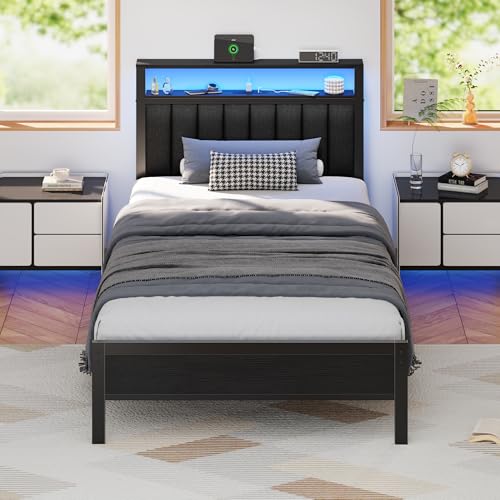


As an Amazon Associate we earn from qualifying purchases at no extra cost to you. Ratings are shown as listed on Amazon.
Twin vs. loft: which fits a small room better?
| Feature | Standard twin bed | Twin loft bed | What it means in practice |
|---|---|---|---|
| Mattress size | About 38 x 75 inches | About 38 x 75 inches | Both use common twin mattresses, but the frames have different outside dimensions. |
| Typical outside length | 76–80 inches | 76–82 inches | Leave extra space for a headboard, ladder, or protruding guardrail. |
| Typical outside width | 40–44 inches | 40–45 inches | A loft may occupy almost the same floor area as a twin, despite adding usable space below. |
| Typical frame height | 12–40 inches | 55–70 inches | Measure from the finished floor to the highest rail or post, not just to the mattress. |
| Useful clearance beside the bed | 24–30 inches | 24–30 inches | This allows a child to make the bed and lets an adult reach the mattress safely. |
| Recommended ceiling height | Any normal bedroom ceiling | About 8 feet or higher for comfortable use | At least 30–36 inches between the top of the mattress and the ceiling is a practical target. |
| Typical frame weight | 35–100 pounds | 80–180 pounds | Heavier lofts are often steadier, but they take longer and sometimes require two adults to assemble. |
These are planning ranges rather than universal specifications. Always use the manufacturer’s outside dimensions and maximum mattress thickness for the exact bed. A nominal twin mattress can vary slightly in length and height, and that difference matters around guardrails.
Best kids beds by room and family situation
Best for the smallest footprint: a low twin bed
Choose a low twin platform or simple twin frame when the bedroom is narrow, the ceiling is low, or the child may move rooms within a few years. A low frame makes sheet changes easier, reduces climbing, and can often accept rolling storage underneath. It also leaves more visual space in a small room.
Look for a frame no wider than about 42 inches and no longer than 78 inches if the room is especially tight. Check whether drawers need to pull fully out: a drawer that extends 24 inches requires that much open floor space, plus enough room for a child to stand behind it.
Best for adding a desk or play area: a twin loft
A loft is worthwhile when the room has sufficient ceiling height and the floor beneath it will serve a real purpose. A desk, bookcase, or compact wardrobe can turn one footprint into two functional zones. Select a loft with a full-length guardrail, a sturdy ladder, and a manufacturer-approved mattress thickness.
Do not judge fit by the mattress footprint alone. A loft measuring 80 inches long by 42 inches wide may need another 6–12 inches for ladder access, depending on the ladder’s angle and position. Allow a clear route to the ladder and avoid placing it directly against a doorway or in front of a heater.
Best for changing needs: a convertible or modular bed
A convertible design can be useful if it changes from a low bed to a loft or separates into two pieces. Its advantage is not automatically a longer service life: more joints and conversion hardware can also mean more opportunities for looseness. Choose one only when the conversion you expect to use is clearly documented and the parts can be stored without getting lost.
Material durability: what to inspect before buying
- Solid hardwood: Usually the most repairable option. Inspect the thickness of rails and the way they attach to the posts. Wood can still split if screws are repeatedly overtightened.
- Engineered wood: Often keeps costs down and can provide a smooth finish, but exposed edges and screw holes are more vulnerable to swelling or stripping. Keep it dry and avoid moving the bed by dragging it.
- Steel: Offers strong slender rails and can be relatively light, but examine welds, powder-coat damage, and the quality of cross-braces. Metal-on-metal joints may develop noise if bolts loosen.
- Veneer or laminate finishes: Resist ordinary marks better than unfinished wood, but damaged edges should be repaired promptly so moisture cannot reach the core.
The parts that commonly wear first are ladder rungs, slats, bolt joints, drawer wheels, and the finish around the child’s usual entry point. A bed with replaceable slats and standard fasteners is easier to own for a decade than one requiring a proprietary replacement rail.
Safety rails and mattress fit matter more than decoration
For an elevated bed, the guardrail should run along the exposed side and be securely attached to the frame. Avoid relying on a removable rail that can shift during ordinary use. The mattress must sit below the guardrail’s specified maximum height; a thicker replacement mattress can reduce the protective rail height even when it fits the bed.
Check the instructions for the intended age range. Elevated sleeping surfaces are not appropriate for every child, and manufacturer guidance should be followed rather than treating a guardrail as a guarantee of safety. Keep cords, curtain ties, and hanging decorations away from the upper bunk or loft. Anchor a tall frame when the instructions call for it, particularly on hard flooring or when the bed includes a climbing ladder.
For any bed, inspect the slat spacing, center support, and maximum weight limit. The limit may include the mattress, child, bedding, and an adult who sits on the edge. A bed rated for 200 pounds is not necessarily designed for repeated adult use if the instructions restrict who may occupy it.
Assembly difficulty and a practical setup plan
A basic twin often takes one adult about 45–90 minutes. A loft commonly takes two adults two to four hours, especially when it includes a desk, stairs, drawers, or multiple guardrails. The number of pieces is less important than the quality of the instructions and whether the frame uses clearly labeled hardware.
- Measure before opening the box. Mark the bed’s footprint on the floor with painter’s tape, then mark the ladder swing and drawer extension.
- Sort hardware by step. Mixing similar bolts is a common cause of stripped threads or rails installed in the wrong orientation.
- Assemble on a level surface. A tilted frame can make a joint appear tight while leaving another joint under stress.
- Keep fasteners finger-tight initially. Square the frame before tightening every joint; tightening one corner completely first can twist the structure.
- Check the mattress clearance. Place the actual mattress inside the frame and confirm that the top remains below the stated guardrail limit.
- Recheck after two weeks. Wood can settle and bolts can loosen. Tighten only as directed, without crushing wood or laminate.
A simple decision matrix
| Your situation | Best starting choice | Why | Watch out for |
|---|---|---|---|
| Low budget and frequent moves | Simple low twin | Fewer parts, lower weight, and easier resale or relocation | Weak center supports and nonreplaceable slats |
| Small room with an 8-foot ceiling | Moderate-height twin loft | Creates room for a desk or storage underneath | Insufficient head clearance and difficult ladder access |
| Young child transitioning from a smaller bed | Low twin or floor-level twin | Less climbing and simpler nighttime access | Storage bins that protrude into walking space |
| Older child who studies in the bedroom | Loft with an integrated desk or open lower area | Uses vertical space efficiently | Poor task lighting, heat buildup, and limited adult access |
| Child likely to share a room later | Standard twin or separable modular twin | More flexible placement than a fixed loft | Conversion kits that must be purchased separately |
Ownership costs and maintenance
General market pricing is often about $100–$300 for a basic twin frame, $250–$700 for a sturdier or convertible design, and $250–$900 or more for a loft with a desk or storage. The mattress, delivery, assembly, and replacement parts can materially change the total.
For example, suppose a $450 loft lasts eight years and needs $40 of replacement hardware and slat parts. The frame cost is approximately $490 ÷ 2,920 nights, or about 17 cents per night. That calculation favors a durable frame only if the loft remains useful; if the family outgrows its height or layout after two years, a cheaper, adaptable twin may have been better value.
Vacuum beneath the frame regularly, wipe spills rather than soaking wood-based panels, and inspect every joint at least twice a year. Never place a damp mattress directly on a closed platform without checking the manufacturer’s ventilation guidance. Most problems come from overloading drawers, dragging the frame, using the wrong mattress thickness, or skipping the post-assembly bolt check.
Final buying recommendation
Choose the best kids bed by measuring the room first, not by starting with a style. Pick a low twin when flexibility, low cost, and easy maintenance are priorities. Pick a loft when the reclaimed floor area has a specific job and the ceiling leaves comfortable clearance above the mattress. In either case, prioritize a replaceable slat system, robust joints, clear mattress limits, secure rails, and instructions that two adults can follow without improvisation.

Write Your Review
No reviews yet. Be the first to share your experience!