

Key takeaways
- Automatic shutoff: A timer of 1 to 12 hours limits the chance of the pad running unattended. Choose a short timer if you tend to fall asleep immediately; choose a longer one only when you specifically need extended warmth.
- Overheat protection: Look for temperature monitoring and automatic reduction or shutdown if abnormal heat is detected.
- UL, ETL, or equivalent certification: Independent electrical-safety certification is more meaningful than vague claims such as “advanced safety technology.” Check the label and manual for the applicable certification.
- Detachable controllers: The controls and power cords should unplug before washing. Never put a connected controller in a washer or dryer.
- Visible damage checks: Do not use a pad with exposed wires, scorch marks, damaged connectors, wet components, or a cord that becomes unusually hot.
The best heated mattress pads are the ones that combine independently controlled warmth, low-voltage or well-insulated wiring, a washable pad, and a controller that stays accessible without crossing the pillow area.
Our top picks
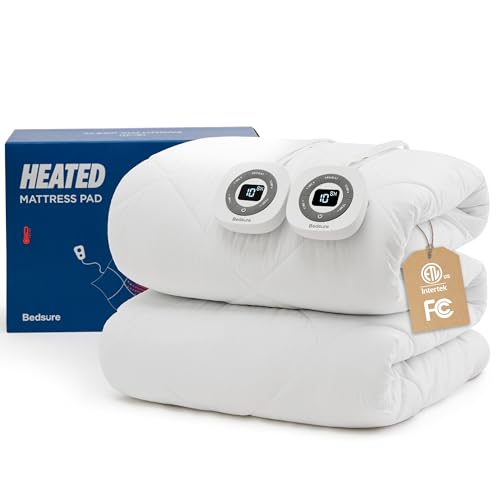


As an Amazon Associate we earn from qualifying purchases at no extra cost to you. Ratings are shown as listed on Amazon.
Best heated mattress pads by sleeping situation
| What matters most | Best choice | Specifications to look for | Why it fits |
|---|---|---|---|
| One person gets cold | Dual-zone heated pad | 2 controllers, at least 6 heat levels per side, independent shutoff | Warms one sleeper without overheating the other |
| Lowest purchase cost | Single-zone polyester pad | 4–10 heat levels, 1–10-hour auto-off, machine-washable construction | Simple controls and fewer components keep the price down |
| Frequent winter use | Durable cotton-blend or quilted pad | Fitted skirt, reinforced controller connectors, removable controls | Better resistance to repeated washing and nightly repositioning |
| Foam mattress owner | Low-profile, flexible-wire pad | Thin construction, deep-pocket skirt, no thick heating modules | Reduces bunching and preserves the mattress’s contouring feel |
| Older or less tech-confident user | Large-button controller | Clearly marked temperature buttons, illuminated display, automatic shutoff | Less fiddly than app-based or touch-sensitive controls |
Heat settings: more numbers are not always better
Most heated mattress pads offer roughly 4 to 10 temperature settings. A wider range is useful when two people have different comfort preferences, but the quality of the control increments matters more than the maximum number. Look for distinct steps from gentle preheating to stronger warmth, rather than several settings that feel nearly identical.
A preheat function can warm the bed before you get in, while a lower overnight setting avoids leaving the pad at its highest output for hours. Some controls remember the last setting; others reset whenever the pad is switched on. That small difference matters if you use it every night.
Digital controllers are usually easier to adjust precisely, but large physical buttons can be more practical in a dark bedroom. Avoid controls whose display is excessively bright unless it can be dimmed or switched off.
Dual-zone controls versus single-zone heating
Dual-zone heating is the most useful upgrade for couples. Each side should have its own controller and power connection, allowing one sleeper to choose low heat while the other uses medium or high heat. Confirm that the listing means independent zones, not merely two controllers operating the entire pad.
There are trade-offs. A dual-zone pad has more cables and connection points, costs more than a basic single-zone model, and can be slightly harder to install neatly. If you sleep alone in a full or queen bed, a single-zone pad is usually simpler. For a couple with different preferences, independent control often solves a daily comfort disagreement more effectively than buying a thicker blanket.
Safety features worth paying for
- Automatic shutoff: A timer of 1 to 12 hours limits the chance of the pad running unattended. Choose a short timer if you tend to fall asleep immediately; choose a longer one only when you specifically need extended warmth.
- Overheat protection: Look for temperature monitoring and automatic reduction or shutdown if abnormal heat is detected.
- UL, ETL, or equivalent certification: Independent electrical-safety certification is more meaningful than vague claims such as “advanced safety technology.” Check the label and manual for the applicable certification.
- Detachable controllers: The controls and power cords should unplug before washing. Never put a connected controller in a washer or dryer.
- Visible damage checks: Do not use a pad with exposed wires, scorch marks, damaged connectors, wet components, or a cord that becomes unusually hot.
Follow the manufacturer’s instructions about folding, bunching, pets, and use with an adjustable bed. People who have reduced heat sensitivity, circulation concerns, or a condition affected by heat should ask a qualified healthcare professional whether this type of product is appropriate.
Washable construction and the parts that wear first
A removable controller is essential, but “machine washable” does not mean maintenance-free. The fabric usually survives longer than the wiring and connectors. Repeated twisting at the edge of the mattress can stress the point where the controller cable joins the pad. Pulling the cord sideways can loosen a connector or damage the socket.
For regular use, choose a pad with a fitted skirt rather than loose elastic straps. A skirt helps keep the heating elements flat, which is both more comfortable and less stressful on the internal wiring. Cotton-blend surfaces tend to feel less slick than plain polyester, while polyester often dries faster and costs less.
Before washing, disconnect every controller and inspect the care label. Use the specified cycle and water temperature, avoid bleach unless expressly permitted, and do not use a heating cycle that exceeds the instructions. Air-drying or low-temperature drying is generally gentler than high heat, but the manual takes priority. Store the pad loosely rolled or folded without sharp creases; compressing it under heavy bedding for months can create permanent wire stress.
Cord placement: a small detail that determines daily usability
Most pads place the controller sockets near the lower corners, allowing the cords to fall beside the bed rather than under your shoulders. This is preferable to a top-edge connection, which can run near your head or become trapped between the mattress and headboard.
Measure the distance from the lower corner of your mattress to the nearest outlet before buying. A typical controller lead may be about 6 to 10 feet long, but the usable distance is shorter when the cable must travel behind a nightstand. Do not use an extension cord or power strip unless the manufacturer specifically permits it.
For a dual-zone pad, check whether both sides need separate wall outlets. Some designs use one main plug with two controller leads; others require two nearby outlets. Route cables along the side of the bed where they cannot be pinched by a heavy frame, caster, or adjustable-base mechanism.
Compatibility with different mattress types
Memory foam and latex
Heated pads generally sit above the mattress and below the fitted sheet, so they are more compatible than heated mattress toppers placed inside the mattress structure. However, foam mattresses can retain warmth. Use a lower setting first, and check that the pad does not bunch beneath the sheet. Avoid adding a thick waterproof cover over the heated pad unless the instructions approve it, because extra layers can affect heat distribution.
Pillow-top and deep mattresses
Measure the mattress height, including any permanent pillow top, before choosing a fitted skirt. A common standard pocket range is about 12 to 15 inches, while deep-pocket models may accommodate roughly 16 to 24 inches. If the skirt is too shallow, the corners can pull upward and concentrate pressure on the heating wires.
Adjustable beds
Choose a flexible pad explicitly approved for adjustable bases. It must move with the mattress without pulling the controller sockets or creating folds at the hinge points. Keep cables clear of the lifting mechanism and inspect them after changing the bed position.
Mattress protectors and toppers
A thin, breathable protector is usually easier to combine with a heated pad than a thick foam topper. Place the heated pad directly over the mattress and under the protector only if the manufacturer’s instructions allow that arrangement. A topper above the pad can reduce the perceived warmth and may hold more heat than intended.
A practical cost-per-use calculation
Electricity use varies by setting and design, so use the wattage printed on the controller or label for an estimate. Suppose a pad draws 100 watts, runs for 6 hours, and electricity costs $0.20 per kilowatt-hour:
0.1 kilowatts × 6 hours × $0.20 = $0.12 per night.
Used 120 nights, that is about $14.40 in electricity. A dual-zone pad may draw more at maximum output, but automatic shutoff and lower overnight settings can reduce actual consumption. The purchase price, washable construction, and expected service life usually matter more than small differences in nightly electricity cost.
Common buying mistakes
- Buying the mattress size without checking the pocket depth.
- Assuming “dual control” means each side heats independently.
- Choosing the highest heat range instead of prioritizing a reliable low setting.
- Ignoring whether the cord reaches the outlet without an extension cable.
- Using the pad on top of a thick topper when the instructions do not permit it.
- Folding it tightly or storing it under heavy objects.
- Washing it with the controller still attached.
Bottom line
Choose a dual-zone pad with independent controllers if two sleepers need different temperatures; choose a washable single-zone model for uncomplicated, lower-cost use. In either case, prioritize automatic shutoff, recognized electrical certification, detachable controls, an appropriate pocket depth, and lower-corner cord placement. Those practical details matter more than an impressive maximum temperature or a long list of heat levels.


Write Your Review
No reviews yet. Be the first to share your experience!