

Key takeaways
- Count the hardware first. Missing barrel nuts or spacers can leave a rail loose even when the bed looks complete.
- Assemble on a level surface. A carpeted or uneven floor can make a square frame appear crooked and cause uneven stress.
- Do not fully tighten too early. Leave connections slightly loose while aligning the opposite rail, then tighten all fasteners gradually.
- Check every joint after one week. Children’s movement can settle wood joints and loosen bolts during the first several nights.
- Keep the manual. It identifies the approved mattress size, maximum thickness, weight limit, and replacement parts.
The best toddler beds are low to the floor, fitted with properly sized guardrails, compatible with a standard crib mattress or clearly specified toddler mattress, and simple enough to assemble securely in the room where they will be used.
Most children move from a crib to a toddler bed between about 18 months and 3 years, but readiness matters more than age alone. A child who can climb out of the crib, understands basic bed rules, and is ready for a new routine may benefit from the change; a child who still sleeps safely in the crib may not need to move yet.
Our top picks
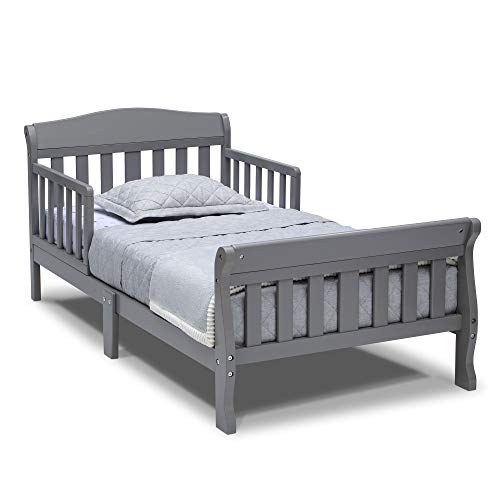


As an Amazon Associate we earn from qualifying purchases at no extra cost to you. Ratings are shown as listed on Amazon.
Best toddler beds by situation
| Situation | Best bed type | Useful specifications | Why it fits |
|---|---|---|---|
| Small bedroom or shared room | Low-profile wood or molded-plastic toddler bed | 27–30 in wide; 52–55 in long; 5–10 in floor clearance | Uses little floor space and makes nighttime access easy |
| First-time assembly project | Simple toddler frame with pre-drilled parts | 20–35 parts; 30–60 minutes; Phillips or hex hardware | Fewer alignment and tightening errors |
| Frequent sheet changes or accidents | Open-sided bed with removable mattress | Standard 27.25 × 52 in crib mattress; washable painted or plastic frame | Fast access to the mattress and easier cleaning |
| Longer ownership | Convertible crib-to-toddler or toddler-to-daybed design | Conversion kit included or separately available; 50–70 lb typical frame capacity | Can extend use beyond the first transition |
| Travel, grandparents, or occasional use | Lightweight folding or portable toddler bed | Usually under 25 lb; tool-free or minimal assembly | Stores more easily, though it may be less durable for daily use |
What makes a toddler bed safe and practical?
Low-to-floor height
A low frame reduces the distance of a possible fall and lets a young child climb in and out without a step stool. Measure from the floor to the top of the mattress, not just to the platform. A frame with 4 inches of clearance can still have a 7-inch mattress, producing a 11-inch sleeping height.
Low does not mean unstable. Look for broad feet, a rigid side-to-side connection, and hardware that can be retightened. A bed that rocks when an adult presses lightly on the rail is not ready for use.
Guardrails that guide rather than trap
Most toddler beds have one or two short guardrails, leaving an opening for entry. Rails should be smooth, firmly attached, and tall enough to help prevent routine rolling while still allowing the child to get out independently. Avoid improvised bed rails, wide gaps, decorative openings, or any space where a child’s head, neck, or limb could become caught.
Check the manufacturer’s stated age, weight, and mattress requirements. A toddler bed is not a substitute for an adult bed rail, and a portable rail intended for an adult mattress may not fit a low toddler frame correctly.
Mattress compatibility
The most convenient choice is a frame designed for a standard full-size crib mattress, commonly about 27.25 inches wide by 52 inches long. However, not every “toddler bed” uses exactly the same dimensions. Measure the inside of the frame and compare it with the mattress label before buying.
The mattress should lie flat without curling or being forced into place. Large gaps at the sides or ends are unacceptable. Do not assume that a thicker mattress is better: it raises the child above the guardrails and changes the intended safety geometry. If the frame specifies a maximum mattress thickness, follow it precisely.
Head-to-head: the main toddler-bed designs
Wooden low-profile bed
A wooden frame is usually the best balance of appearance, rigidity, and repairability. Painted or finished wood fits a bedroom more naturally than brightly molded plastic, and replacement hardware may be easier to source. The trade-off is assembly time: slats, rails, and crossbars must be aligned and tightened evenly.
The IKEA SNIGLAR toddler bed is an example of the simple wood-frame approach, while the IKEA MINNEN range illustrates a more adjustable metal-frame style. Availability, included components, and mattress requirements can change by market, so confirm the current product manual before purchase.
Molded-plastic toddler bed
Plastic beds are often lighter, easier to wipe clean, and quicker to assemble. They can be useful in rooms where spills and frequent laundering are common. Their limitations are cosmetic wear, flexing under movement, and less attractive long-term appearance. The Delta Children Plastic Toddler Bed is a recognizable example of this category.
Convertible crib
If the child is already using a convertible crib, the matching toddler conversion may be the most economical route. It preserves a familiar mattress and can reduce the number of large pieces in the room. Before relying on this option, check whether the toddler rail is included, sold separately, or discontinued. A “convertible” label does not guarantee that every conversion stage remains supported years later.
Portable or folding bed
Portable beds suit occasional visits and limited storage, but they should not automatically be treated as equal to a daily wooden frame. Inspect hinges, locking mechanisms, fabric seams, and the floor underneath before every use. Use only the supplied mattress or pad unless the instructions explicitly permit another one.
Assembly details that matter more than they appear
- Count the hardware first. Missing barrel nuts or spacers can leave a rail loose even when the bed looks complete.
- Assemble on a level surface. A carpeted or uneven floor can make a square frame appear crooked and cause uneven stress.
- Do not fully tighten too early. Leave connections slightly loose while aligning the opposite rail, then tighten all fasteners gradually.
- Check every joint after one week. Children’s movement can settle wood joints and loosen bolts during the first several nights.
- Keep the manual. It identifies the approved mattress size, maximum thickness, weight limit, and replacement parts.
A practical assembly target is 30–60 minutes for a basic frame and 60–120 minutes for a conversion or slatted design. If a frame requires force to make parts line up, stop and check whether a rail is reversed or a spacer is missing; forcing it can distort the frame.
Durability and ownership: what wears first?
The finish usually shows wear before the structure fails. Look for scuffs around the entry opening, chipped paint from toys, and swelling if a wood frame repeatedly gets wet. Plastic can develop stress whitening near screw holes, while metal frames may loosen at joints or develop surface corrosion if cleaned with excessive water.
Mattress protection is the most useful consumable. A waterproof, properly fitted crib-mattress protector can reduce staining and shorten cleanup time, but it must not create wrinkles or change the mattress fit. Wash bedding according to its care label, wipe plastic with mild soap, and use a barely damp cloth on finished wood. Avoid soaking joints.
For a simple ownership calculation, suppose a $120 bed is used nightly for two years: 730 nights makes the frame cost about 16 cents per night before bedding and mattress costs. A $220 convertible frame used for four years costs about 15 cents per night. The cheaper purchase is not automatically the lower-cost choice if it is outgrown quickly or cannot accept replacement hardware.
A quick decision checklist
- Measure the room, including clearance for opening drawers and walking around the bed.
- Confirm the inside mattress dimensions, not merely the advertised bed size.
- Choose a low sleeping height without exceeding the manufacturer’s mattress-thickness limit.
- Prefer smooth, firmly attached rails with no decorative gaps.
- Decide whether daily wipe-cleaning or long-term rigidity matters more.
- Verify whether conversion rails, replacement parts, and the mattress are included.
- Inspect the assembled frame for rocking, sharp edges, loose fasteners, and gaps.
- Keep the area around the bed clear of cords, blind loops, large pillows, and climbable furniture.
Frequently asked questions
Can a toddler bed use any crib mattress?
No. It should use only a mattress that matches the frame’s specified length, width, and thickness. Compare the measured mattress with the manufacturer’s instructions and check that it sits flat with minimal gaps.
Is a floor mattress better than a toddler bed?
A floor mattress eliminates the frame fall height, but it may be harder to keep clean and can provide less airflow underneath. A low toddler bed offers a defined sleeping space and easier bedding changes. Either choice requires a clear, hazard-free area.
How long do children use toddler beds?
Many children use one for roughly two to four years, but timing varies with growth, behavior, and room arrangements. Move to a larger bed when the child exceeds the stated limits, regularly climbs over the rails, or needs more sleeping space.
The best toddler beds are therefore not the most elaborate ones. Choose the frame that fits the mattress precisely, keeps the sleeping surface low, provides useful guardrails, suits the room’s cleaning and storage demands, and can be assembled and maintained without shortcuts.


Write Your Review
No reviews yet. Be the first to share your experience!