

Key takeaways
- 1 inch: A modest surface adjustment. Useful when the mattress is nearly right or when you want to preserve its existing support.
- 2 inches: The most versatile starting point. It can soften a firm mattress or add resilience to a slightly tired one without completely replacing the original feel.
- 3 inches: A substantial comfort layer for pressure relief. It is more likely to correct a firm surface, but it can also exaggerate sagging in a worn mattress.
- 4 inches: Usually a specialized choice. It creates a pronounced new sleep surface and may reduce stability if the mattress underneath lacks support.
The best latex mattress toppers for better support are usually 2–3 inches thick, made from a single piece of natural latex, and chosen by firmness: Dunlop for a denser, steadier feel or Talalay for a springier, more pressure-relieving surface.
Our top picks
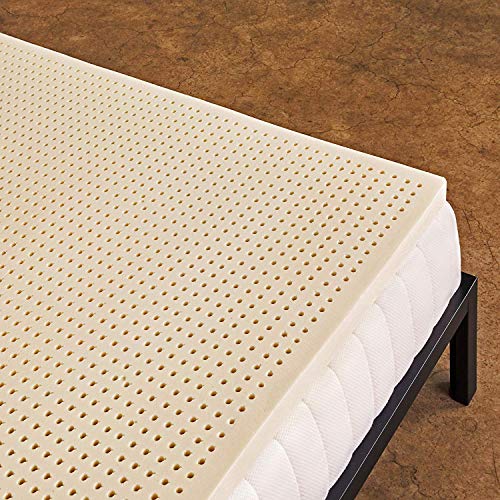

As an Amazon Associate we earn from qualifying purchases at no extra cost to you. Ratings are shown as listed on Amazon.
Best latex mattress toppers by sleeping situation
| Situation | Best starting choice | Why it fits | Trade-off |
|---|---|---|---|
| Mostly back sleeping | 2-inch medium Dunlop, about 28–33 ILD | Adds resilient cushioning without allowing excessive sink | May feel too firm for lightweight side sleepers |
| Mostly side sleeping | 3-inch soft or medium Talalay, about 19–28 ILD | More room for shoulders and hips to settle | Greater risk of a soft, less stable feel |
| Stomach sleeping | 2-inch medium-firm Dunlop, about 30–36 ILD | Limits the depth of cushioning around the midsection | Can feel unforgiving on a firm mattress |
| Couples with different preferences | 2-inch medium topper or split firmness in a king | Moderate height preserves more of the mattress’s original feel | A split setup can create a center seam |
| Hot sleeper | 2–3-inch ventilated latex with a breathable cotton or wool cover | Latex generally retains less heat than dense memory foam | Cover and sheets still affect airflow substantially |
| Budget-conscious upgrade | 2-inch Dunlop without elaborate quilting | Uses less material while providing noticeable firmness change | Less pressure relief than a 3-inch topper |
Dunlop versus Talalay latex
Dunlop and Talalay are manufacturing methods, not separate kinds of tree. Both can be made with natural latex, synthetic latex, or a blend, so check the label rather than assuming that “latex” means fully natural.
Dunlop latex: denser and more grounded
Dunlop latex is poured into a mold and baked in a relatively simple process. The result is typically denser toward the bottom, with a slightly more solid, stable sensation. It is a strong choice when your priority is support, durability, or a less buoyant feel.
A Dunlop topper can work well on a mattress that feels too soft, especially in a medium-firm or firm specification. It is also often the better value because the manufacturing process generally uses fewer steps. Density varies by product, so ILD alone should not be treated as a complete quality score.
Talalay latex: more buoyant and pressure-relieving
Talalay latex is molded, vacuum-expanded, frozen, and then vulcanized. This produces a more uniform, airy structure and a lively, springy response. Talalay is often preferred by side sleepers who want cushioning at the shoulders and hips without the slow, enveloping sensation associated with memory foam.
Talalay is not automatically more supportive. A soft Talalay topper can make an already-soft mattress feel unstable, while a medium or firm Talalay layer can provide substantial lift. It also tends to cost more for the same thickness and size.
How thickness and firmness change the result
Thickness controls how much the topper can alter the mattress beneath it. Firmness controls how strongly it resists your body. These two variables should be considered together.
- 1 inch: A modest surface adjustment. Useful when the mattress is nearly right or when you want to preserve its existing support.
- 2 inches: The most versatile starting point. It can soften a firm mattress or add resilience to a slightly tired one without completely replacing the original feel.
- 3 inches: A substantial comfort layer for pressure relief. It is more likely to correct a firm surface, but it can also exaggerate sagging in a worn mattress.
- 4 inches: Usually a specialized choice. It creates a pronounced new sleep surface and may reduce stability if the mattress underneath lacks support.
For firmness, labels such as soft, medium, and firm are not standardized across manufacturers. Some companies publish ILD, or indentation load deflection, as a rough resistance measure. A lower number generally feels softer, but ILD tests do not capture thickness, density, zoning, cover construction, or how the topper interacts with your mattress.
If your mattress is too firm, start with 2 or 3 inches in a softer or medium specification. If it is too soft but not visibly sagging, try 2 inches of medium-firm or firm latex. If there is a permanent body impression, a topper can disguise the problem temporarily but cannot restore the mattress’s underlying support.
Pressure relief, motion isolation, and ventilation
Pressure relief
Latex cushions by compressing under load and pushing back quickly. That combination can relieve pressure without the deep, slow sink of memory foam. Talalay is often the easier choice for prominent shoulders or hips, while softer Dunlop can also provide cushioning with a denser feel.
A thick soft topper is not always more comfortable. If your hips sink farther than your shoulders, alignment may feel worse. Your body weight, sleeping position, and the firmness of the mattress underneath matter more than the material name alone.
Motion isolation
Latex absorbs some movement, but it is more elastic than memory foam. You may feel more push-back and slightly more transfer when a partner changes position. A thicker, softer latex topper usually isolates motion better than a thin, firm one, although neither will provide the same motion-dampening character as very slow-response foam.
Ventilation
Latex has an open-cell structure, and many toppers include pinholes that allow air movement. Talalay’s more uniform, airy structure may feel especially breathable, but the practical result depends on the cover, mattress protector, sheets, room temperature, and humidity.
Choose a removable cotton or wool cover when possible. Avoid enclosing latex in a thick, non-breathable waterproof layer unless spill protection is essential. That layer can restrict airflow and change the feel more than expected.
What to expect at the edges
Latex toppers are usually strongest in the center and less stable at the perimeter because they are not enclosed in a rigid mattress border. Sitting on the edge can compress the topper and make it appear to slide or buckle, especially when it is 3 inches or thicker.
Edge behavior is better when the topper matches the mattress dimensions closely, the bed frame has adequate perimeter support, and the topper is covered by a fitted sheet with enough depth. A non-slip pad can reduce movement, but it will not turn a soft topper into a reinforced mattress edge.
If you regularly sit on the side of the bed, choose a 1- or 2-inch topper rather than an extra-thick soft layer. Keep the mattress on a stable foundation with slats spaced according to the mattress manufacturer’s instructions; wide gaps can allow both mattress and topper to flex unevenly.
Ownership realities: weight, care, and durability
| Common size | Approximate latex area | Typical weight for a 2-inch topper | Typical weight for a 3-inch topper |
|---|---|---|---|
| Twin | 38 × 75 inches | 35–50 lb | 50–70 lb |
| Queen | 60 × 80 inches | 55–80 lb | 80–110 lb |
| King | 76 × 80 inches | 70–100 lb | 100–140 lb |
Weights vary considerably with latex density and whether the cover is included, but latex is heavy enough that rotating or removing a queen topper may require two people. Measure the finished topper, not just the advertised mattress size, because small dimensional differences can create exposed edges or bunching.
Latex should generally be spot-cleaned rather than saturated. Remove the cover if it is machine washable, use a mild detergent, and let all components dry completely before putting them back on the bed. Do not fold a thick latex topper sharply for long periods, and keep it away from prolonged direct sunlight and high heat.
The cover, corners, and surface areas under repeated pressure usually show wear before the latex itself. A fitted sheet that is too tight can pull the topper toward one side and accelerate bunching. A mattress protector helps with perspiration and spills, but a poorly ventilated protector can make the sleep surface warmer.
A practical setup process
- Inspect the mattress first. Check for permanent sagging, broken springs, or a weak foundation. A topper is a comfort layer, not a structural repair.
- Confirm the dimensions. Measure length and width and verify that your fitted sheet has enough extra depth for the mattress, topper, protector, and bedding.
- Choose the smallest effective thickness. Start at 2 inches unless you have a clear reason to need more cushioning.
- Unpack and ventilate it. Allow the topper to expand flat in a well-ventilated room, following the manufacturer’s timing instructions.
- Secure the layers. Place the topper directly on the mattress, add a breathable protector if desired, and use a properly sized fitted sheet.
- Reassess after several nights. Give your body time to adapt, but stop if discomfort is persistent or worsening. For ongoing pain, numbness, or sleep problems, consult a qualified health professional.
Final buying recommendation
For most shoppers, a 2-inch medium Dunlop topper is the safest support-focused starting point. Choose 3-inch softer Talalay when pressure relief is the priority and the mattress underneath is adequately supportive. Choose firmer Dunlop when you want more lift, lower cost, and a steadier feel. Whichever type you select, prioritize a clear firmness specification, a washable breathable cover, accurate dimensions, and a return policy that allows enough time to judge the change.


Write Your Review
No reviews yet. Be the first to share your experience!